



When launching an advertising campaign for a new geography, it is not enough to choose the right audience, prepare a creative, and find a converting offer. It is important that after clicking, the user lands on a page that matches their habits, language, and expectations. This is exactly where localization mistakes begin: the ad is targeted at one country, but the landing page uses a different currency, an inappropriate language, or a domain that looks unfamiliar to the local audience.
Each of these details can affect trust in the offer and the user's readiness to complete the target action. Even if the product itself is of high quality, a mismatch between the ad and the landing page can reduce conversion.
In this article, we will break down why language, currency, and domain must match the GEO, how to check localization before launch, and what mistakes media buyers most often make when working with multiple countries.
Why GEO matching affects conversion
GEO (Geographic Location) - the geographical location of the user, which is taken into account when setting up ad campaigns, choosing offers, and analyzing traffic. In traffic arbitrage, geography determines not only the availability of the offer, but also the requirements for its presentation.
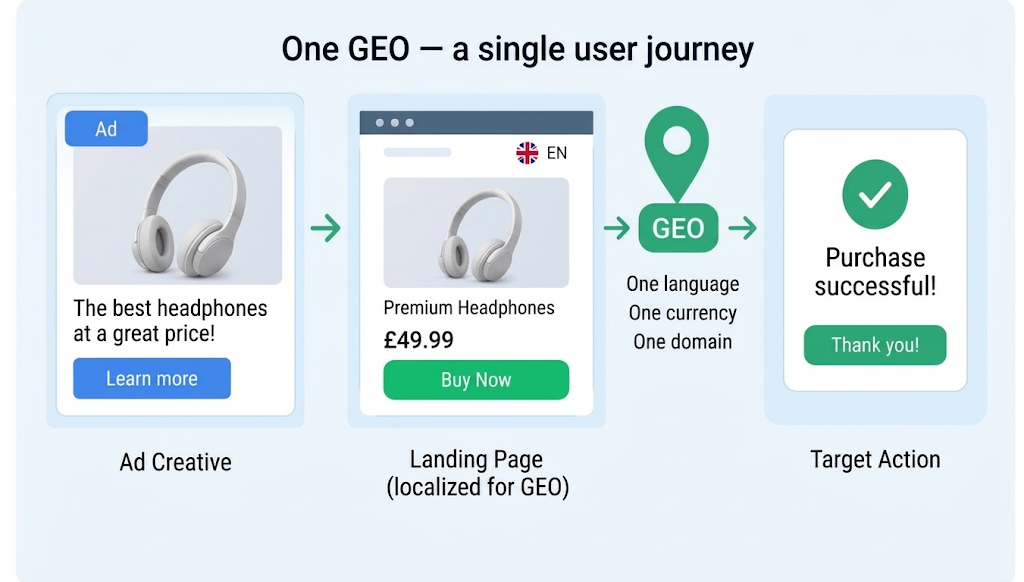
A user from the UK, Brazil, and Germany might be interested in the same product, but expect a completely different user experience. The interface language, price format, payment methods, familiar symbols, and even the perception of the brand itself will differ.
Imagine that an ad campaign is launched for the UK. The creative is written in English and promises a clear product cost, but after clicking, the user sees a page in Spanish with prices in dollars. An obvious mismatch occurs. The person has to figure out the terms of the offer, recalculate the cost, and doubt whether the site is intended for their region.
As a result, the user may close the page without reaching the target action.
Landing page language: the user must understand the offer
Language is one of the first factors by which a visitor evaluates the convenience of a site. If an ad addresses the audience in a familiar language, and the landing page switches to another, the user experience becomes less consistent.
For a media buyer, this is especially important when working with multiple GEOs and scaling ad funnels.
Why translation alone is not enough
Translating text into the target country's language is a necessary, but not always sufficient step. Quality localization takes into account the specifics of phrasing, local expressions, terminology, and the usual style of communication.
For example, a literal translation of an ad headline might be grammatically correct but sound unnatural to a native speaker. The same applies to the description of benefits, promotion terms, buttons, and registration forms.
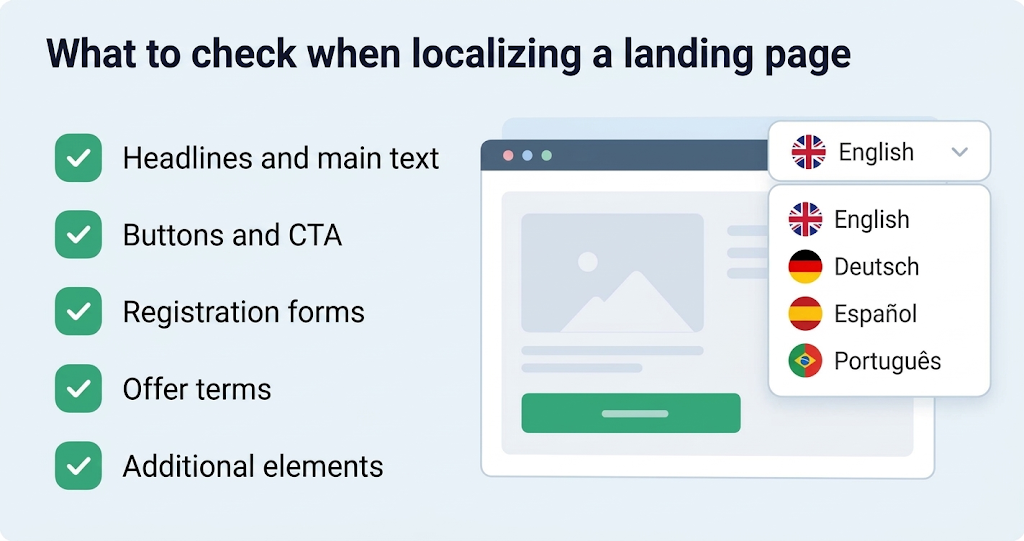
Before launching, it is worth checking the following elements:
Headlines and body text. The phrasing should be understandable to the target audience and match the ad content.
Buttons and calls to action. The CTA should clearly explain what will happen after clicking.
Registration forms. Field names, tooltips, and error messages must be translated correctly.
Offer terms. Restrictions, promotion validity periods, and user requirements must be clear.
Additional elements. Menus, notifications, legal pages, and post-submission messages also need localization.
Special attention should be paid to translation quality. Automatic localization can speed up page preparation, but before launching, it is advisable to check the result manually, especially when it comes to financial products, subscriptions, or other offers with significant terms.
When it is worth creating separate versions of a landing page
If a campaign covers countries with different primary languages, it is more convenient to prepare separate localized versions of the page. This allows you to adapt not only the text but also the content structure, examples, images, and user scenarios.
At the same time, it is not always necessary to create a new site for each country. Depending on the project, you can use language versions on separate URLs, subdomains, or directories within the main domain. The main thing is to provide clear navigation and not force the user to search for the appropriate page version on their own.
Currency: how to remove unnecessary obstacles before purchase
Cost is one of the key elements of a commercial offer. If a user sees a price in an unfamiliar currency, they have to independently calculate the approximate expenses. This is an extra step that can cause doubts, especially when it comes to a purchase, subscription, or balance top-up.
Local currency makes the price clearer and helps to evaluate the offer faster.
Why price display matters
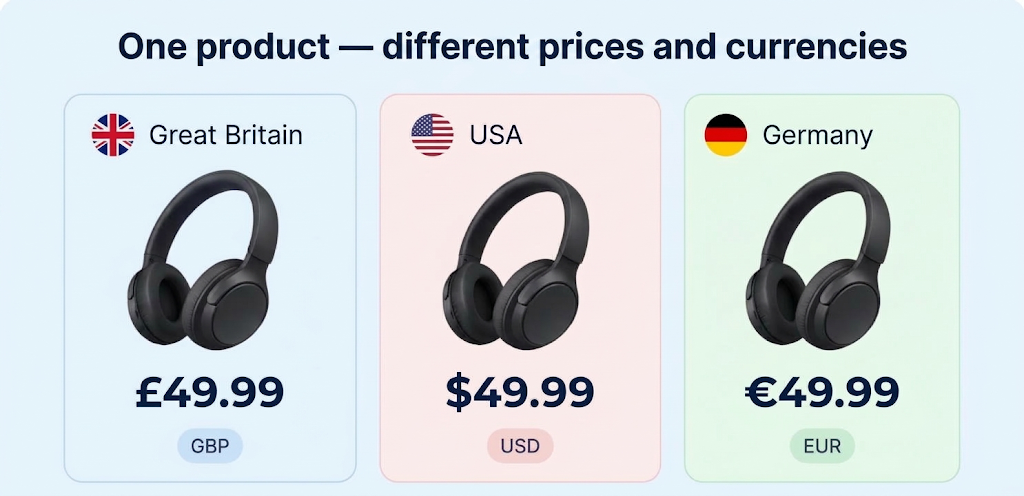
Suppose a user from the UK lands on a product page costing 49 dollars. To understand the final expenses, they need to convert the amount into pounds, account for possible bank commissions, and check if the charge will actually be in dollars.
If a competitor offers a similar product with a clear price in pounds, the competitor's offer may be perceived as more convenient.
However, displaying the price in local currency does not mean that the final amount will automatically be lower. It is important to consider the exchange rate, possible fees, taxes, and payment terms.
Before launching a campaign, check:
in what currency the price is indicated on the landing page;
in what currency the charge actually occurs;
whether the currency matches the ad;
whether thousand separators and decimals are displayed correctly;
whether taxes, fees, and additional charges are clear to the user;
whether there is a discrepancy between the price on the page and the amount at the payment stage.
Currency formatting is also important
Even when using the correct currency, the price format may differ from what the local audience is used to. For example, for the UK, the format £49.99 is usually used, and for the US - $49.99. In other countries, the currency symbol, its placement, and decimal separators may differ.
When working with multiple GEOs, you should check not only the currency code but also the local price display format. For this, you can use locale settings and regional formatting standards.
Domain: how well it matches the target market
The domain is another element that forms the first impression of a site. A user may notice it in an ad, the browser address bar, or search engine results.
At the same time, the domain zone itself does not determine the quality of the site and does not guarantee trust. What matters is a combination of factors: brand awareness, a clear address, secure connection, content relevance, and transparency of terms.
National and generic domains
When choosing a domain for an international project, two main options are usually considered:
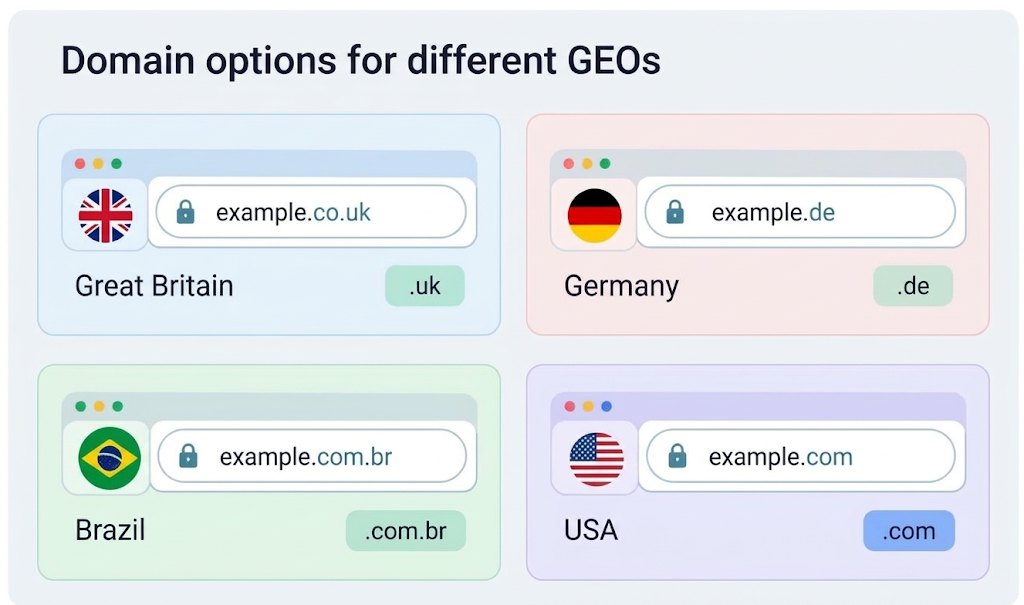
National top-level domains (ccTLD). For example, .uk for the UK or .de for Germany. They can explicitly indicate the site's orientation to a specific country.
Generic domains (gTLD). For example, .com, which are suitable for international projects and are not tied to a single country.
Which option is better depends on the site structure, promotion strategy, and domain name availability.
A national domain may be appropriate for a business operating primarily in one market. A generic domain is convenient when a company plans to scale to multiple countries and maintain a single brand.
What to check before launch
When choosing a domain for a specific GEO, consider a few factors:
Address clarity. The domain should be easy to read and not create the impression of a random or suspicious address.
Brand match. If an ad promotes a specific product, the site address should be logically connected to it.
URL language and structure. For different language versions, it is advisable to use a clear and consistent URL structure.
Technical availability. Check that the site opens from the target country, uses HTTPS, and correctly loads all necessary elements.
Regional restrictions. Make sure that the domain, product, and page content comply with the requirements of the market where the ad is launched.
You shouldn't choose a domain zone purely for a visual match with the GEO. If a national domain is not suitable for legal, technical, or commercial reasons, you can use an international domain with separate localized site versions.
How to align language, currency, and domain in one campaign
Language, currency, and domain do not work separately, but as elements of a single user experience. If two parameters match the GEO, and the third causes doubts, the overall picture may still look inconsistent.
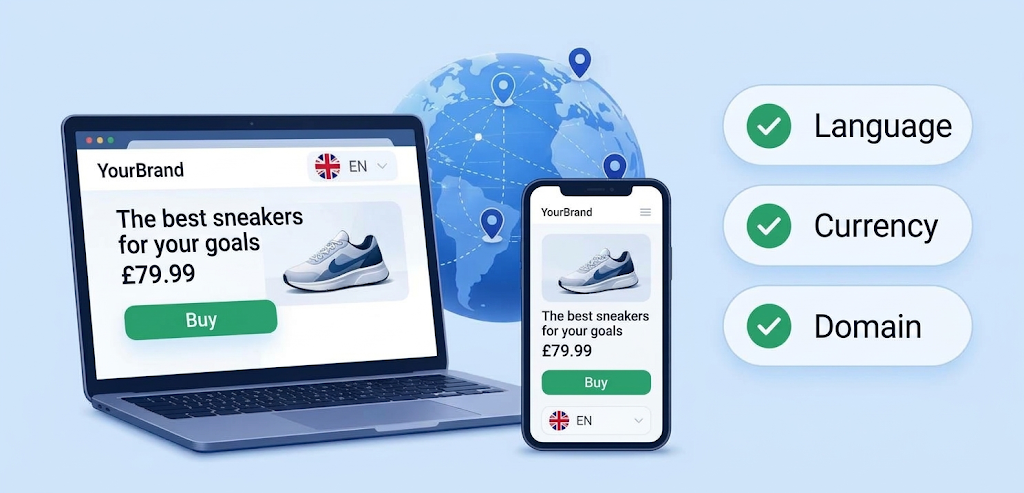
Let's look at a few examples.
| GEO | Page Language | Currency | Domain Approach |
| UK | English | GBP (£) | .uk or international domain |
| Germany | German | EUR (€) | .de or international domain |
| Brazil | Portuguese (BR) | BRL (R$) | .com.br or international domain |
| USA | English | USD ($) | .com or other suitable domain |
These are basic guidelines, not universal requirements. The specific option depends on the product, audience, and available payment methods.
For example, for an international SaaS service, a single domain with localized pages and correct currency display might be enough. For a local store, a separate national domain might be a more logical solution.
How to automate work with multiple GEOs
When working with one country, checking localization is relatively easy. But as scaling happens, a media buyer may simultaneously launch campaigns for dozens of GEOs, use multiple offers, and test different landing pages.
In such a situation, it is important to plan the campaign structure and quality control system in advance.
Separate page versions
For each target market, it is advisable to determine which version of the landing page is used, what language is set by default, and what payment terms are available. This simplifies testing and helps avoid accidental mixing of settings.
It is useful to maintain a spreadsheet with key parameters:
GEO and traffic source;
offer and target action;
landing page URL;
interface language;
currency and payment terms;
date of the last check;
testing results.
This approach helps to quickly find discrepancies and understand which changes affected the result.
Use traffic checking tools
When launching multiple campaigns, it is important to understand what audience actually visits the site and how they interact with the landing page. For this, analytics, test clicks, and traffic parameter checking tools are used.
For example, Cloaking.House allows you to set up traffic filtering by GEO and other parameters, as well as analyze transitions in the Clicks section. The service can be used as part of the technical infrastructure of campaigns when it is necessary to control traffic distribution and verify the operation of configured scenarios.
Conclusion
When launching ads to different GEOs, it is important to evaluate not only the cost per click and the volume of the available audience, but also what experience the user gets after clicking. Language, currency, and domain are basic elements that help make an offer clear and consistent.
Before scaling a campaign, it is worth checking the localization, payment terms, site structure, and the entire path to the target action. This will allow you to identify technical and content issues before they start affecting the results of ad spend.
A systematic approach to localization, testing, and traffic analysis helps to adapt campaigns to new markets faster and make decisions based on real data, rather than assumptions.






Be the first to share your opinion!
We value your feedback — share your thoughts.