


If you look at blocks through the eyes of a beginner, everything seems chaotic: yesterday the ads were live, today the account is restricted; for one person, the same offer runs for weeks, for another, the ban arrives almost immediately. In practice, Facebook's logic is quite simple: the system rarely punishes for a single minor detail. Much more often, it sees a set of risk signals — a "raw" account, an unstable login environment, a weak post-click page, unusual behavior in the dashboard, sudden budget changes, repetitive creatives, and payment issues. When there are many such signals, the advertising begins to look suspicious.
Therefore, reducing the risk of a ban should not be done with a single "secret setting," but across the entire "bundle" at once. You need to look at advertising as a system: the account, working environment, IP, payment method, creative, landing page, and behavior after launch. This is what usually distinguishes bundles that live longer from those that burn out at the start.
Facebook Bans Not for a Single Ad, but for the Overall Picture
The most common mistake of a beginner is to look for a single cause. For example: "I was banned because of a word in the text" or "The card broke everything." Sometimes this is true, but more often the problem lies in the aggregate. A new account without preparation, an empty page, a sudden start, identical actions, logins from different IPs, and too-similar creatives — all this adds up to one picture. And the more inconsistencies there are, the faster Facebook begins to stifle the bundle.
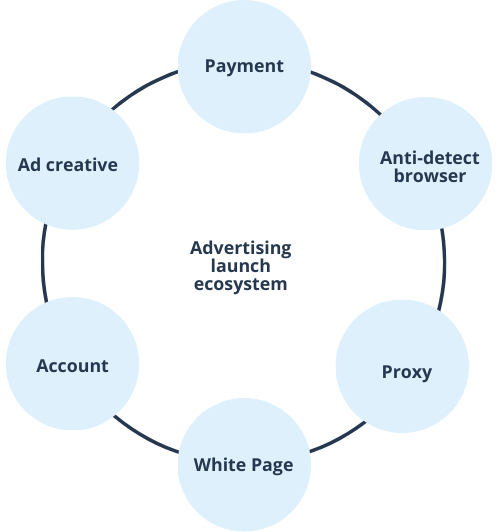
A vital conclusion follows from this: if you want to truly reduce the risk, you must stop treating only the symptoms. Don't just change the creative or relink the card, but look at which link in the chain looks the weakest.
Raw Account: The Most Common Cause of Bans at the Start
A new account is almost always under increased scrutiny. If it has just appeared, and after a short time is already actively entering the ad account, attaching a payment method, performing many actions in a row, and trying to start quickly, it looks unnatural. For the platform, such a profile looks not like an ordinary user, but like a tool created for a specific task.
What really helps? A calm entry. Don't launch on the day of creation. The account must first gain at least some natural history: a filled profile, normal activity, a normal rhythm of actions. After that — a cautious entry into the advertising section, and only then tests. The fewer sharp jumps at the very beginning, the better.
Another mistake is trying to do too much at once. Multiple campaigns, many ads, constant edits, jerking the budget in the first hours — all this creates a sense of artificiality. In the beginning, one calm test is better than five nervous launches simultaneously.
Antidetect: Why It Is Needed in Practice
Many beginners perceive antidetect incorrectly. They think it's some kind of "magic against bans." In fact, its main benefit is much simpler: it creates a separate and isolated environment for each working profile. This is necessary so as not to mix cookies, sessions, browser fingerprints, and technical traces of different accounts with each other. In affiliate marketing, an antidetect is primarily a tool for order and separation, not a magic button.
Roughly speaking, if you work with multiple accounts in the same environment, it's easier for Facebook to see intersections between them. Antidetect is needed so that there are fewer such intersections.
Which Antidetect Mistakes Most Often Kill Accounts
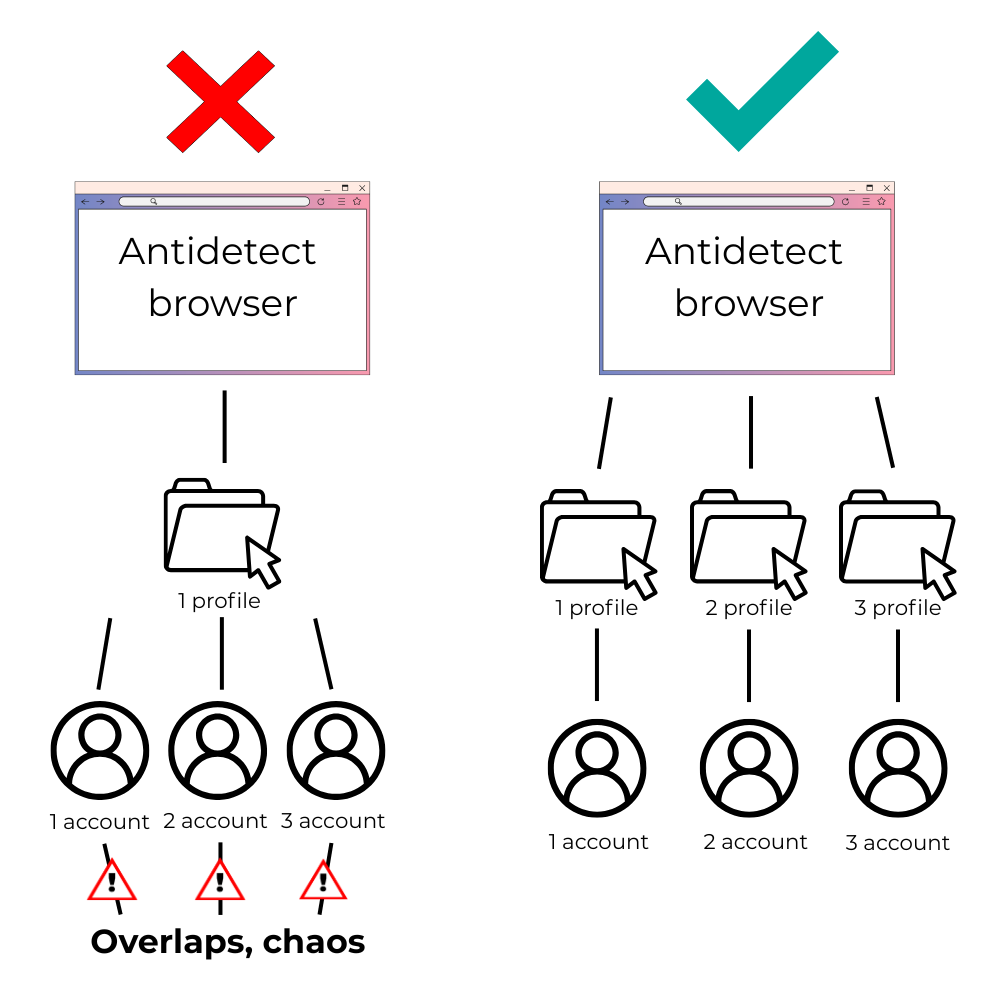
The most common mistake is one profile for everything. The same browser profile is used for different accounts, different pages, different projects. As a result, the person mixes all technical traces themselves and then wonders why the bundle falls apart.
The second mistake is crooked manual fingerprint configuration. For example, a person works with macOS but creates a profile for Windows with parameters that don't match in real life. Or chooses a strange screen resolution, an unnatural set of characteristics, or a language that doesn't match the geography. It's on such minor details that many get caught. In affiliate marketing analyses, it is explicitly pointed out: if you don't have experience, it's better not to assemble the fingerprint by hand, because the antidetect can generate a realistic profile itself, while a human often creates a technical chimera.
The third mistake is instability. Today the profile is one way, tomorrow another; yesterday it was one language and time zone, today another; the same account lives in different environments without logic. Antidetect helps when it makes work more stable. If you turn it into a source of chaos yourself, it won't save you.
How to Use Antidetect Wisely
In practice, the working principle is simple: one profile — one account — one logic of work. You don't need to run the same profile for different tasks. You don't need to constantly redo the fingerprint without reason. You don't need to mix several projects in one profile. Antidetect should not "deceive Facebook," but remove technical intersections that you would otherwise create with your own hands.
Proxies: Why They Are Needed and Why They Lead to Burnouts More Often Than You Think
Proxies in affiliate marketing are not used for beauty. Their task is to give the account a stable network environment, so that you don't pull all accounts through the same real IP and create unnecessary suspicion. In professional materials, this is described very directly: even one authorization in the dashboard from your own IP can provide an extra signal to anti-fraud systems, and with multi-accounting, it is generally difficult to work for long without a proxy.
Proxies help in three things. First, they separate accounts from each other. Second, they allow you to maintain clear geography. Third, they reduce the risk that several different working entities will look like the same source of traffic or login. Mobile proxies are used particularly often for Facebook because in affiliate practice they are considered more resistant to bans, and changing IPs within a single subnet looks softer than sharp jumps between random addresses.
Proxy Mistakes That Make Facebook Nervous
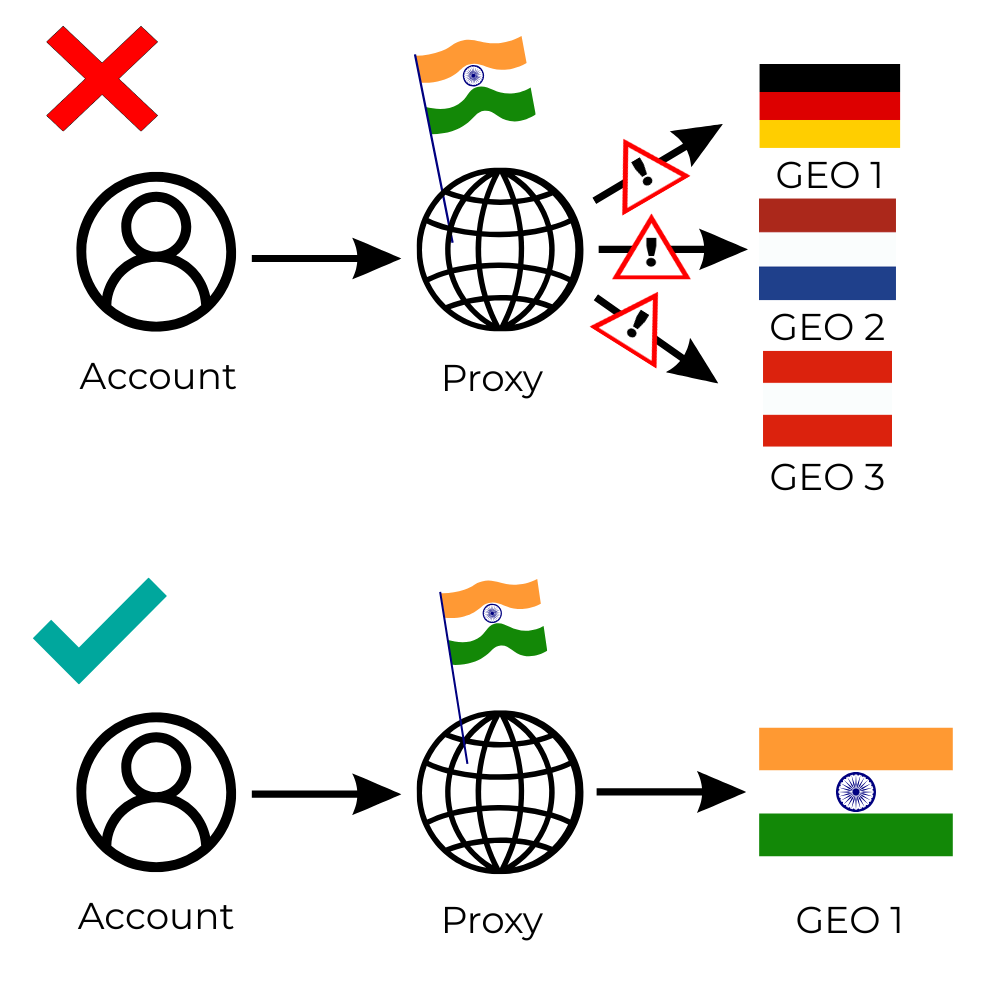
The first mistake is economizing to the point of absurdity. Free or cheap proxies are often already "flagged," unstable, work slowly, and easily create problems. You seemingly bought a cheaper consumable, but then you lose the account.
The second mistake is one proxy for everything. When several profiles, accounts, or projects sit on the same network point, you create a connection between them yourself. Later, Facebook notices this connection.
The third mistake is geographical mismatch. For example, your profile looks like Italy, the offer is for Italy, but the browser language is Russian or the IP jumps to other countries. This doesn't always kill an account immediately, but it certainly creates extra suspicion. Experienced webmasters emphasize separately that the language, IP, and overall profile logic should at least not conflict with each other.
The fourth mistake is too aggressive IP rotation. Rotation itself is useful, but if the IP changes constantly and without clear logic, especially right during the work process, it also looks bad. What's needed is not a chaotic change of addresses, but a stable and predictable environment.
What Really Works with Proxies
What works best is simple logic: one stable network environment for one profile, without jumps and without mixing tasks. For new launches, it's not the "most anonymous proxy on earth" that matters, but a proxy that doesn't break, doesn't jump geographically, and doesn't introduce extra noise into the work. In this sense, network quality is often more important than a low price.
Empty Fan Page, Weak White Page: What Beginners Underestimate
A lot of people think that Facebook only evaluates the ad. In practice, the bundle breaks after the click as well. If your White Page is empty, looks like a temporary placeholder, loads slowly, or doesn't match the theme of your offer at all compared to what the ad promised, the risk grows. This is a weak link that causes problems for many campaigns.
The rule here is simple: moderation after the click should land in a clear and finished place, not a raw scrap. The page should open quickly, not feel like a fake, not contradict the ad, and not be cobbled together.
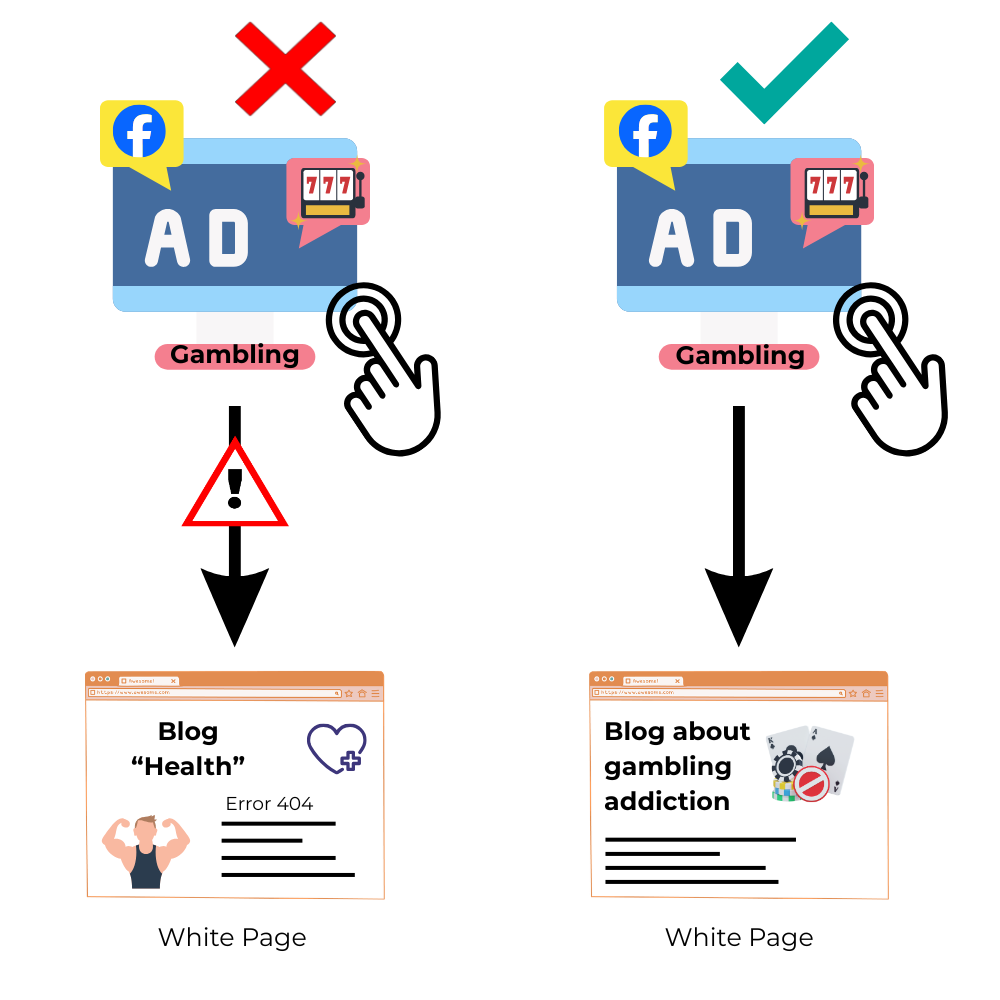
The same applies to the Facebook page itself. An empty Fan Page without design, description, and activity degrades trust in the entire bundle. This doesn't mean you need an ideal brand. Но the page should not look like an empty shell created five minutes ago.
Creatives: Why Even a Technically Clean Bundle Can Burn Out
Even if the account is warmed up, proxies are fine, and the environment is neat, a weak creative can still pull everything down. In affiliate practice, there is a recurring set of mistakes: overheated promises, worn-out approaches, overly aggressive headlines, visuals similar to hundreds of others, and a feeling that the ad is trying to squeeze out a click at any cost. Such creatives not only fall under scrutiny more often but also degrade the quality of the bundle themselves.
What helps? A cleaner delivery. Less shouting, less cheap sensation, less of a feeling of "pushing at any cost." A good creative for Facebook in the long run is not necessarily boring advertising, but it's certainly not visual hysteria.
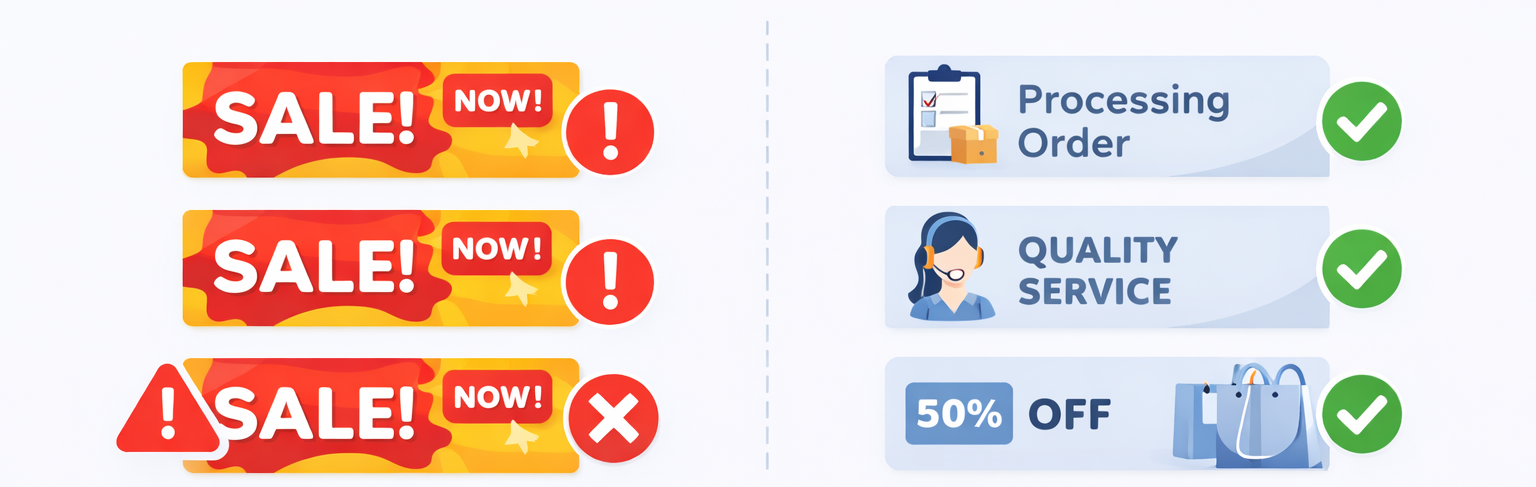
Another mistake is replicating the same materials. If you run many campaigns and your creatives are almost identical, the risk is higher. In affiliate marketing analyses, it is directly advised to create more unique variations so as not to collect same-type signals across different launches.
Payment: A Boring Place That Should Stay Boring
Payment methods for beginners often turn into a separate catastrophe. Either the card won't link, or the bank blocks online payments, or the currency doesn't fit, or the person starts fussing and changing the card three times a day. As a result, the same chaos appears around the payment as around the launch itself. And Facebook precisely dislikes chaos.
The rule here is as simple as possible: payment should be the most boring and stable link in the bundle. One working payment method, without constant fuss. Before launching, it is better to check in advance whether online and international payments go through, whether there are restrictions at the bank, and whether you'll have to urgently redo everything at the moment of launch.
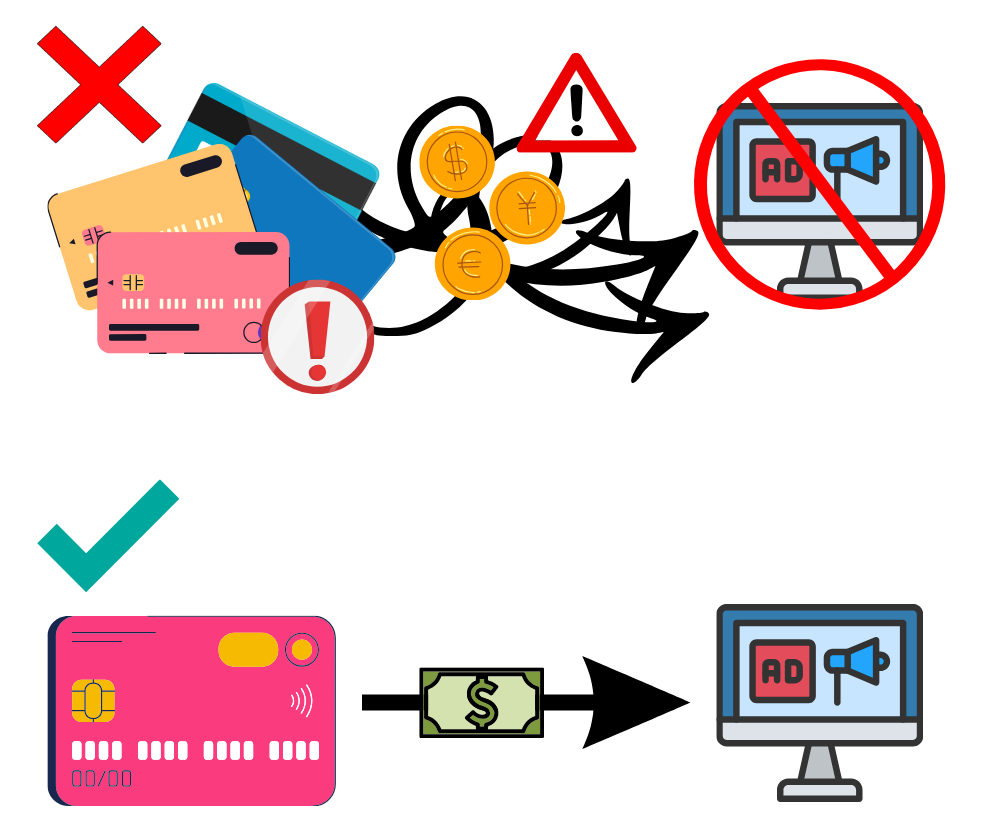
And another important point: if you have sudden budget changes, logins from different IPs, and card problems all at once, the system sees not separate errors, but general noise. This noise is what kills accounts most often.
Traffic Filtering and Cloaking: Where the Real Benefit Is, and Where People Harm Themselves
In practice, traffic filtering tools, such as Cloaking House, are needed to bypass moderation and increase account lifespan. They also have a very practical use: cleaning statistics from junk traffic, filtering out bots, VPN users, spy traffic, and other unwanted visits, in order to better see the quality of incoming transitions and not ruin the analytics.
That is, the very idea of separating traffic can be useful: when you understand who came from where, how they behaved on the page, and whether technical junk is cluttering your picture.
But here, beginners often make a dangerous mistake: they start to think that any filtering tool automatically "protects against bans." It doesn't. If the ad itself is weak, the White Page is low quality, and the infrastructure is crooked, no filtering will save it. Moreover, an overly complex chain of redirects, poorly configured routes, slow loading, and inconsistent pages can by themselves make a launch even more fragile.
If you use such tools as part of the infrastructure, their task should be simple: making traffic clearer and analytics cleaner, rather than turning the launch into a tangled labyrinth. The more unnecessary complexity in a bundle, the more places where everything can break.
It is very useful to see everything in one place. The most common failures look like this:
An account is put in an antidetect, but the same profile is used for different tasks.
Proxies are bought cheaply, resulting in an unstable network and poor geography.
A fingerprint is assembled manually, creating a set of parameters that is almost never found in real life.
An ad is launched to an empty page and a raw landing page.
Proxies, card, creative, and budget are changed simultaneously after the first reject.
A traffic filtering tool is installed, but speed and routing logic are not tested.
A problem is found in one place, but everything is treated at once.
In all these cases, the root is the same: the person is not building a smooth system, but trying to plug holes during the launch. And Facebook sees such nervous bundles very well.
What to Do After the First Rejection to Avoid Killing the Account for Good
After the first reject, people often start to panic. And it's at that moment they finish off the account definitively. They start cloning campaigns, changing the card, reassembling the profile, rotating proxies, rewriting the creative, and touching the budget — all at once. From the outside, it looks like active work, but in fact, it's just an amplification of chaos.
The correct way is to go in the opposite direction. First, ask yourself: what exactly looks the weakest here?
If the problem is in the environment — stabilize the environment.
If it's in the page — fix the page.
If it's in the creative — change the creative.
If it's in the payment — bring order to the payment.
The main rule: don't treat everything simultaneously. The most useful habit when working with Facebook is finding one weak link and fixing it precisely.
Summary
Facebook doesn't block advertising just because "it felt like it." Usually, a ban is the result of a bundle being assembled unevenly: the account is raw, the environment is unstable, the IP is jumping, the White Page is weak, the creative is over-pushed, the payment is twitching, and panic begins after the first problems.
Reducing the risk of a ban is achieved not by trickery, but by discipline. You don't need a single "secret tool," but a normal infrastructure: a calm start, separated profiles, high-quality proxies, a careful antidetect, a stable payment method, a clear post-click page, and a minimum amount of chaos in the work. In practice, this is what gives bundles a longer life.





Be the first to share your opinion!
We value your feedback — share your thoughts.