


When you launch ads on the Internet, every little thing matters. You have probably noticed long links with a question mark and many incomprehensible characters at the end (for example, ?click_id=123). These "tails" are called GET parameters.
Usually, marketers use them to understand exactly where a customer came from. But did you know that these same parameters can become a reliable shield and save your ads from being blocked? Let's analyze how this works using the "GET parameters" filter in Cloaking House as an example.
Why is such protection needed?
Imagine: you have launched an ad, and for it to run as long as possible, you need to reliably hide the sales site from the ad network's review bots. Basic cloaking settings are often enough, but the GET parameter filter makes your protection many times stronger. By cutting off unnatural transitions, you build an additional, very precise barrier that minimizes the risk of your site being detected and significantly extends the life of your account.
The whole trick is that an ordinary person, when clicking on an ad, always follows a long link with those very parameters. However, review bots often try to enter via a short, "naked" link. This difference is exactly where we will catch them!
How the GET parameter filter works in Cloaking House !
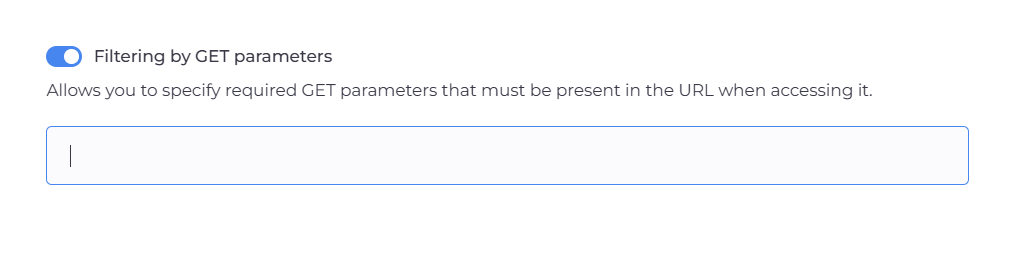 Everything ingenious is simple. You tell the system: "Show my sales site (Offer Page) only to those who have specific words in the link".
Here are the three main rules of this "face-control":
Checking for presence, not value: The system does not care at all what is written after the equal sign. The main thing is the mere presence of the required word in the link. Is the word
click_idthere? Pass through.
IMPORTANT: If you specify the exact value of the GET parameter in the settings, the system will work like face-control with a secret password and will only let those who followed the ideal link onto the Offer Page. For example, if you set the filter to
?source=555, then a review bot or a competitor with the link?source=123will not guess the password and will be sent to a harmless White Page.
Strict admission policy. If you told the system to check for two parameters, but a visitor arrived with a link that has only one — they will not pass. If even one parameter is missing, access is closed.
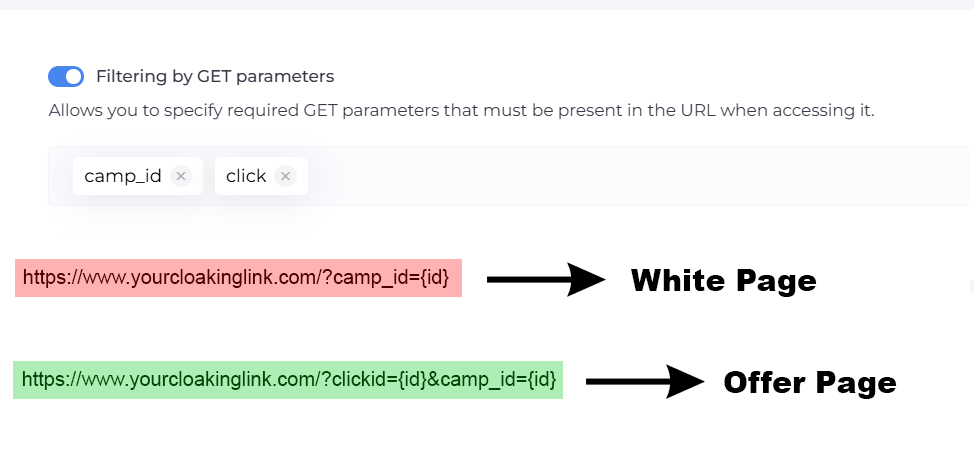
Where "uninvited guests" are sent. If the filter realizes that a bot followed the link (because the required parameters were not in the link), it automatically redirects it to a "White Page." This is a maximally boring, harmless site (for example, a blog about body care) that reviewers will have no complaints about.
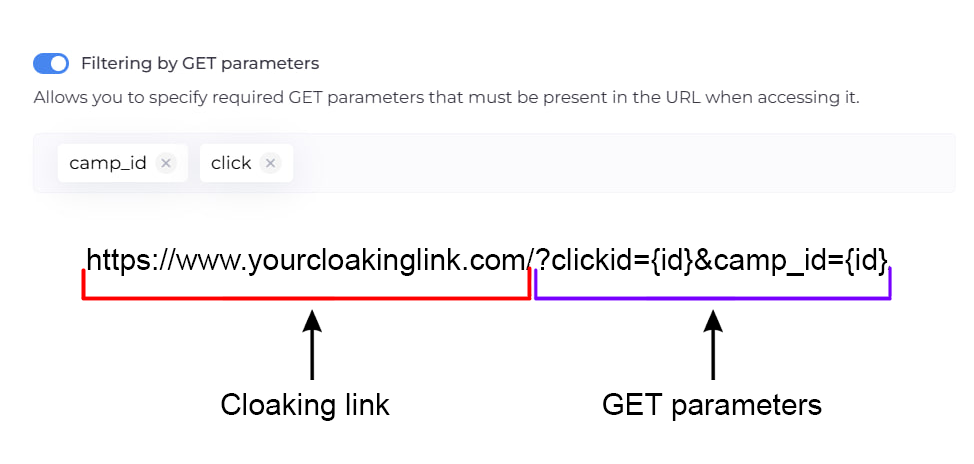
You can also add your own parameters to pass information to trackers or an affiliate network. To do this, add the parameters to the "GET parameters" filter and add it to your cloaking link; it should look like this:
A real-life example
Suppose you are launching an ad on Facebook. You set everything up so that two parameter words are automatically added to each of your links: campaign (ad campaign number) and adset (ad group number).
In the Cloaking House service, you turn on the filter and enter these two words: campaign and adset. What happens next?
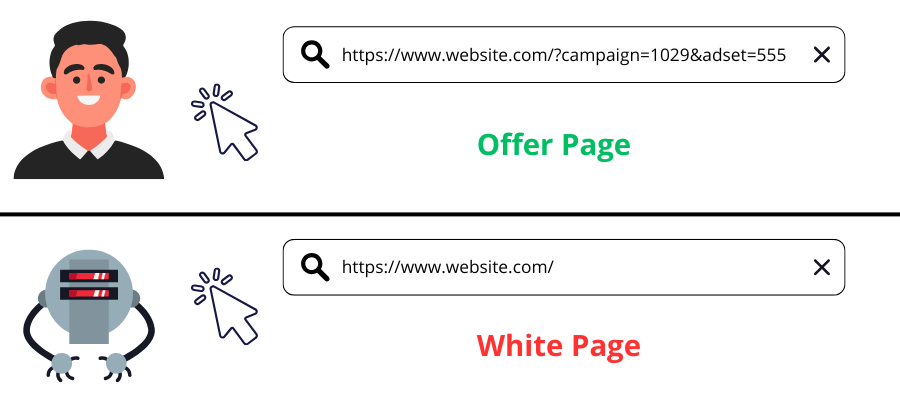
A regular customer enters. They click on an ad in the feed. Facebook itself inserts the numbers, and the link becomes long: website.com/?campaign=1029&adset=555. Cloaking House sees both words, understands that this is a real customer from the ad, and shows them your site with the product.
A Facebook review bot enters. It wants to check your ad and enters simply via the short address: website.com (without any parameters). Cloaking House sees that the required parameters are not in the link. Then the filter is triggered, and the bot sees a harmless site about body care. The ad passes the review, and your account lives and generates income.
Summary
The GET parameter filter is a mandatory tool for those who want to protect their ads from reviews and blocks. It works invisibly but cuts off almost all bots simply because they enter via the wrong links. By setting up this filter once, you will save your nerves and advertising budgets.




Be the first to share your opinion!
We value your feedback — share your thoughts.