


Proxies have long been a basic working tool for those involved in affiliate marketing, SEO, scraping, e-commerce, multi-accounting, and automation. When you connect to a website through a proxy, the resource does not see your real IP address, but the IP of an intermediate server. This allows for flexible configuration of the network environment: working with the required GEO, separating tasks, safely testing search results, checking advertisements, and not tying all your activity to a single address.
However, there is still a lot of confusion surrounding proxies. Some talk about residential, others about mobile, others advise exclusively SOCKS5, and some even believe that a cheap datacenter IP is enough for any task. In practice, everything depends on the specific goal. One type of proxy is better suited for speed and large-scale requests, another for masking as natural user traffic, and a third for creating a stable mobile environment.
What a Proxy Is in Simple Terms and What It Provides

If we set aside complex technical definitions, a proxy is your intermediary when communicating with a website. Instead of accessing the resource directly, you send a request through an intermediate node. From the outside, it looks as if the request came to the site from a completely different device.
Because of this, proxies allow you to:
Work with any geolocations, bypassing regional blocks.
Use isolated IPs for different processes without mixing traffic between accounts.
Check how your website or landing page opens for a user from another country.
Scale data collection (web scraping) without the risk of getting banned by IP.
Test advertising campaigns in real-world conditions.
At the same time, it is important to understand: proxies themselves do not solve all problems. This is not a magical protection against bans or a universal master key to all platforms. It is an infrastructure tool. The more accurately it is selected for your task, the higher the chances of success.
Why One Proxy Does Not Fit Everything

One of the most common mistakes beginners make is trying to find one universal option for all occasions. In practice, this does not happen.
For scraping and technical tasks, speed, bandwidth, and price are usually critical. For working with trust accounts, session stability comes first. For GEO checks, you need the correct region down to the city, and for an anti-detect browser, it is extremely important that the proxy does not fall out of the general logic of the profile fingerprint.
That is why proxies are selected strictly for the task. You are not just buying "IPs," you are building a working network environment.
Proxy Classification: From Servers to Smartphones
To avoid confusion, it is convenient to divide the classification into two large categories: the origin of the IP address (who owns it) and the connection protocol (how data is transmitted). Let's start with IP types.
Datacenter proxy — these are IP addresses belonging to large data centers and cloud hostings. Their strengths are high speed, 24/7 availability, and relatively low price. Datacenter proxies are ideally suited for scraping, automation, and technical requests where volume is important, rather than masking as a real person. The downside: websites easily recognize them as server-based, so they are not suitable for working with platforms sensitive to fraud (Facebook, Google).
ISP proxy (Static Residential) — an intermediate solution between data centers and home internet. These are IP addresses from real internet service providers but hosted on servers. They provide one stable IP for a long time. The format is perfectly suited for managing accounts, long sessions in anti-detect browsers, and the "one account — one IP" scheme. Here, the importance lies not in rotation, but in predictability and consistency.
Residential proxy (Home proxies) — these are the addresses of real home users (Wi-Fi). Traffic through them is perceived by anti-fraud systems as naturally as possible. Residential proxies are needed where it is important to 100% blend in with the crowd: SEO monitoring, competitive intelligence, multi-accounting, and access to strictly geo-dependent content. They provide a huge choice of GEOs and the ability to flexibly configure rotation.
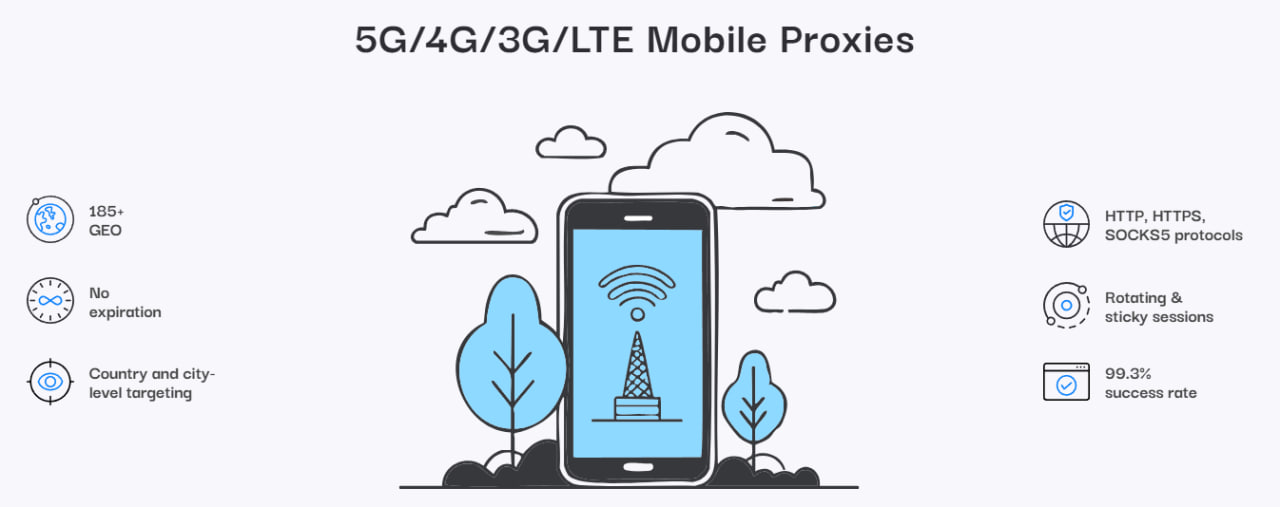
Mobile proxy — IP addresses of cellular operators (3G, 4G, LTE, 5G). For the target platform, such traffic looks like a connection from a smartphone. Given that mobile operators use NAT technology (where thousands of real people sit on one IP), it is extremely disadvantageous for platforms to ban such addresses. This is the most trusted type of proxy, which is necessary for testing mobile ads, registrations, and working with complex social network algorithms.
What Is the Main Difference Between Residential and Mobile?
The difference is not that one of them is "better," but in exactly which environment you are imitating. If you need to test a desktop site from another GEO or collect data — choose Residential. If you need traffic identical to the behavior of a user with a smartphone in a mobile network — take Mobile.
Static, Rotation, and Sticky Sessions
In addition to the origin of the IP, it is important to understand the logic of address changes:
Static proxies: The IP does not change. Suitable for long-term continuous work with a specific profile.
Rotating proxies: The IP changes with every new request. A must-have for mass scraping and bypassing limits on the number of requests.
Sticky session: One IP is held for a fixed time (for example, 10 or 30 minutes) and then changes. A convenient compromise when you need time to perform a chain of actions from one address (for example, register an account and "warm it up").
Protocols: HTTP(S) and SOCKS5
After choosing the IP type, you need to decide on the protocol.
HTTP/HTTPS is most often used for standard web traffic — browsers, viewing sites, and basic work.
SOCKS4 is an obsolete format that is almost never used today.
SOCKS5 is a modern, flexible, and universal protocol.
Why do professionals more often choose SOCKS5? It does not modify network packets and does not leave HTTP headers, which makes the connection more anonymous. Furthermore, it supports all types of traffic, not just web pages. The fewer restrictions the protocol has, the easier it is to assemble a combination of software, anti-detect, and proxy without "crutches."
Why You Should Choose SimplyNode for Work
When it comes to practice, the quality of the service is what matters. On paper, proxies from different providers may sound the same, but in operation, the difference in stability, pool cleanliness, and GEO quality becomes apparent immediately.
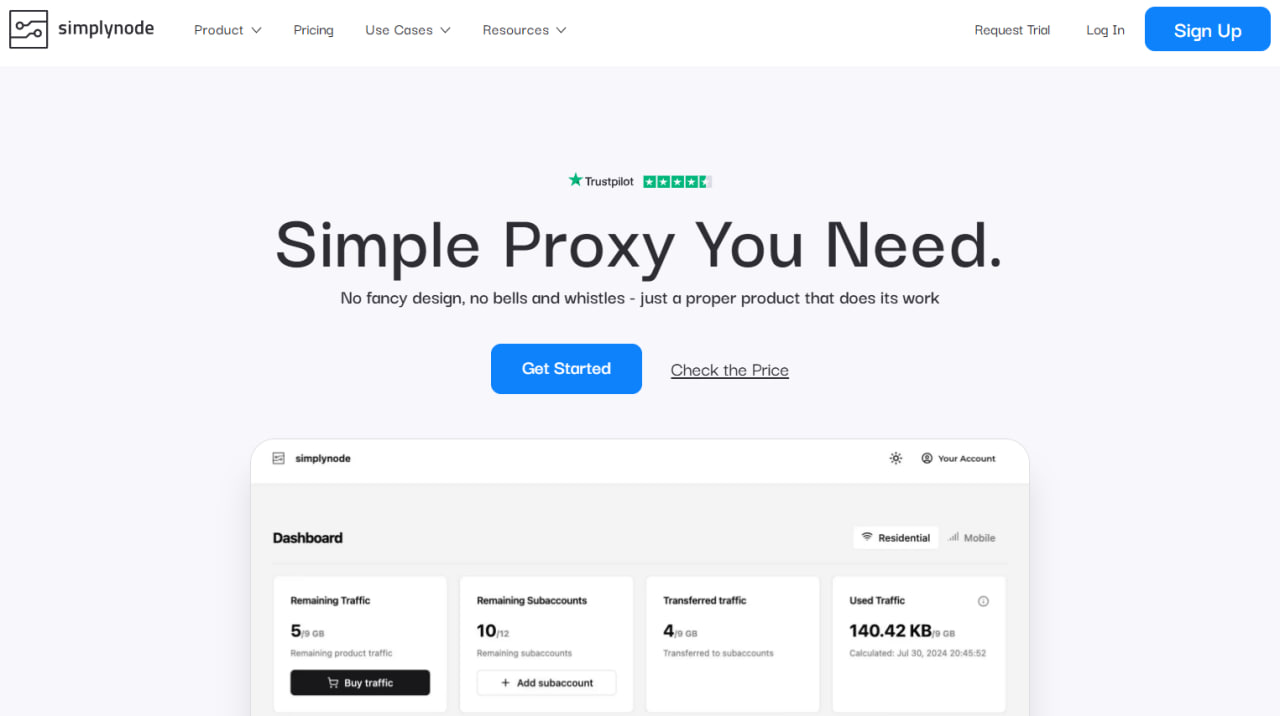
SimplyNode should be considered as a primary platform for several reasons:
Everything in one ecosystem. The service provides both high-quality Residential and Mobile proxies. You don't need to fragment your infrastructure and spawn accounts in different services.
Versatility. They are suitable for any tasks: from basic browsing and SEO monitoring to complex work with anti-detect environments.
SOCKS5 and HTTP(S) support. You get maximum compatibility with any software.
Convenient start. SimplyNode is perfectly suited not only for enterprise volumes but also for a comfortable start. You can take a small volume for tests on your real tasks before committing a large budget.
Bonus for Cloaking House readers
When contacting SimplyNode support, mention that you came from Cloaking House, and the team will provide you with proxies for testing. This is an ideal option: you aren't buying a pig in a poke, but can check the IP cleanliness, GEO accuracy, and operational stability on your real campaigns.
The collaborative work of the traffic protection service Cloaking House and the proxy provider SimplyNode creates a powerful and reliable combination for affiliate marketers striving to secure their advertising campaigns as much as possible. The integration of high-quality residential proxies from SimplyNode allows for replacing a real IP address with trusted IPs of real users, which is critically important for bypassing strict anti-fraud systems of advertising networks (such as Facebook or Google). At the same time, Cloaking House's advanced algorithms take over the filtering of bots, moderators, and spy services, directing them to "white" pages, while the target audience unhinderedly reaches the required offer. Using these two tools in tandem provides the highest level of anonymity, accurate geo-targeting, and significantly reduces the risk of account blocking, allowing affiliate marketers to consistently run traffic and increase their ROI.
Additionally, a welcome bonus on the first purchase is available for new users. This is a sensible way to start scaling your combinations without unnecessary risks.
Conclusion
A proxy is not a technical formality, but the foundation of your network security and efficiency.
Need speed and economy? Take Datacenter.
Need stable profile operation? Your choice is ISP.
Is masking as a real user and accurate GEO important? Use Residential.
Imitating mobile traffic for social networks? Only Mobile will help.
And if you are looking for a reliable partner that covers all these needs in one window, supports SOCKS5, and allows you to test the quality of the pool before buying, SimplyNode will be an excellent choice for your infrastructure.






Be the first to share your opinion!
We value your feedback — share your thoughts.