


Arbitrage marketers often divide GEOs into Tier-1 and Tier-3, but reality goes far beyond a simple “easy/hard” distinction. The real difference lies in the structure of reviews, depth of analysis, and the speed at which algorithms react. In this context, cloaking is no longer just a bypass tool — it becomes a traffic adaptation system aligned with the platform’s level of control.
The Cloaking.House team conducted a detailed analysis comparing Tier-1 and Tier-3, identifying key differences in how algorithms evaluate traffic, infrastructure requirements, and behavioral signals.
Differences in Tier-1 and Tier-3 Review Logic
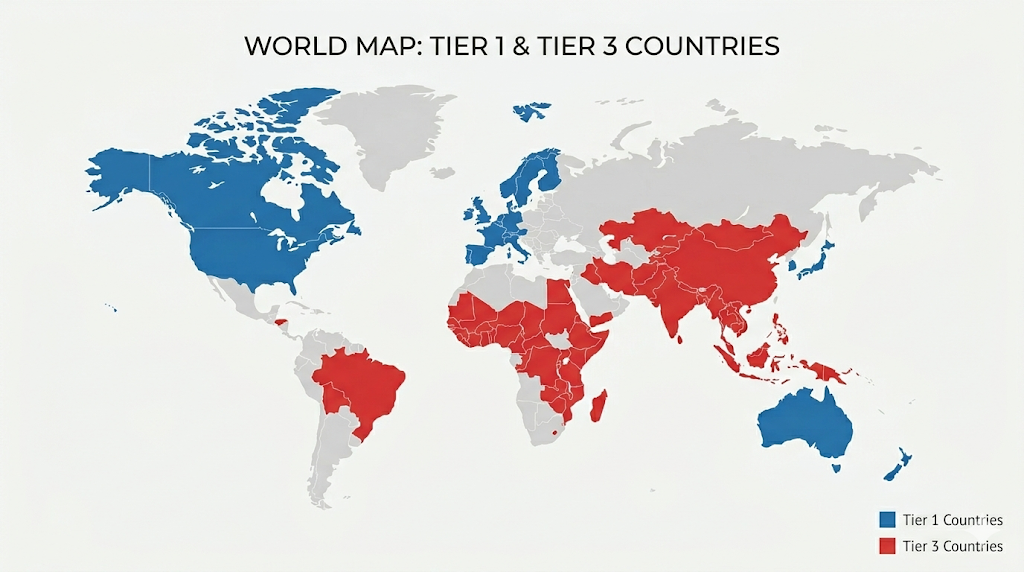
In Tier-1 (USA, Canada, United Kingdom, Germany), algorithms operate on massive datasets: user behavior patterns, domain history, hosting footprint, and trust signals are all analyzed. Any anomaly in traffic behavior, sudden CTR spikes, or abnormal bounce rates immediately increase risk. Cloaking here must precisely filter suspicious traffic, apply segmentation by source and device, and provide a high-quality, fully relevant white page for review checks.
In Tier-3 (Latin America, parts of Asia, Africa), reviews occur more slowly. There is less historical data, fewer active user complaints, and fewer manual reviews. This allows for a more aggressive initial testing phase, but once abnormal signals accumulate, consequences can be cascade-like.
Key Differences:
| Parameter | Tier-1 | Tier-3 |
|---|---|---|
| Review depth | Very high | Moderate, less data available |
| Reaction speed to anomalies | Instant | Delayed but cumulative |
| Impact of behavioral signals | Strong | Moderate |
| Infrastructure requirements | Strict (trust domains, hosting, IP) | More tolerant (new domains pass faster) |
| Cloaking strategy | Slow start, realistic white page, deep segmentation | Fast testing, strict scale control and suspicious traffic filtering |
Behavioral Analysis and Cloaking
The defining feature of Tier-1 is high sensitivity to user behavior. Algorithms track time on site, scrolling, CTR, bounce rate, and complaints. Any abnormal activity can trigger an instant ban. In this environment, cloaking functions as a precision traffic filtering mechanism that separates high-risk visits and reduces behavioral anomalies.
Tier-3 reacts more slowly to anomalies. A bundle may run longer, but once negative signals accumulate, blocking can happen abruptly. Here, cloaking plays a critical role in scale management: filtering suspicious IPs, devices, and traffic sources to maintain campaign stability.
Infrastructure Differences
Tier-1 infrastructure must be exceptionally clean: IP reputation, hosting footprint, and domain history are deeply analyzed, while the payment layer is often integrated with verification systems. In Tier-3, infrastructure requirements are softer, allowing faster deployment of new bundles. However, poor scaling can still lead to cascade bans even in more tolerant GEOs.
The table below shows which infrastructure elements are critical for different GEO levels:
| Infrastructure Element | Tier-1 | Tier-3 |
|---|---|---|
| IP reputation | Critically important | Moderately important |
| Hosting footprint | Important | Less critical |
| Trust domain | Domain with verified reputation required | New domains can be used |
| Payment layer | Strict verification | Medium-level verification |
Ban Speed and Review Dynamics
In Tier-1, bans occur quickly, especially when sharp anomalies are detected. In Tier-3, a bundle may survive for some time, but once signals accumulate, bans often become cascade-like.
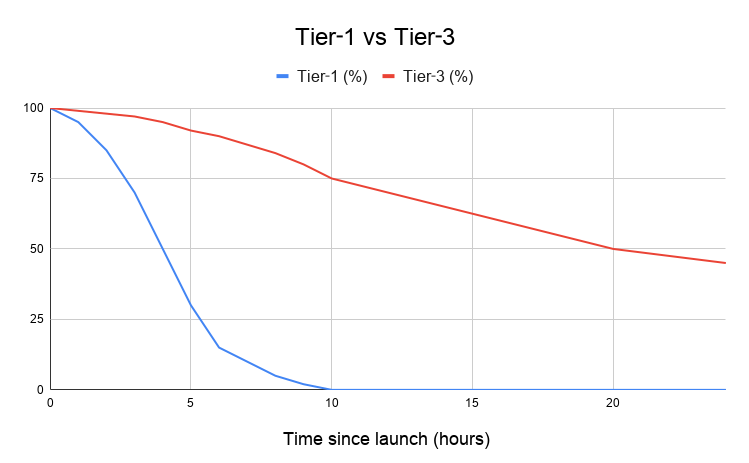
Tier-1: sharp activity drop after anomaly detection
Tier-3: gradual risk accumulation followed by sudden drop
Common Mistakes When Working with Tier-1 and Tier-3
The difference between Tier-1 and Tier-3 is reflected not only in ban speed but also in risk accumulation logic. Most issues arise from failing to adapt strategy to the algorithmic control level.
Mistake №1: One White Page for All GEOs
In Tier-1, algorithms evaluate page relevance to the creative, localization quality, behavioral signals, and content structure. An oversimplified or poorly localized white page increases the likelihood of additional reviews.
In Tier-3, requirements are softer, but accumulated behavioral anomalies can still lead to blocking.
Cloaking ensures precise traffic filtering by geography and other parameters, directing review or potentially risky traffic to a properly optimized white page, reducing mismatch triggers.
Mistake №2: Ignoring Infrastructure Pressure During Traffic Growth
As traffic volume increases, hidden issues may surface: slower loading speed, rising bounce rates, or unusual IP distribution.
In Tier-1, such changes are quickly detected and may initiate re-verification. In Tier-3, the reaction is usually cumulative, gradually building a negative profile.
Cloaking allows filtering suspicious visits by IP reputation, geography, device type, and other parameters, reducing the share of risky traffic and stabilizing campaigns during scaling.
Mistake №3: Overestimating Tier-3 “Safety”
There is a common belief that Tier-3 implies minimal control. In reality, algorithms still accumulate signals.
If a campaign receives large volumes of low-quality or suspicious traffic, the system gradually builds a negative assessment. Once the threshold is exceeded, blocking may become cascade-like, affecting the domain and advertising infrastructure.
Cloaking enables early-stage filtering of risky visits and ensures that the offer page is shown only to audiences matching predefined parameters, reducing negative signal accumulation.
Conclusion
Tier-1 is defined by high algorithmic sensitivity and instant reactions to anomalies, while Tier-3 reacts more slowly but may trigger cascade bans after signal accumulation.
In this environment, cloaking is a professional traffic filtering and risk management mechanism tailored to the control level of a specific GEO. Using reliable, comprehensive solutions such as Cloaking.House allows arbitrage marketers to build safer campaigns, extend bundle lifespan, and achieve stable ROI.






Be the first to share your opinion!
We value your feedback — share your thoughts.