


A campaign can work perfectly for weeks on a modest budget of $300-$500 per day, consistently demonstrating a high ROI and a low cost per targeted action. But as soon as a media buyer or team multiplies the spend by 5 or 10, the well-tuned system begins to rapidly collapse. Within 48 hours, the cost of conversion jumps significantly, fresh traffic stops paying off, and a proven flow begins to operate at a deep loss.
The main reason for this problem is that high budgets instantly expose the bottlenecks of the campaign, which remained unnoticed at low volumes. Media buying reacts to market changes in a matter of hours, while creative production, inventory hygiene, fraud filtering, and analytics at the individual app level require much more time. When daily expenses become noticeable, these time and analytical gaps instantly burn through working capital.
In this article, together with the therockapp.com team, we will analyze in detail how to properly scale In-App and DSP sources, control the quality of incoming traffic, and prevent the advertising campaign from losing its economics during a sharp increase in spend.
1. The trap of average numbers: why fresh cohorts are more important than monthly ROI
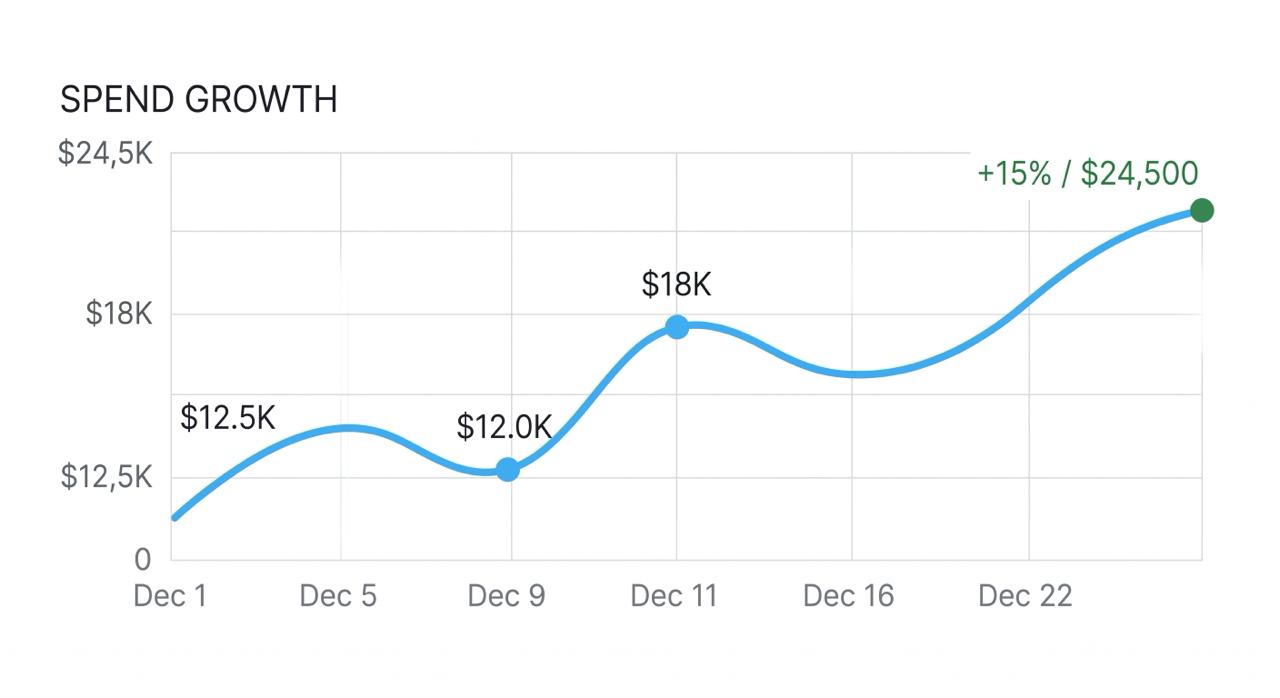
The first and most common mistake when scaling - focusing on average monthly metrics (CPI, CPA, ROAS). The blended ROI contains the history of the campaign over the previous few weeks or even months. Early traffic was purchased under completely different conditions: the audience was not burned out by ads, the auction was not heated up by additional budget, and key apps within the source had a huge reserve of capacity.
A new wave of scaling brings your budget into today's harsh auction realities. That is why focusing on averaged analytics creates an illusion of safety:
- Distorting the real picture: The overall ROI for the month may look comfortable (for example, +30%), while fresh traffic bought on yesterday's budget increase is already bringing a -20% loss.
- Frequency growth and burnout: When reaching serious volumes, the reach of target users grows much slower than the number of impressions. The frequency per user increases, and the speed of passing the funnel to the target action sharply decreases.
- Delayed reactions: Relying on inflated historical data, the team loses from 3 to 7 days before realizing the drop, draining a solid part of the budget during this time.
For clarity, let's compare how campaign metrics are read with a different approach to analytics:
| Performance metric | Historical metric (for 30 days) | Fresh cohort (LTV D1-D3 after scaling) | Real campaign status |
|---|---|---|---|
| Average cost per click (CPC) | $0.25 | $0.48 | The auction heated up by 2 times |
| Cost per install (CPI) | $1.80 | $3.20 | The capacity of cheap inventory is exhausted |
| Conversion rate to target action (CR) | 4.5% | 1.8% | New placements provide non-targeted traffic |
| Final profitable ROI | +35% (Plus) | -18% (Minus) | Immediate optimization required |
Practical conclusion: Analyze each new scaling wave strictly in isolation through cohort analysis (evaluating the metrics of the first 1-3 days). This is the only way to accurately determine the real capacity reserve of the source before deciding on the next daily limit increase.
2. Creative dynamics: how to speed up production to match the campaign rhythm
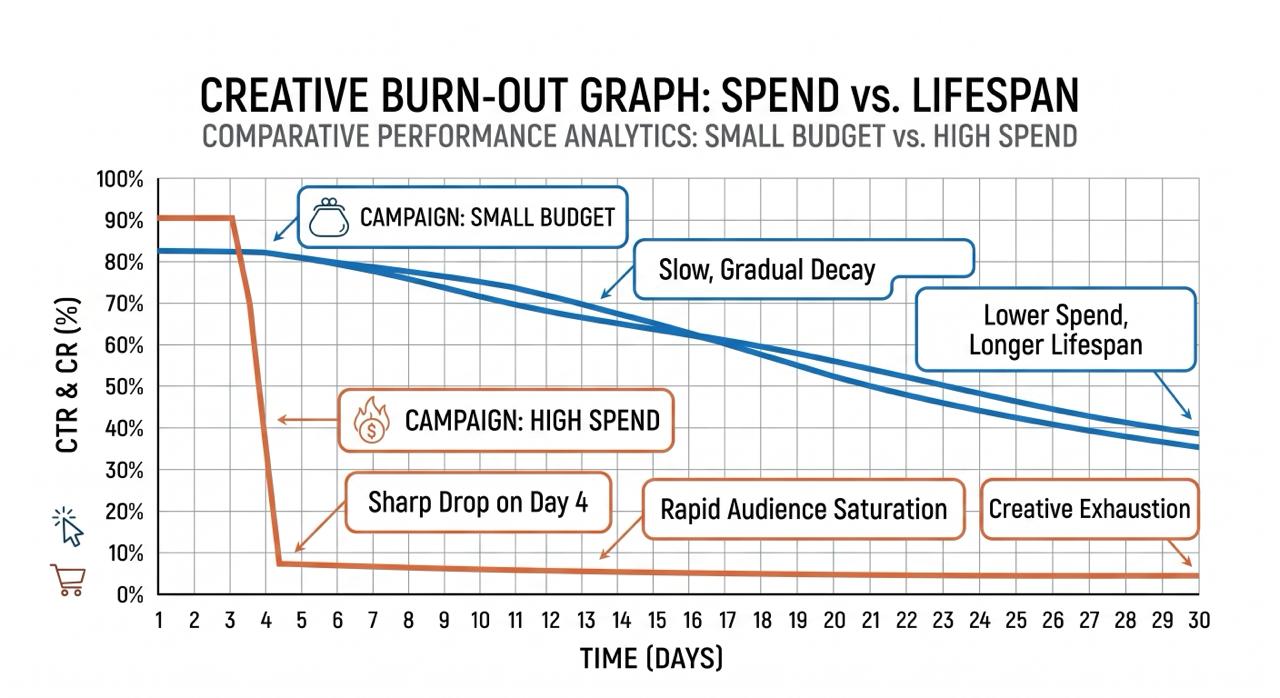
A creative that worked successfully for 3-4 weeks on a modest budget of $200 per day, with a sharp scaling to $2,000 per day, burns out in literally 3-5 days. The audience quickly gets used to the visuals and the offer, the click-through rate (CTR) drops rapidly, and the algorithms of advertising networks punish the campaign by increasing the CPM.
Standard budget ($200/day): The lifespan of a creative - from 20 to 30 days.
Scaled budget ($2000+/day): The lifespan of a creative - from 3 to 5 days before burnout begins.
The critical phase occurs when 2-3 proven assets begin to hold up to 80-90% of all traffic. The media buyer continues to spend the bulk of the money on them, as they still provide at least some conversion while new concepts are just being assembled in design or slowly passing moderation. The gap between the current leaders and new tests is shrinking, turning into losses.
How to organize work with creatives at a high spend:
- Advance launch: New hypotheses and adaptation packs should be uploaded to the campaign before current leaders start losing in CTR and conversion.
- Multi-adaptation of flows: A successful concept must be quickly scaled in depth: changing formats (from vertical video to banners and playable interactives), testing different durations, and localizing for adjacent GEOs.
- Synchronization of design and analytics: The internal creative production team ROCKAPP works in a single flow with media buying. Designers receive tasks not on a fixed calendar schedule, but based on live data about the load level on active creatives in the account.
3. Inventory transformation: what happens inside DSP and In-App networks
When working with In-App and DSP networks, it is important to understand: an increase in budget never means a simple growth of the exact same traffic that you received before.
As soon as the advertising system receives a command to spend more money, its algorithms begin to go beyond proven placements and use a wider pool of apps, exchanges (SSPs), and placements. The audience quality on these new placements can differ drastically from the initial inventory.
Two completely different apps within one DSP network can demonstrate the same cost per install (CPI), but differ radically at the stage of performing a target action within the product:
App A (Mass inventory): Provides 70% of the total traffic volume. CPI = $1.40. Conversion to purchase = 1.2%. Real cost per acquisition (CPA) = $116.6.
App B (Target inventory): Provides 30% of the traffic volume. CPI = $1.60. Conversion to purchase = 5.8%. Real cost per acquisition (CPA) = $27.5.
With sharp scaling, the DSP network algorithm will tend to pour the main budget specifically into App A, since there is a huge capacity and cheap installs. As a result, garbage or illiquid inventory will begin to dominate the total mass of traffic, completely destroying the final ROI of the entire campaign.
4. Automatic traffic filtering and anti-fraud protection
At high volumes, In-App traffic inevitably becomes a target for unscrupulous placements, botnets, and fraudulent schemes (for example, Click Flooding, Install Hijacking, device emulation). The larger the budget, the higher the percentage of garbage clicks and non-targeted visits trying to absorb your funds.
To maintain the planned metrics, a two-level protection system is required:
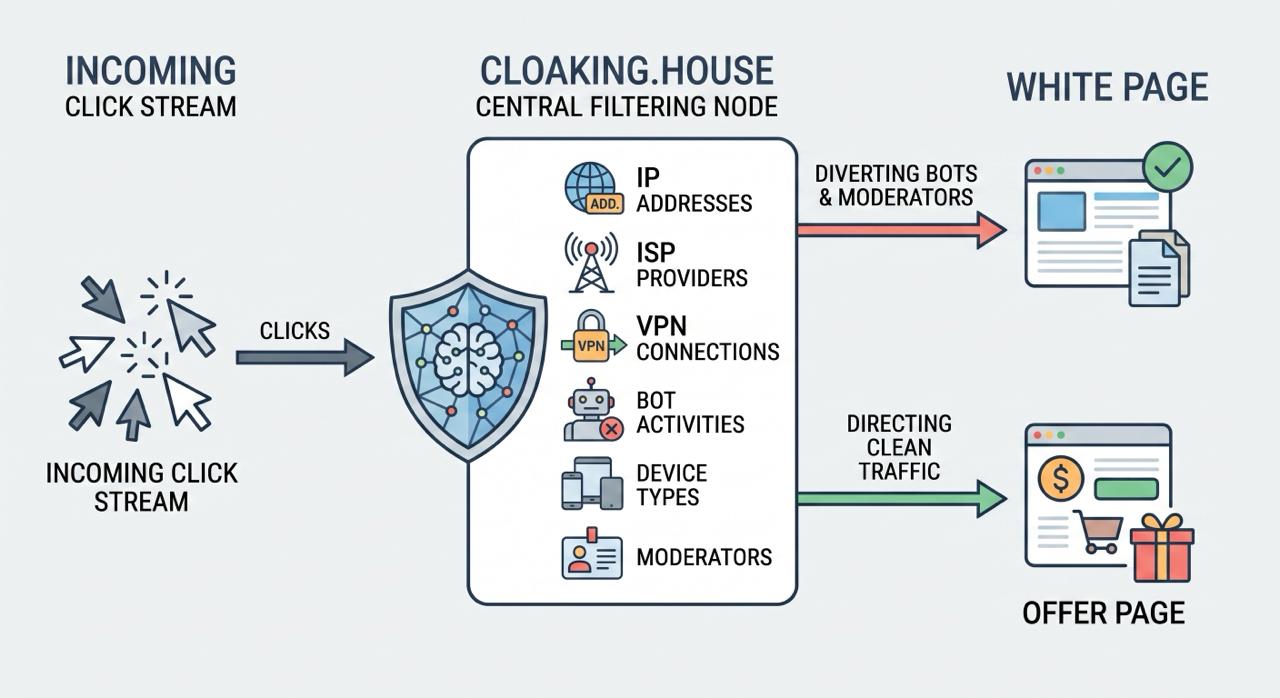
- Technical shield at the incoming flow level: The use of specialized filtering services, such as Cloaking.House, allows you to automatically cut off bot traffic, server IP addresses, data centers, VPN/Proxy, spy services, and moderators. The system redirects unwanted visits on the fly to a safe White Page, letting only real unique users through to the target offer.
- Hygiene at the App ID / Publisher ID level: Constant audit of placements through trackers and internal analytics. All apps demonstrating abnormally high click-through rates with zero activity inside the product should instantly be sent to Blacklists.
5. ROCKAPP Case: How to maintain CPA during an explosive 2x volume growth
An excellent example of working with dynamic inventory and traffic quality is the real case of the ROCKAPP team in the transportation vertical.
Initial situation and task
The app was running at a stable volume with a target cost per acquisition of an active user (CPA) around $29. The team faced the task of multiplying the number of installs and target actions without increasing the final acquisition cost.
The problem that arose
Within 48 hours, the campaign budget was increased, which led to a 2x growth in the total traffic volume. However, along with the volume, the structure of the incoming inventory changed sharply: advertising algorithms redirected money into groups of apps with low conversion, which created a threat of CPA drawdown.
Measures taken and optimization
- Precise filtering: The media buying team promptly connected a deep analysis of the inventory at the level of individual App IDs.
- Disabling spam placements: Sources with a low passage of key events inside the app and an abnormally high click rate were blocked.
- Budget redistribution: The released funds were redirected to groups of apps with a higher density of the target audience.
Final result
The campaign successfully maintained the target CPA at the $29 level, while due to the prompt cleaning of the inventory and filtering of non-targeted users, the share of a high-quality audience with a high LTV grew by 50% over the same period.
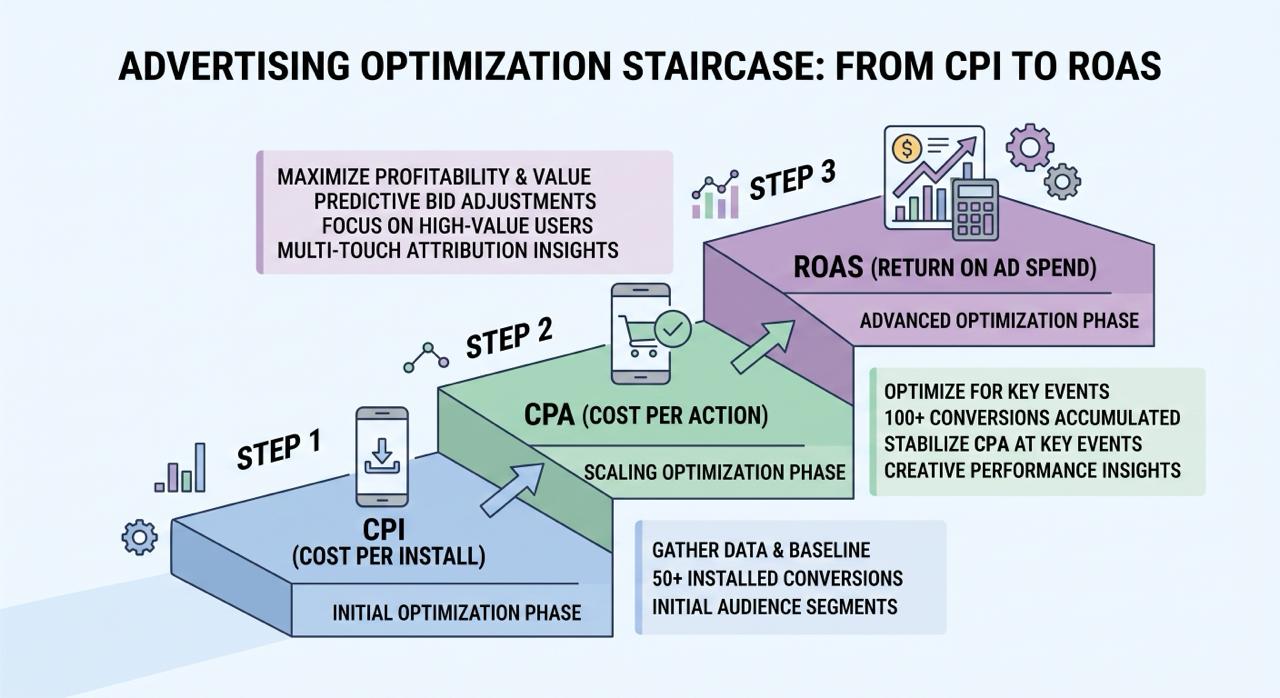
6. Optimization ladder: step-by-step transition from CPI to ROAS
Every optimization decision on a large-scale budget is expensive. Emotional changes, attempts to reconfigure the entire campaign due to one unsuccessful segment of a few hours usually lead to the destabilization of purchasing algorithms.
The campaign optimization process must strictly correspond to the volume of accumulated data and go through three consecutive stages:
Stage 1: Start and launch (Optimization by CPI)
Goal: Gaining the initial traffic volume, testing hypotheses on creatives, and initial cleaning of obviously garbage inventory.
Stage 2: Accumulating signals (Optimization by CPA)
Goal: Transferring optimization to specific target actions within the product (registration, completing the tutorial, first purchase) as a sufficient volume of events is accumulated.
Stage 3: Scale and payback (Optimization by ROAS / LTV)
Goal: Deep adjustment of budgets based on the real profitability of users from different sources and inventory groups.
The golden rule of buying: Changes to the campaign structure or blacklists are introduced only if there is a recurring pattern. A drawdown within a couple of hours is often just auction noise, and making edits at this moment only knocks down the optimization algorithms.
7. Finding the bottleneck: ROCKAPP Growth Framework
When a campaign hits the ceiling and loses profit when trying to raise the budget, an attempt to change "everything at once" only confuses analytics. Segment-by-segment diagnostics allows you to find the single limiting factor and work strictly with it.
Within the ROCKAPP Growth Framework approaches, diagnostics is built according to the following algorithm:
- If the inventory acts as a limiter: The current pool of apps is exhausted to the limit. Solution: Connecting new DSP networks, expanding the list of SSP exchanges, conducting tests on adjacent geo-directions.
- If creatives act as a limiter: Current promo materials have burned out, CTR is falling. Solution: Launching internal production to generate a series of localized adaptations and new visual hypotheses.
- If traffic quality acts as a limiter: Volume is growing, but payback is falling. Solution: Strengthening technical filters through Cloaking.House, reassembling blacklists (Blacklists), and deep audit of bot traffic.
The "one problem - one solution" methodology allows you to accurately measure the effect of each change and not lose control over the economics of the campaign.
8. Checklist for a media buyer before the next budget increase
Before increasing daily limits in the advertising account, check against the following checklist of your infrastructure's readiness:
- Analytics of fresh cohorts: Is the separate transfer and analysis of data on D1-D3 users configured without taking into account past periods.
- Reserve of creative concepts: Are at least 3-5 new diverse assets prepared and uploaded to the system, having passed moderation.
- Technical traffic filter: Is protection against bots, spy services, and fraudulent clicks configured using Cloaking.House.
- Inventory hygiene: Are basic app blacklists formed based on preliminary tests.
- Optimization strategy: Is a specific metric (CPI, CPA, or ROAS) determined, by which decisions are made at this stage of growth.
Scaling advertising campaigns - it is not just the ability to spend more money. It is a systematic process in which ROI preservation is ensured through strict control of traffic quality, continuous adaptation of creatives, and deep analytics of each purchased cohort.






Be the first to share your opinion!
We value your feedback — share your thoughts.