


Most guides on ad account security focus on cloaking scripts, landing page split-testing, or tracking setup. The proxy layer, which lies at the foundation of all this, gets far less attention, even though it is often the first thing an ad platform's anti-fraud system evaluates. Even before a moderator or bot sees your creative, the system has already assigned a risk score to the IP address from which the request originated. Make a mistake at this stage, and everything built on top of it will inherit that risk.
This article explains in detail how the proxy type, IP history, and session behavior actually affect the verification results, so you can make an informed choice regardless of which provider you use.
What Ad Platforms and Filtering Systems Actually Check
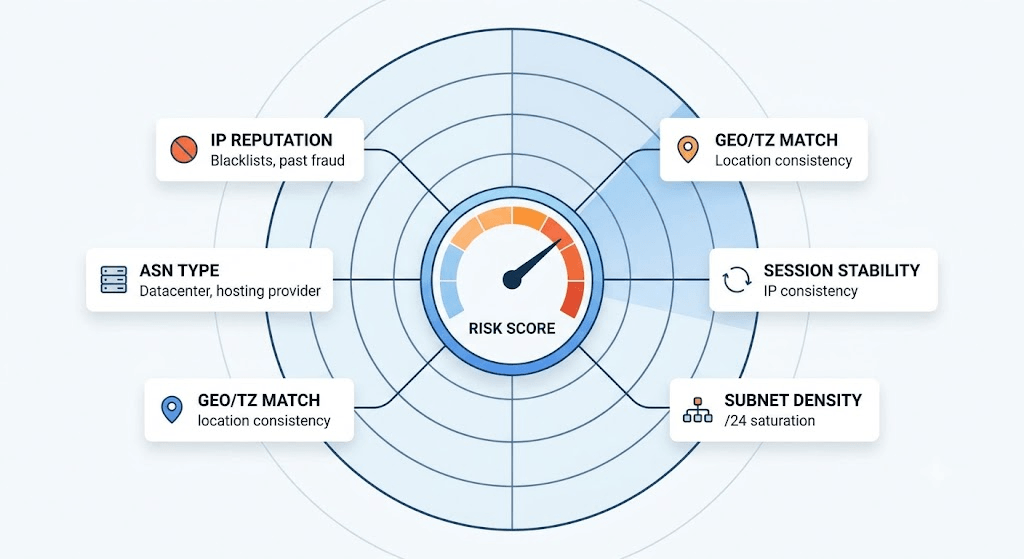
Detection systems of major ad networks rarely rely on a single signal. Instead, they combine multiple data points into a risk score for each visitor or request:
IP Reputation: Has this address or others near it in the same subnet been previously spotted in spam, fraud, or bot traffic?
ASN and Hosting Classification: Does the IP belong to a known data center or hosting provider rather than a residential Internet Service Provider (ISP)?
Geo and Timezone Match: Does the IP location match the device language, timezone, and browser locale?
Session Does the visitor maintain the same IP throughout the entire session, or does it change in the process?
Subnet Density: How many other active accounts or sessions are observed from the same /24 range?
None of these factors alone is usually sufficient grounds for a ban. It is their combination that raises the risk score which is why the choice of proxy has a much greater impact on the final result than is commonly believed.
Types of Proxies and What They Actually Signal
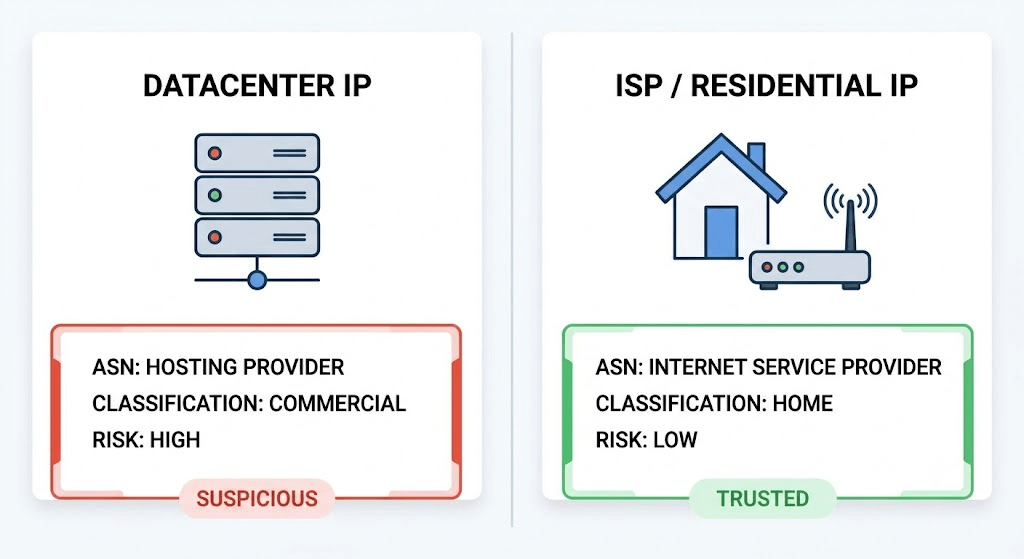
Not all proxies look the same to detection systems. The three main types used for traffic filtering and account management have different baseline reputations:
Datacenter Proxies: Fast and cheap, but the IP range is registered to a hosting company, not an ISP. Most ad platforms maintain lists of known datacenter ASNs and default to treating traffic from them with increased suspicion.
Rotating Residential Proxies: IP addresses sourced from real home connections, which helps with reputation, but the address can change from request to request. This is a problem for any process where the same visitor needs to look consistent across multiple stages.
ISP Proxies (Static Residential): IPs hosted in data centers but registered under the ASN of a real internet provider. They combine the speed and stability of a server connection with an ASN classification that looks like a regular home or corporate connection, while the IP remains unchanged for the entire rental period.
For cloaking and multi-accounting, ASN classification and IP stability are usually more important than raw speed. A fast proxy that gets flagged as server traffic will still fail the very first check.
Why Session Consistency is More Important Than it Seems
The Cloaking.House system directs a visitor to a "white page" or an "offer page" based on a real-time decision. If the visitor's IP changes mid-session whether due to proxy rotation or a short IP Time-To-Live (TTL) in the pool to the platform checking the traffic, this visitor might look like two different sessions. This inconsistency itself is a red flag, regardless of how correctly your cloaking logic works.
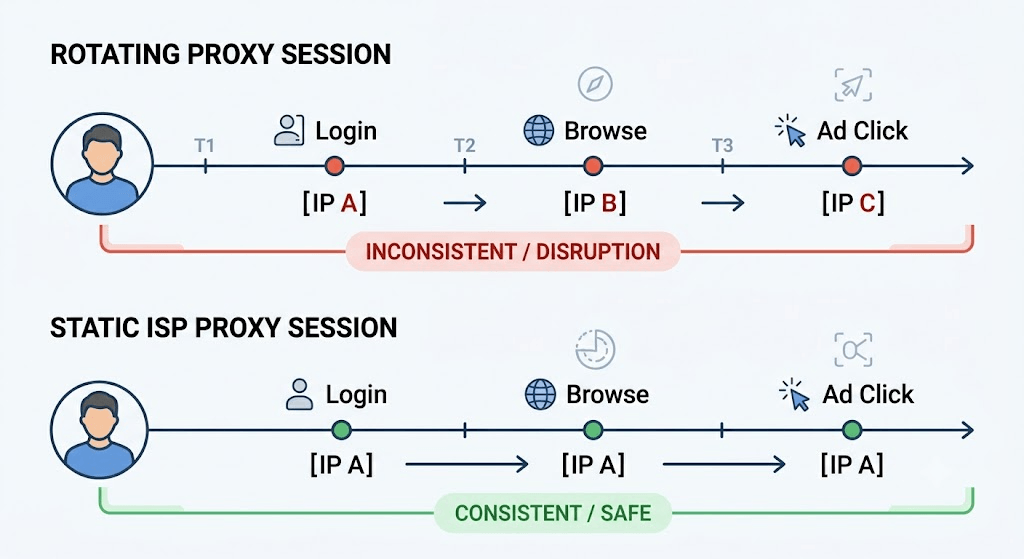
This is one of the most common points of failure in otherwise perfectly configured systems. The creative meets the rules, the landing pages are clean, the filtering logic is solid, but the proxy pool changes the IP faster than the session lasts, and this mismatch ultimately leads to a ban. A dedicated static IP for each account or campaign avoids this specific error, as the address does not change until you decide to change it yourself.
Subnet Diversity and the Risks of Shared IPs
Even with a clean ASN and a stable IP, launching multiple accounts from the exact same subnet creates a second vulnerability. If one account on a /24 subnet gets flagged, and the platform starts scrutinizing that range more closely, any other account nearby receives a share of that attention, even if it didn't violate anything.
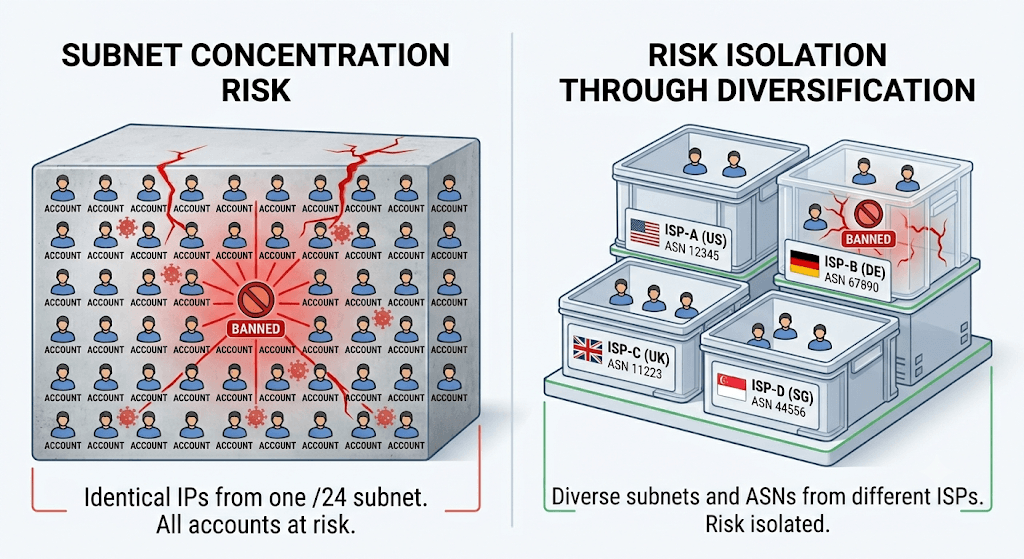
Distributing accounts across different subnets and, ideally, different geographical pools, limits the damage one banned account can do to the rest of the operation. This is a basic form of risk isolation that costs almost nothing to set up but is frequently ignored.
Common Mistakes That Ruin a Good Setup
Using free or shared proxy lists, where the same IPs are already flagged due to previous abuse by other users.
Geolocation mismatch: The IP is registered in one country, but the timezone or browser language settings indicate another.
Ignoring WebRTC leaks, which can expose the device's real IP even if the proxy is configured correctly at the browser level.
Mid-session IP rotation instead of at session boundaries, which breaks the sequence expected by detection systems.
Concentrating too many accounts on a small number of subnets, causing one banned account to jeopardize many others.
Most of these are setup issues, not proxy quality issues, but they compound each other. A high-quality IP used carelessly will perform worse than a mid-tier proxy configured correctly.
Practical Checklist Before Choosing a Proxy Provider
Check the ASN classification of the IPs being sold to you. Ask directly if they are registered to a hosting company or an ISP.
Clarify whether the IPs are dedicated (only for you) or shared with other clients simultaneously.
Verify session consistency: does the IP remain fixed until you change it, or can it change unexpectedly?
Ask about subnet diversity and how many of your accounts will end up in the same range.
Test ping and uptime from the actual regions your campaigns are targeting, not just from the provider's demo location.
None of this replaces a properly configured cloaking system or a clean creative. But it eliminates one of the most frequent and least noticeable causes of account loss, which is well worth an extra ten minutes of vetting before working with a new provider.
How to Solve These Problems in Practice
Finding a provider that honestly meets all the points on the checklist above can be difficult. Often, disguised server pools are sold as ISP proxies, and static IPs actually go into rotation without warning.
If you are looking for a solution built from the ground up with strict anti-fraud systems in mind, a good example is the BirdProxies service. Their infrastructure covers the main vulnerabilities when working with multi-accounting:
Clean ASN: Proxies are registered to real ISPs, not data centers. Traffic does not receive hidden "penalty points" before it even reaches the cloaking script.
Real Dedicated IPs: Each address is strictly issued to one person. There is no risk that a pool neighbor will "burn" your IP with spam or black-hat verticals.
Strict Session Consistency: The IP remains static for as long as you have it. The account will ping from the same address from the first to the hundredth visit no session drops.
Subnet Diversity: Pools cover a wide range of countries and subnets. This allows you to properly distribute your account farm so that the ban of one cabinet doesn't drag down the entire network on the same /24 subnet.
Speed and Unlimited Usage: Response time is maintained at 30–50 ms, which is critical for instant redirection during cloaking. Traffic and the number of threads are not metered, so the cost of maintaining an account remains fixed.
Conclusion
In affiliate marketing and media buying, saving a couple of dollars on proxies often results in the loss of dozens of warmed-up accounts and drained budgets. A proper setup requires one high-quality, static ISP IP per account.
Regardless of the provider, always pay attention to the foundation: ASN cleanliness, subnet isolation, and the absence of forced rotation. Build this layer correctly, and your cloaking system will work exactly as intended.




Be the first to share your opinion!
We value your feedback — share your thoughts.