


In the digital advertising industry of 2026, moderation systems of ad platforms have fully transitioned into the era of AI-driven risk control.
Platforms like Google Ads and Meta Ads no longer just check ad creatives. Now, they analyze traffic sources, the network environment, device fingerprints, and user behavioral patterns.
For teams working in the affiliate sphere, simply launching ads is no longer enough. It is crucial to understand how ads are actually displayed to users: whether they appear in the correct region, if the landing page opens properly after a click, and if the ad account operates in a stable and secure environment.
What are Proxies for Ad Verification and Why Are They Important?
The primary goal of Ad Verification is to ensure that ads are shown to real users exactly as specified in the campaign settings.
For example, an advertiser needs to verify:
whether ads are shown only in target countries
if landing page redirects work correctly
if ads are delivered to the correct audience segments
In practice, ad verification typically performs two main tasks.
1. Self-Audit
After launching an ad campaign, media buyers usually use proxy IPs to simulate real users from different regions and verify ad delivery.
Typical checks include:
whether ads are displayed correctly in specific countries
if cloaking scripts correctly identify users
if redirect logic works across different devices and network environments
Without a real regional IP, the page you see might just be an advertiser's preview version, rather than the one seen by actual users.
By using residential and mobile IP proxies that mimic real user behavior, brands can see exactly the version of the page that a real visitor would see.
2. IP Isolation
For teams managing ad accounts long-term, verification proxies also play a critical role in creating a clean and stable network environment.
This is especially vital in scenarios such as:
managing multiple ad accounts
testing affiliate campaigns
verifying cloaking pages
monitoring ads across different countries
High-quality proxies allow each account to operate under a unique network identity, reducing the risk of the platform detecting multiple operations from a single operator.
In other words, proxies are used not only for ad verification—they also ensure the security of ad accounts.
IPFoxy Proxies: Application in the Advertising Environment
In advertising scenarios, a proxy is more than just an IP address change.
They must provide:
realistic user characteristics
network stability
control over the operational environment
To maintain a stable advertising infrastructure, many teams utilize high-quality proxy services.
IPFoxy is a global proxy network that helps advertising teams build a stable environment at various stages of working with ad campaigns.
1. Verifying Ads in Different Regions
Using proxies from various countries and cities allows advertisers to see exactly how ads are displayed to local users.
Typical use cases:
geo-targeted Google Ads campaigns
testing regional delivery for Meta Ads
verifying TikTok ad displays
2. Testing Landing Pages in Different Network Conditions
After launching an ad campaign, it is important to ensure the user journey works correctly: the ad opens the right page, the landing page loads quickly, and transitions between pages do not break.
Using proxies from different regions, ad teams can check how the site and ad link perform for users from various countries and network environments. This allows for the early detection of issues with page loading, redirects, or regional restrictions.
3. Environment Isolation for Ad Accounts
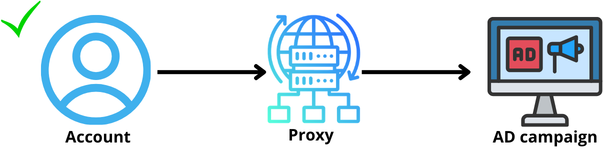
For teams managing multiple ad accounts, assigning a separate proxy to each account can significantly reduce risks such as:
IP-linking between accounts
detection of bulk operations
chain suspensions of multiple accounts
Proxy Strategy for Advertising in 2026: Matching Proxy Types to Tasks
Different advertising scenarios require different types of proxies.
IPFoxy Proxies provides proxy services in over 200 countries and regions, supporting flexible protocols and various proxy types suitable for different advertising processes.
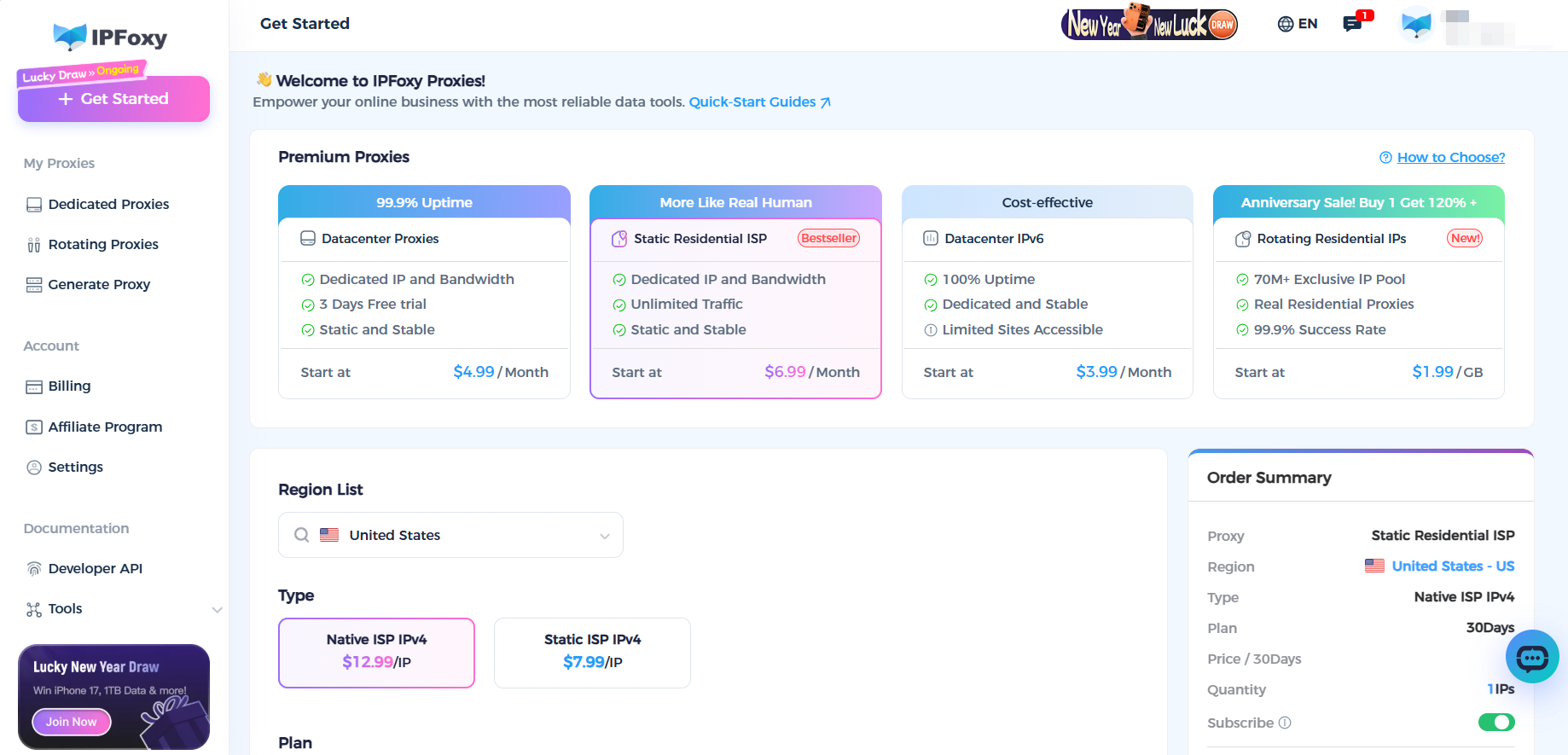
Below is an overview of the most commonly used proxy types in the advertising environment.
1. Residential Proxies
Residential IPs originate from real home internet connections, providing a high level of authenticity.
They are ideal for:
verifying ad displays
testing geo-targeted ads
simulating users for cloaking
Currently, residential proxies are the most common type of proxy for ad verification.
2. ISP Proxies
Static residential IPs remain unchanged over a long period.
In teams managing multiple ad accounts, they are often used alongside:
fingerprint browsers
multi-accounting tools
This helps create a stable, isolated environment.
Suitable for:
long-term ad account management
account warm-up strategies
logging into ad dashboards
Compared to rotating IPs, static residential IPs are better suited for long-term account stability.
3. Mobile Proxies (4G / 5G)
Mobile proxies originate from real mobile carrier networks, which often carry a higher level of trust on certain high-risk platforms.
Typical usage scenarios:
TikTok Ads
Meta Ads
affiliate marketing
In high-risk advertising environments, mobile proxies can further reduce the probability of detection.
Comparison of Proxy Types
| Parameter | Residential Proxy | ISP Residential IP | 4G/5G Mobile Proxy |
| IP Source | Real home networks (P2P or via ISP) | Real home network with a fixed IP | Real mobile carrier networks |
| Key Features | High authenticity, hard to detect as a proxy, usually dynamic rotation | Combination of authenticity and stability | Massive IP pool, high dynamics |
| Main Use Cases | Ad verification, geo-tests, user simulation | Long-term account management | Working on high-risk platforms |
| Stability | Medium | Very high | Low |
| Anonymity | High | Very high | Maximum |
| Typical Tasks | Verifying ad displays in different regions | Long-term account management | Launching TikTok / Facebook ads |
| Limitations | Fast rotation may trigger suspicion | Limited resources and higher price | Higher latency and cost |
Why Proxy Quality Directly Affects Ad Verification Results
Many ad teams face the same issue: even when using proxies, ads still do not display correctly or accounts receive restrictions.
In many cases, the real reason is proxy quality.
1. Low-Quality Proxies Are Easily Detected
Datacenter IPs or abused proxy networks are often flagged by ad platforms.
If an IP has a poor reputation, you may encounter issues such as:
ads not displaying
pages being restricted
verification results becoming inaccurate
2. IP Pollution Can Lead to Account Linking
If multiple ad accounts use the same proxy pool, platforms can detect abnormal operational patterns.
If one account is banned, other accounts in the same IP environment may also suffer.
3. Inaccurate Geolocation
Some low-quality proxies have inaccurate geolocation databases, which can lead to situations where:
an IP is labeled as "USA" but is detected as a datacenter
the region is identified incorrectly
This directly affects the accuracy of ad verification.
Conclusion
For teams running long-term ad campaigns, ad verification should not be a one-time test but a permanent part of the operational infrastructure. It is essential to regularly see how ads appear to users in different regions, how landing pages open, and how stable the environment is where ad accounts operate.
In these tasks, proxy quality plays a key role. Reliable services like IPFoxy help ad teams work with traffic from different countries, maintain a stable network environment, and more accurately verify how ads and landing pages look to real users. This enables the building of a more resilient and predictable advertising infrastructure.






Be the first to share your opinion!
We value your feedback — share your thoughts.