


In 2026, affiliate marketing has officially ceased to be a game of "speed." Automated moderation in Meta, TikTok, and Google now operates based on machine learning, graph analysis, and behavioral signals. However, under certain conditions, the decision is made by a human rather than an algorithm. It is this manual review that most often becomes the point of no return for an advertising account.
In this article, we will break down when manual review is triggered, what exactly a moderator looks at, where the infrastructure breaks down, and what role Cloaking.House plays in mitigating risks.
When Automated Moderation Hands an Account to a Human
Algorithms pass the majority of ads without human intervention. However, there are a number of triggers that cause the system to escalate the level of verification. This could be an abnormally high CTR in the first hours of a launch, a sharp budget increase, repeated ad rejections, user complaints, or a discrepancy between the target GEO and the technical parameters of the infrastructure.
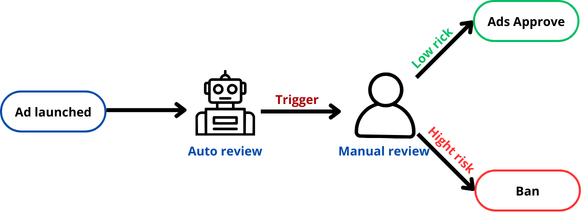
Manual review is not a random occurrence. It is the system's reaction to increased risk. If a launch is initially built with "weak" elements, a manual check almost guarantees sanctions.
What Happens During a Manual Review
Unlike an algorithm, a moderator thinks in context. They don't just analyze text; they evaluate the logic of the entire chain: the ad, the transition, the page, the domain, redirect behavior, and regional consistency.
The process typically looks like this:
Clicking the ad from within the internal system.
Checking the redirect (detecting instantaneous redirection).
Analyzing the white page.
Inspecting the website structure.
Checking domain history.
Matching GEO, language, and currency.
This is where cloaking begins to play a strategic role. If the flow in Cloaking.House is configured correctly, the reviewer sees a full-fledged white page without an aggressive offer. If the filtration is poorly constructed, the human may land on the target page, leading to a near-instant ban.
What a Moderator Notices First
A manual review is not just a search for "grey" words; it is a search for inconsistencies.
The moderator checks if the page language matches the targeted GEO, if the currency is displayed correctly, if the date format fits the region, and if the address looks realistic. If an ad is running in Germany but the page contains a US phone format and USD currency, that is an immediate red flag.
Next, the site structure is evaluated. The presence of a menu, footer, privacy policy, and contact information creates the impression of a real project. The absence of these elements heightens suspicion.
Content is also analyzed for aggressive claims: guaranteed income, medical promises, or "exclusive offers today only." Even if such wording doesn't directly violate rules, it can serve as grounds for a deeper account analysis.
Where Bans Most Often Occur
Most blocks during a manual review are related to the infrastructure, not the creative. Below is a brief summary of typical risk points:
| Verification Zone | What Causes Suspicion | Consequence |
| White Page | Templated structure, minimal text | Ad rejection |
| GEO | Mismatched language and currency | Account ban |
| Domain | New, no history | Increased risk |
| Connectivity | Repeating domains/cards/templates | Mass ban |
During a manual review, the moderator evaluates not only the site itself but also its technical footprint. If an IP address is blacklisted or comes from a heavily abused IP pool, it can raise concerns and lead to further scrutiny. However, choosing a reliable proxy provider based solely on marketing claims can be risky. To make more informed decisions, affiliate marketers can turn to independent analytics platforms such as ProxyVero, which provides proxy benchmarks and provider comparisons to help evaluate available options. Combining reliable proxy infrastructure with a properly configured traffic filtering setup can help maintain a more consistent technical environment.
The Role of Cloaking During Manual Review
It is important to understand: cloaking does not "deceive" the moderator. It structures the traffic flow and separates audiences. The reviewer gets access to a compliant, safe version of the page that meets platform requirements. User traffic goes to the target version.
Cloaking.House allows for flexible filtration and flow management, separating moderators, bots, and real users.
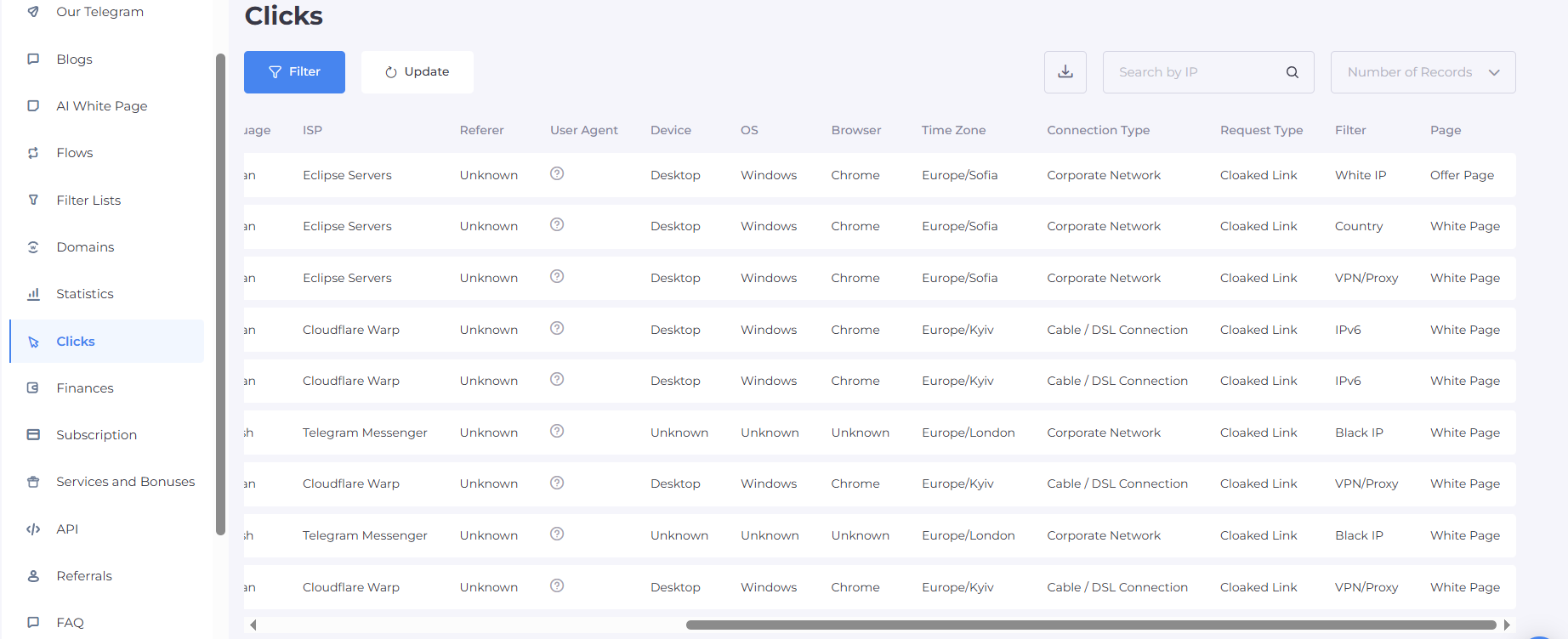
High-quality cloaking solves three tasks:
Isolation of review traffic;
Control of behavioral signals;
Reduction of the probability of the offer falling under direct analysis.
However, cloaking itself is not a guarantee of safety. If the white page looks unnatural or the domain has a negative history, a manual review will still end in sanctions.
When Cloaking Won't Save You
There are situations where even perfect filtration cannot prevent a ban. If an account is already in a risk zone, if the same payment infrastructure is used across multiple launches, or if the system has flagged connectivity between accounts, manual review becomes a mere formality.
Risk also increases with sharp budget scaling. A human begins checking not just the page, but the account's behavioral history: launch frequency, ad creation speed, and domain repetition.
A Typical Ban Scenario
Day 1: Campaign passes automated moderation.
Day 2: CTR grows.
Day 3: Budget increases. The system flags an anomaly.
Day 4: Manual review.
Day 5: Account banned for "circumventing systems."
The problem wasn't the creative; it was that the infrastructure wasn't synchronized: the domain was new, the white page was templated, and the language didn't fully match the GEO.
How to Reduce Manual Review Risk
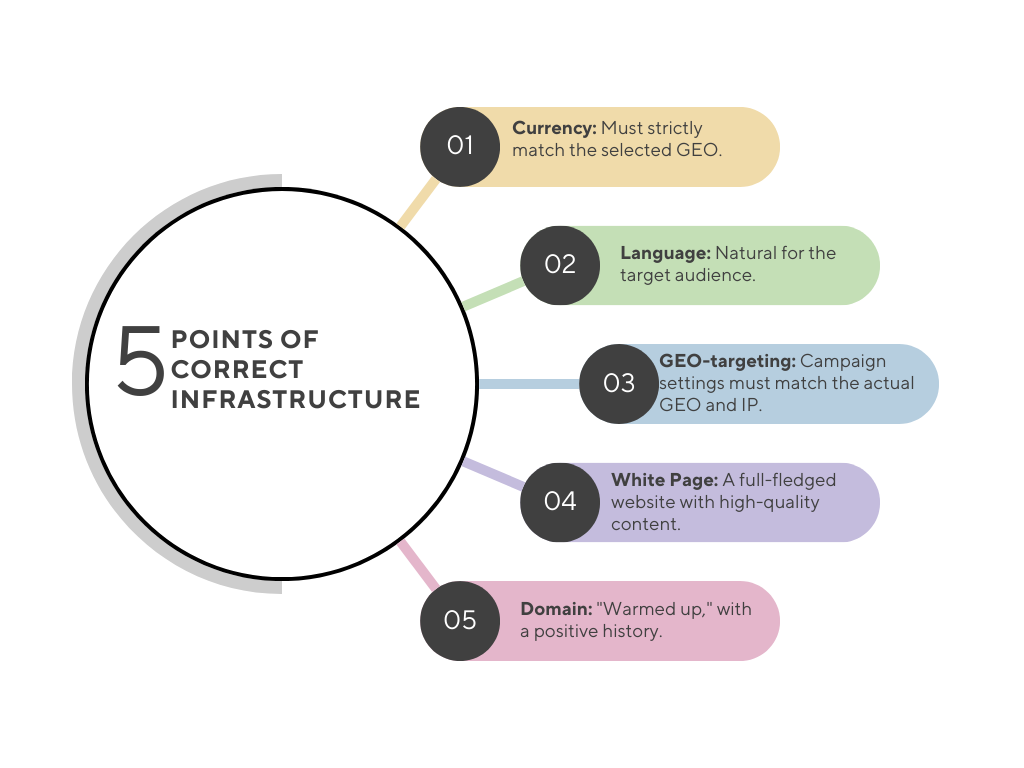
Minimizing risk is built not just on "masking," but on the consistency of elements:
GEO matching across all parameters;
A full-fledged white page;
Logical domain structure;
Gradual budget scaling;
Correct traffic filtration via cloaking.
When scaling budgets, it is vital to be gradual. A safe practice is to increase the budget by no more than 20% per stage. Sudden spikes in spending are often perceived as anomalies and can trigger a review.
Conclusion
Manual moderation in 2026 is not an exception but part of the normal lifecycle of advertising campaigns. Algorithms identify risk; humans confirm the decision. It is at this moment that the quality of your launch architecture becomes evident.
Cloaking in this model is not a way to "hide" an offer, but a tool for flow management and infrastructure risk reduction. Properly configured, Cloaking.House isolates review traffic and helps you pass manual reviews without bans.
If you look at the process through a moderator's eyes, it becomes clear: a ban is almost always a consequence of inconsistency. A systemic launch architecture is the only way to minimize risk in the long term.






Be the first to share your opinion!
We value your feedback — share your thoughts.