


Any creative sooner or later stops working this way, this can happen even on the first day of launch. The question is not whether it will burn out - it will burn out for sure, - but whether you will have time to notice it and react before you drain your budget for nothing. In this article we will analyze specific metrics and signs by which you can diagnose creative burnout, distinguish it from other problems in the campaign flow, and understand what to do next.
What is creative burnout
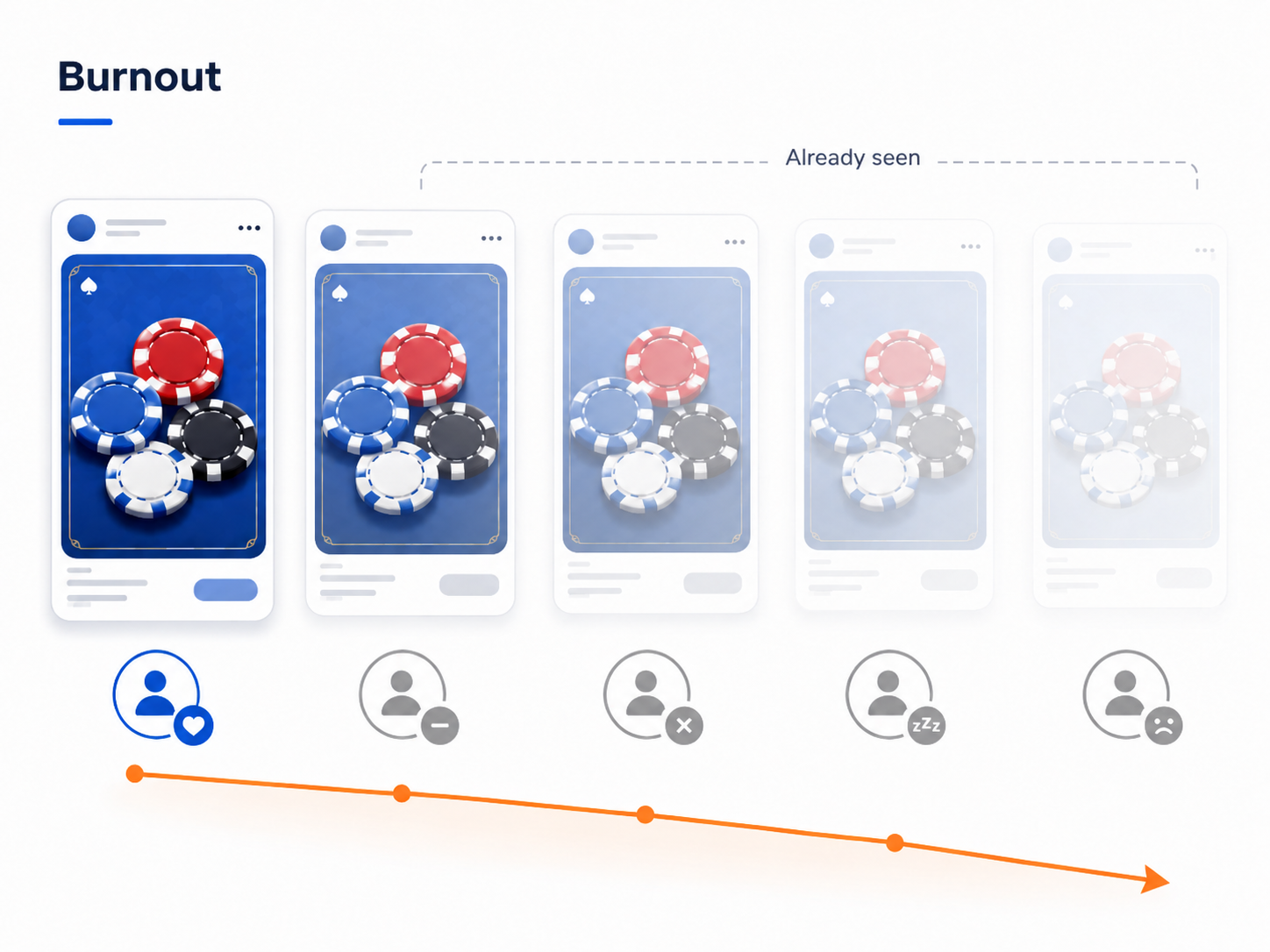
Burnout - is a drop in ad performance caused not by a change in the offer, GEO or landing page, but by the fact that the audience has already seen this creative too many times. The same people start scrolling past the banner, not reading the text and ignoring the call to action - simply because the brain has already classified this visual as "already seen, not interesting".
 It is important to distinguish burnout from related problems:
- Poor launch - the creative initially did not resonate with the audience, metrics are low from the first day.
- Problem with moderation or traffic quality - metrics jump chaotically, without smooth degradation.
- Seasonality and external factors - the drop in conversion coincides with changes in the market, not with the duration of display.
- True burnout - consistently good metrics gradually and predictably decline as the frequency of impressions to the same user grows.
Next - about how to recognize exactly the last case.
Key metrics that signal burnout
 1. CTR drop with unchanged targeting
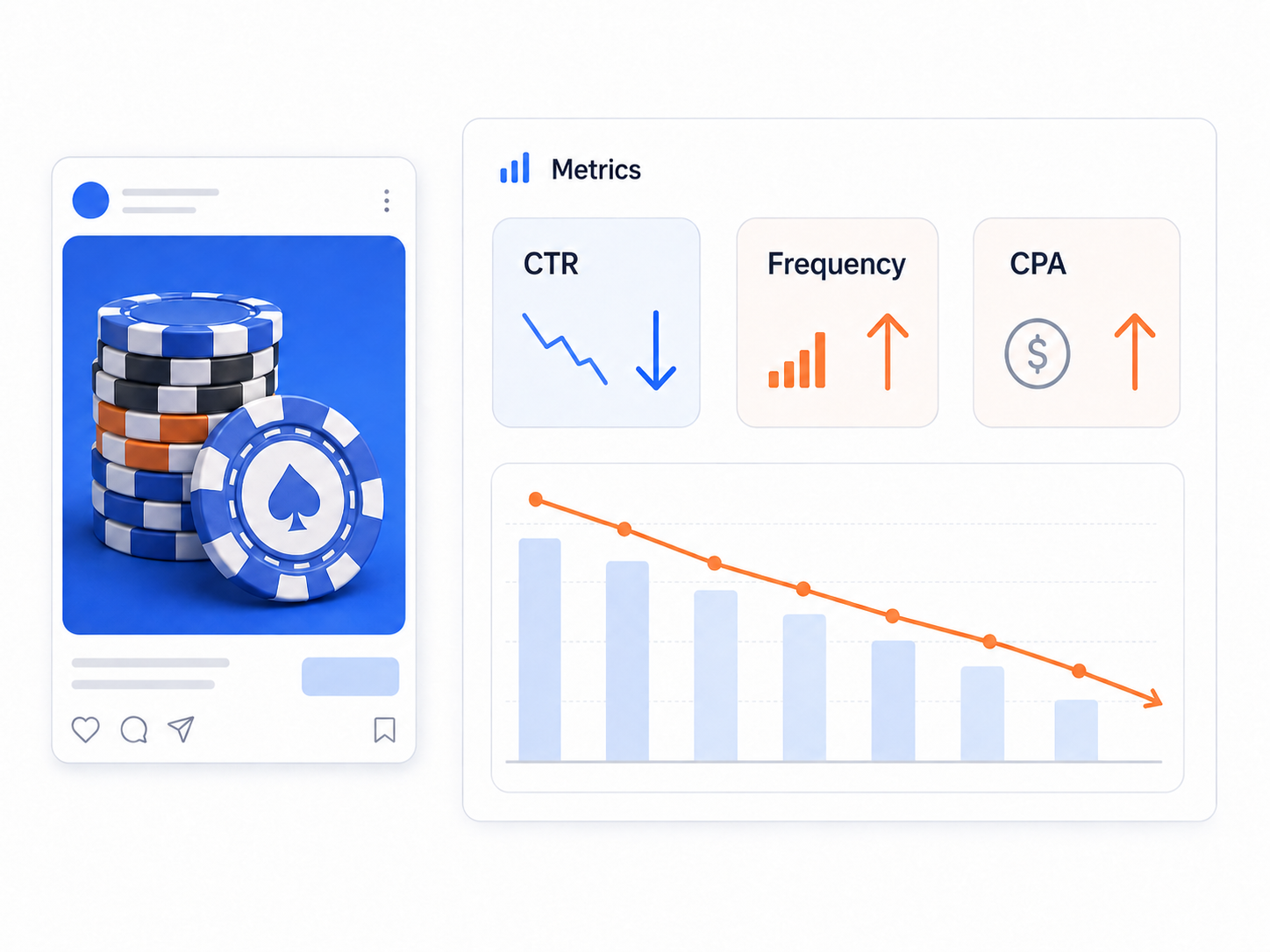
This is the first and most obvious indicator. If you have not changed the audience, GEO, placements and budget, and CTR systematically decreases over several days - this is a classic sign of audience fatigue from the visual.
It is important to look not at a one-time failure, but at a trend over at least 3-5 days. A one-time drop in CTR by 10-15% can be noise or a temporary auction effect. A steady decline of 25-40% or more from peak values - is already a signal to act.
2. Growth of impression frequency (Frequency)
Frequency - is the average number of impressions per user. The metric is directly related to burnout: the higher the frequency, the higher the probability that the audience is already "fed up" with the creative.
Conditional benchmarks depend on the vertical and audience size:
- Frequency 1-3 - usually a normal zone, the audience is still fresh.
- Frequency 4-6 - risk zone, it is worth carefully monitoring the dynamics of CTR and CPA.
- Frequency 7+ - in most cases a clear sign of overheating, especially if the audience is narrow.
If the frequency is growing, and the CTR is falling at the same time - this is almost always burnout, not a coincidence.
3. Increase in the cost of result (CPA/CPL/CPI)
Even if the CTR is still holding, the cost of the target action may begin to grow earlier than it becomes noticeable by clicks. The reason is simple: those who have already seen the ad and became interested once click by inertia, but further down the funnel the conversion drops, because the "hot" part of the audience has already gone through the campaign flow.
If CPA has been growing for several consecutive days without changes in the rest of the funnel - this is another argument in favor of the "burnout" diagnosis.
4. Decline in conversion to click from impression (Impression-to-Click Rate) with reach growth
If the advertising system is forced to show the creative to a wider or less targeted audience in order to maintain traffic volume, - this is an indirect sign that the core of the target audience has already been processed and exhausted.
5. Drop in engagement
For formats with reactions, comments and reposts, a decrease in engagement with stable reach also indicates burnout. The audience sees the content, but stops reacting to it.
How to distinguish burnout from other causes of the drop
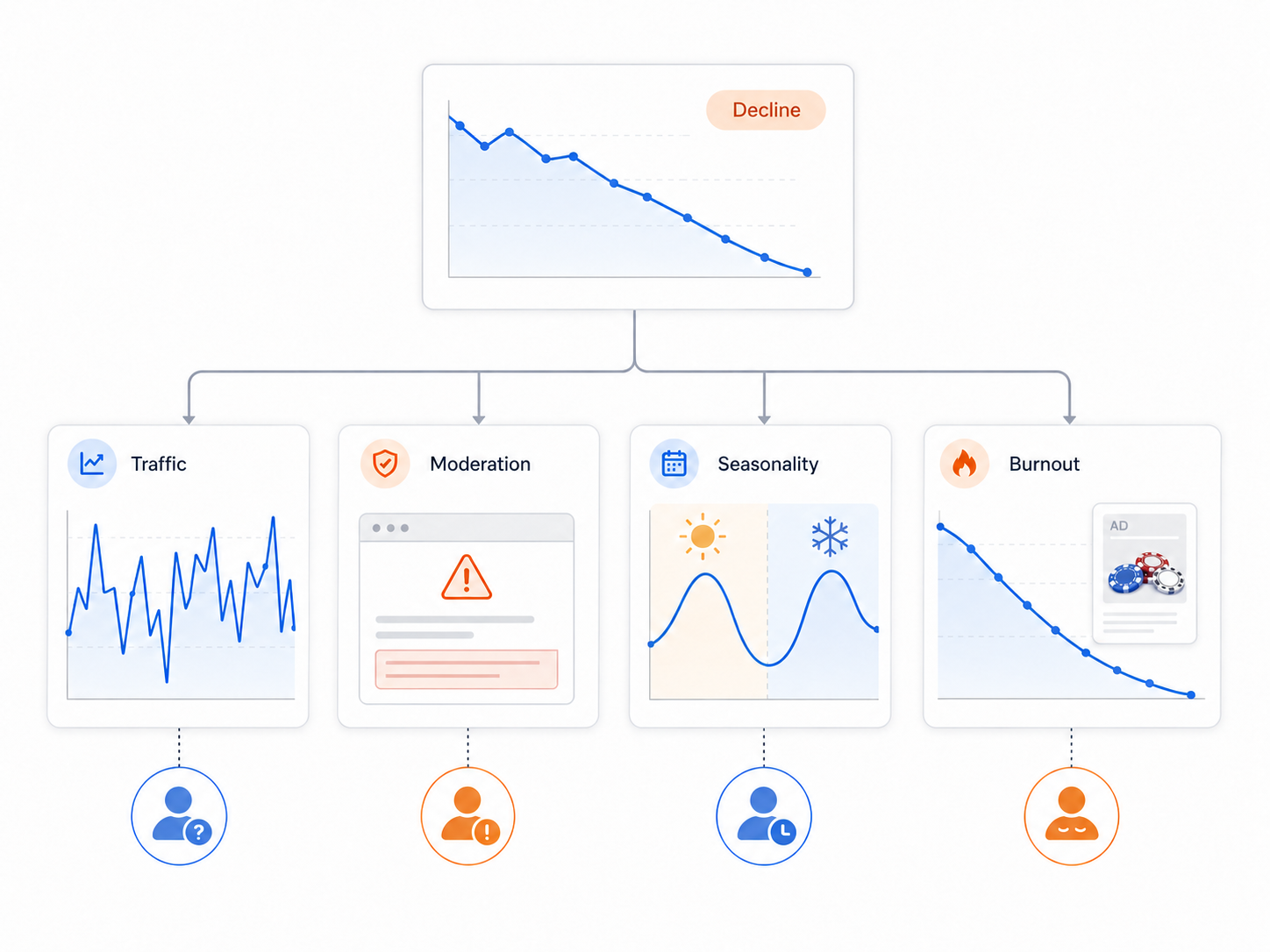 To avoid mistakenly making the decision to "change the creative", you should go through a short exclusion checklist:
- Check the moderation and ad status. Sometimes the drop in metrics is associated with a partial restriction of impressions on the platform's side, not with audience fatigue.
- Look at traffic quality by GEO and devices. Sharp skews in traffic structure, for example, a sudden increase in the share of one low-quality GEO, can distort the picture.
- Check the dynamics against changes in the offer or on the landing page. If the landing page, offer conditions or bids changed in parallel - the drop may be caused by this, not by the creative itself.
- Evaluate the time period. Burnout - is always a gradual, stretched over time process. A sharp collapse in one day - is almost never burnout, but a technical failure, ban or tracking problem.
- Compare metrics with the benchmark for the vertical. In some verticals, for example, in iGaming or dating, the natural life cycle of a creative is shorter than in others. What looks like rapid burnout may be the norm for a specific niche.
How long a creative lives: rough guidelines
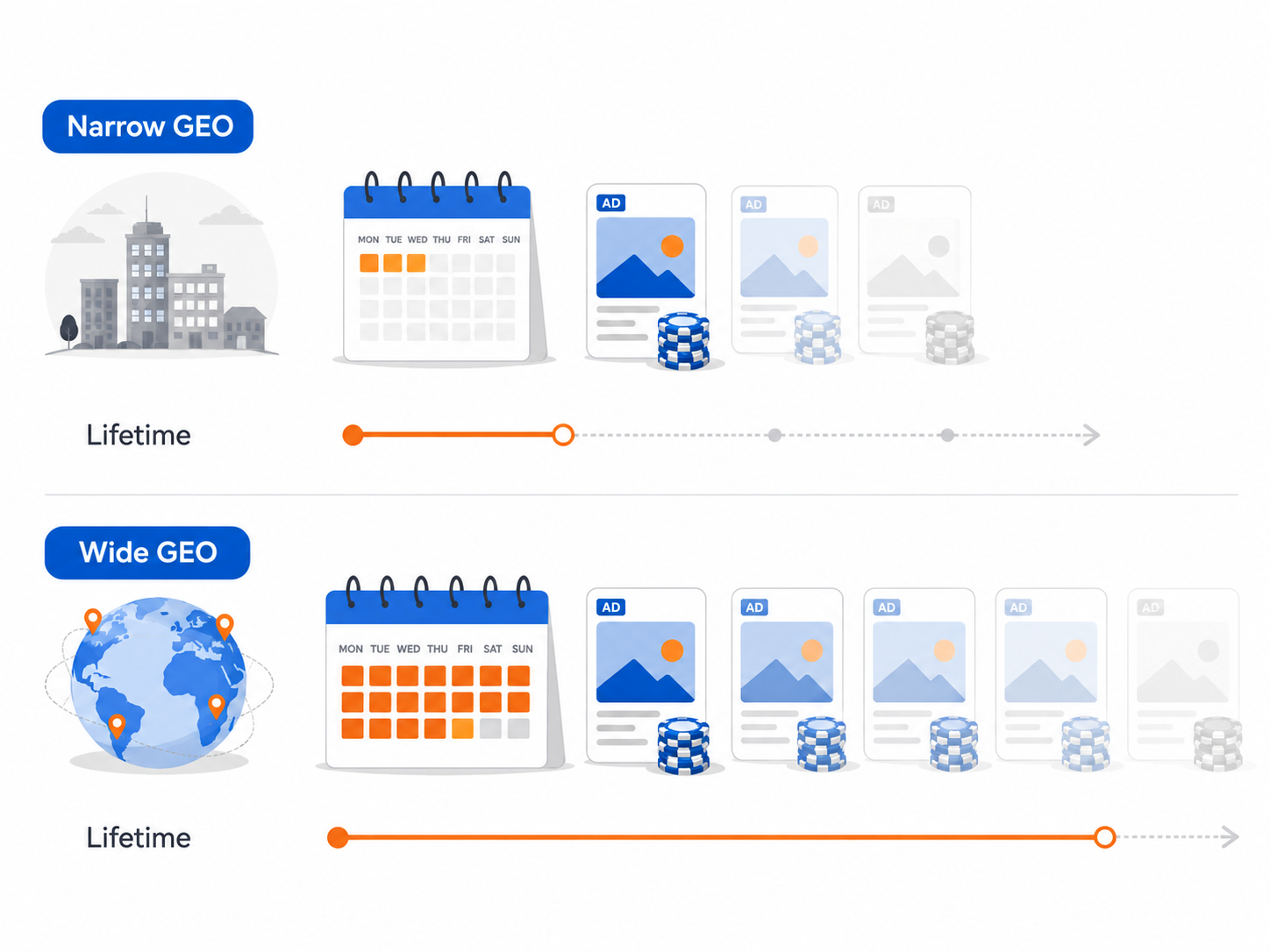 There are no exact universal numbers - the lifespan depends on audience size, budget, rotation frequency and vertical. But there are general patterns:
- Narrow audiences and small GEOs - the creative burns out faster, sometimes in 3-7 days of active delivery.
- Broad audiences and voluminous GEOs - the life cycle can stretch for 2-4 weeks and longer.
- High-frequency verticals, for example gambling and betting, - the audience is more "trained" by advertising, habituation occurs faster, therefore creative rotation should be planned more frequently.
- Calmer verticals, for example nutra and some types of dating, - the life cycle of a creative is on average longer.
Practical conclusion: do not rely on fixed timeframes - focus on the dynamics of metrics, not on the calendar.
What to do when the creative is burned out
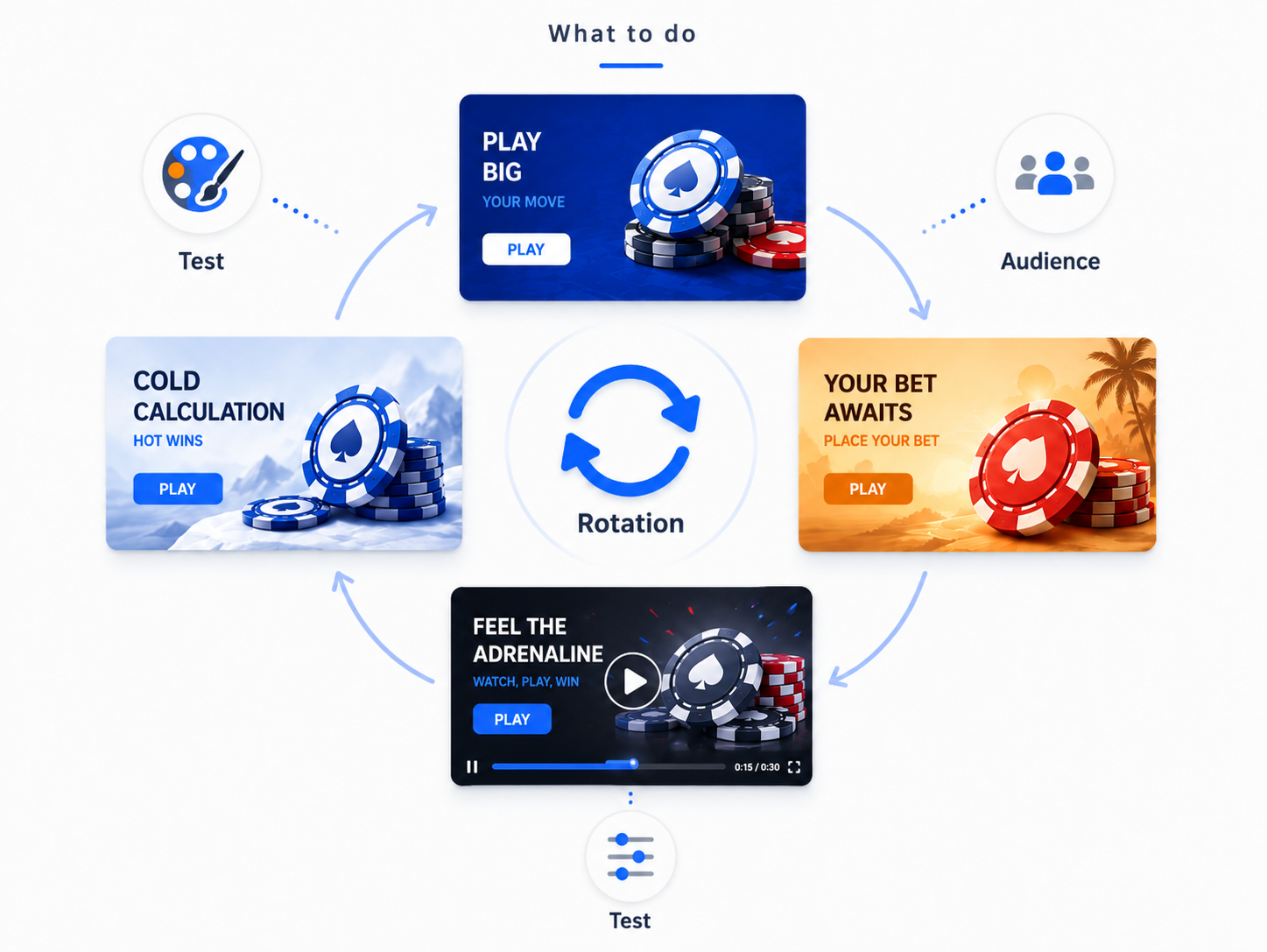 Rotation of variations, not complete replacement
It is not necessary to immediately create a fundamentally new creative from scratch. Often it is enough to refresh the visual:
- change the color scheme;
- change the angle;
- change the format: static → video → carousel;
- update the text on the banner;
- replace the first frame of the video.
This gives the effect of a "new" ad for the algorithm and audience, maintaining the working campaign flow at the core.
Expanding or updating the audience
If the impression frequency has grown due to narrow targeting, try to expand the audience, add look-alike segments or new interests. This reduces the number of impressions per user and prolongs the life of the current creative.
A pool of creatives instead of one "favorite"
The most sustainable strategy - is not to wait for the burnout of one creative, but initially to launch several variations in parallel and rotate them as the audience becomes fatigued.
This reduces the risk of a sharp drop of the entire campaign due to the burnout of a single ad.
Testing new formats and hypotheses in advance
While the current creative is still showing good results, it is worth testing 1-2 new hypotheses in a small volume in parallel.
This way, by the time the main creative burns out, you will already have a proven replacement, not a pause to search for a new solution.
Working with impression frequency
If the platform allows, use an impression frequency limit - frequency cap, to artificially slow down the pace of audience burnout and stretch the life cycle of the creative over time.
Why this is especially important when working with cloaking
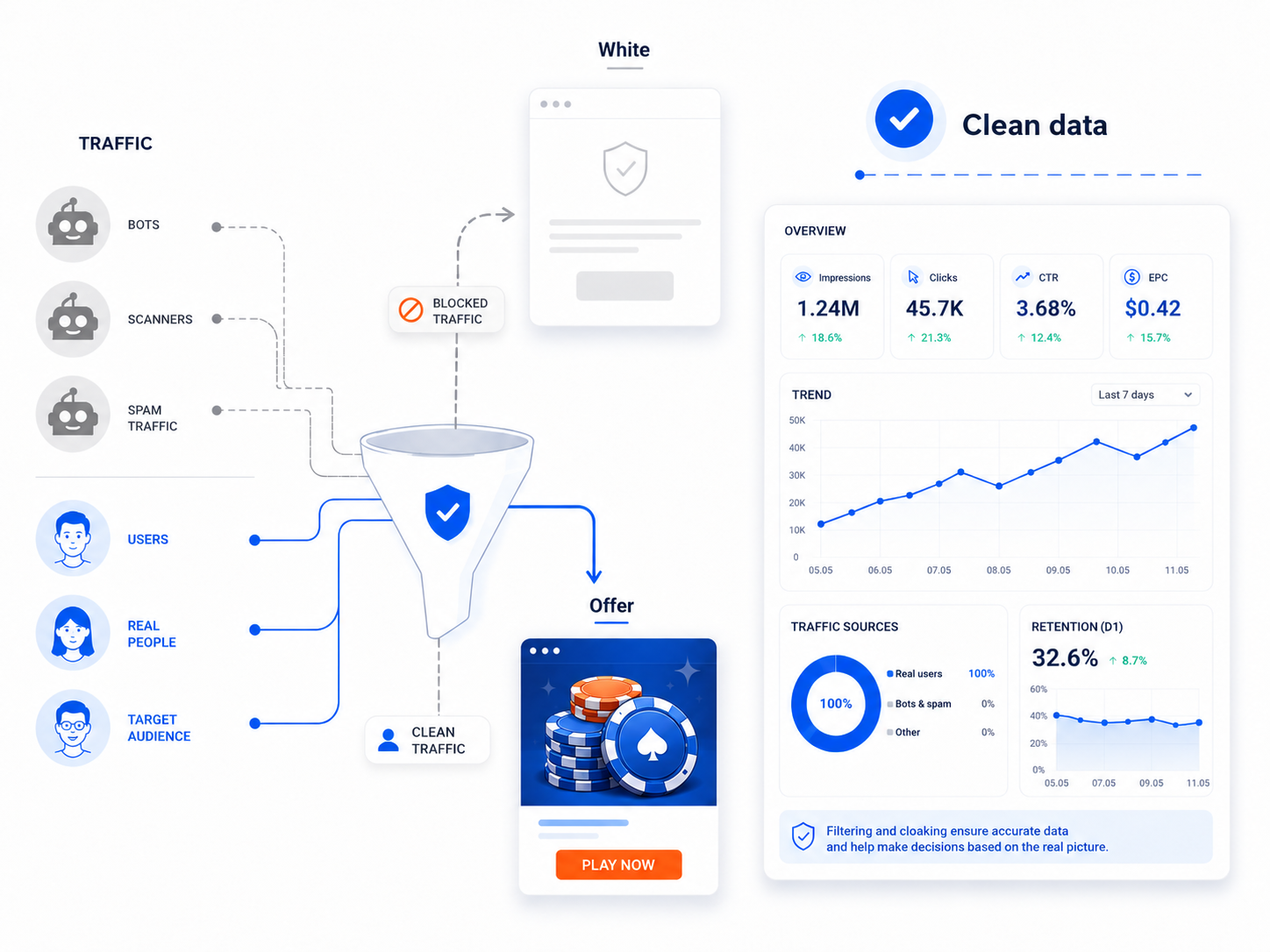 When working through cloaking services, such as Cloaking.House, the affiliate marketer has an additional layer of control over which audience and what traffic see the real offer, and which users - a safe white page.
This allows to more accurately analyze the behavior of precisely the target audience without distortions from bots, moderators and non-targeted traffic, which often "noise up" the statistics and prevent from noticing the real creative burnout in time.
When traffic filtering is set up correctly, the metrics of CTR, CPA and impression frequency reflect the actual behavior of live users, and not a mixture of bots and moderator checks.
This makes the diagnosis of creative burnout more accurate and allows to make decisions on rotation based on reliable data, not guesses.
Short checklist for diagnosing creative burnout
- CTR steadily declines for 3-5 consecutive days with unchanged targeting.
- Frequency has grown above 4-6 impressions per user.
- CPA/CPL grows with the same traffic quality.
- Engagement falls with a stable reach.
- The drop occurs gradually, rather than sharply and instantaneously.
- Moderation, landing page and offer have not changed over this period.
- The dynamics are not explained by seasonality or external factors.
If at least 3-4 items from the list match - with a high probability you are facing exactly burnout. It is time to launch the rotation or update of the creative, without waiting for a further drop in metrics and an increase in the cost of result.
Where to find high-quality creatives?
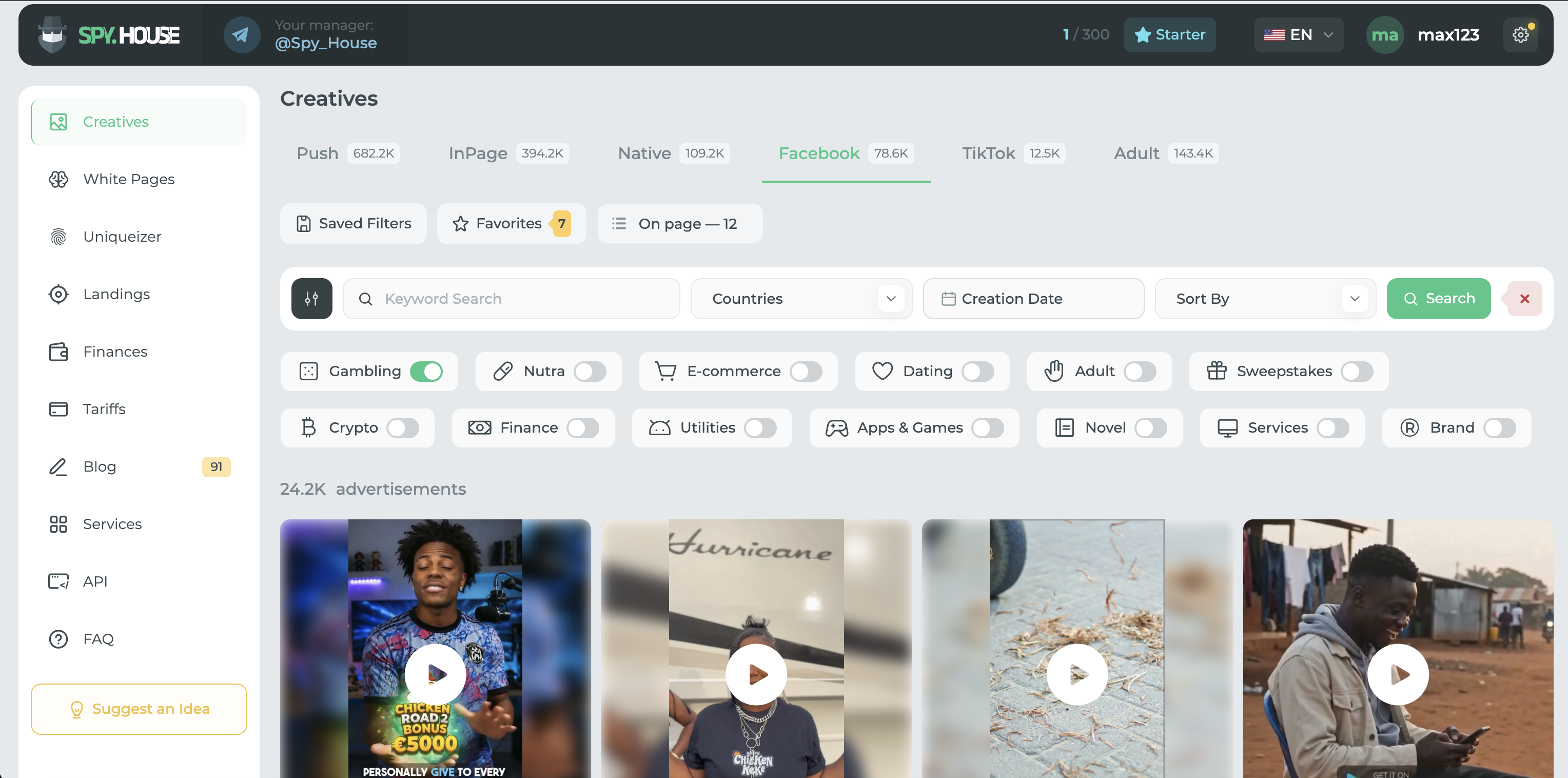 High-quality creatives for new launches can be found in Spy.House. The service helps to study current ads and competitors' creatives, find working approaches and ideas for tests, to faster prepare new variations and replace creatives that have already begun to burn out.
Conclusion
Creative burnout - is not an accident, but a natural stage of its life cycle. The ability to recognize it in time by specific metrics - CTR, Frequency, CPA and engagement - saves the budget and prevents the campaign from sliding into a loss.
Keep a pool of alternative creatives at hand, test new hypotheses in advance and rely on clean, filtered traffic data. Then the decision on rotation will be made on the basis of facts, rather than intuition.






Be the first to share your opinion!
We value your feedback — share your thoughts.