


You launched a campaign, the budget is draining, there are clicks, but conversions - zero. Or they are there, but the ROI is not even close to being positive. The first thought - a bad creative. The second - an evil algorithm. In fact, in most cases, the problem is deeper: the offer and the traffic source simply do not match. This is one of the most frequent and costly mistakes in affiliate marketing.
Below - specific signs by which this can be recognized, and the logic that will help not to drain the budget in vain.
What does "the offer does not fit the source" even mean
A traffic source - is not just a channel for delivering clicks. It is an environment with a specific audience, behavioral pattern, level of awareness, and purchase intent. Facebook, Google Ads, TikTok, push networks, native advertising - each of them has its own user "temperature".
The offer, in turn, requires a certain type of user: some convert better from cold traffic (nutra, adult), others - only if a person is already looking for a solution (finance, loans, high-ticket products). When these two systems do not match in expectations - the money burns.
Sign 1: CTR is high, but CR is near zero
If the ad is clicked willingly, but no one leaves a lead on the landing page - the audience came "for the wrong thing". This is a classic for Facebook and TikTok, where the algorithm drives traffic based on engagement, not intent. A person clicked out of curiosity, saw a serious financial offer - and closed the page.
 What this means: the source generates entertainment or impulse traffic, and the offer requires a thoughtful decision. Typical examples - loans, real estate, B2B services on Facebook without a warm-up. These offers work better in Google Search, where a person is looking for a solution themselves.
Sign 2: High bounce rate on the landing page (over 80%)
The user arrives and leaves in 3-5 seconds. This indicates not a mistake in the landing page itself, but a mismatch of expectations: what they saw in the ad and what met them on the page - are different things in tone, audience, or topic.
 Push traffic converts well into offers with a simple, quick action: download, get a bonus, register. If you drive a push user to a multi-step microloan form - they will leave. Not because the landing page is bad. It's just not their thing.
Sign 3: Moderation bans campaigns from the first hours
This is a slightly different kind of signal, but also important. If Facebook, Google, or TikTok systematically block ads even at the launch stage - perhaps the offer niche is incompatible with the platform's requirements.
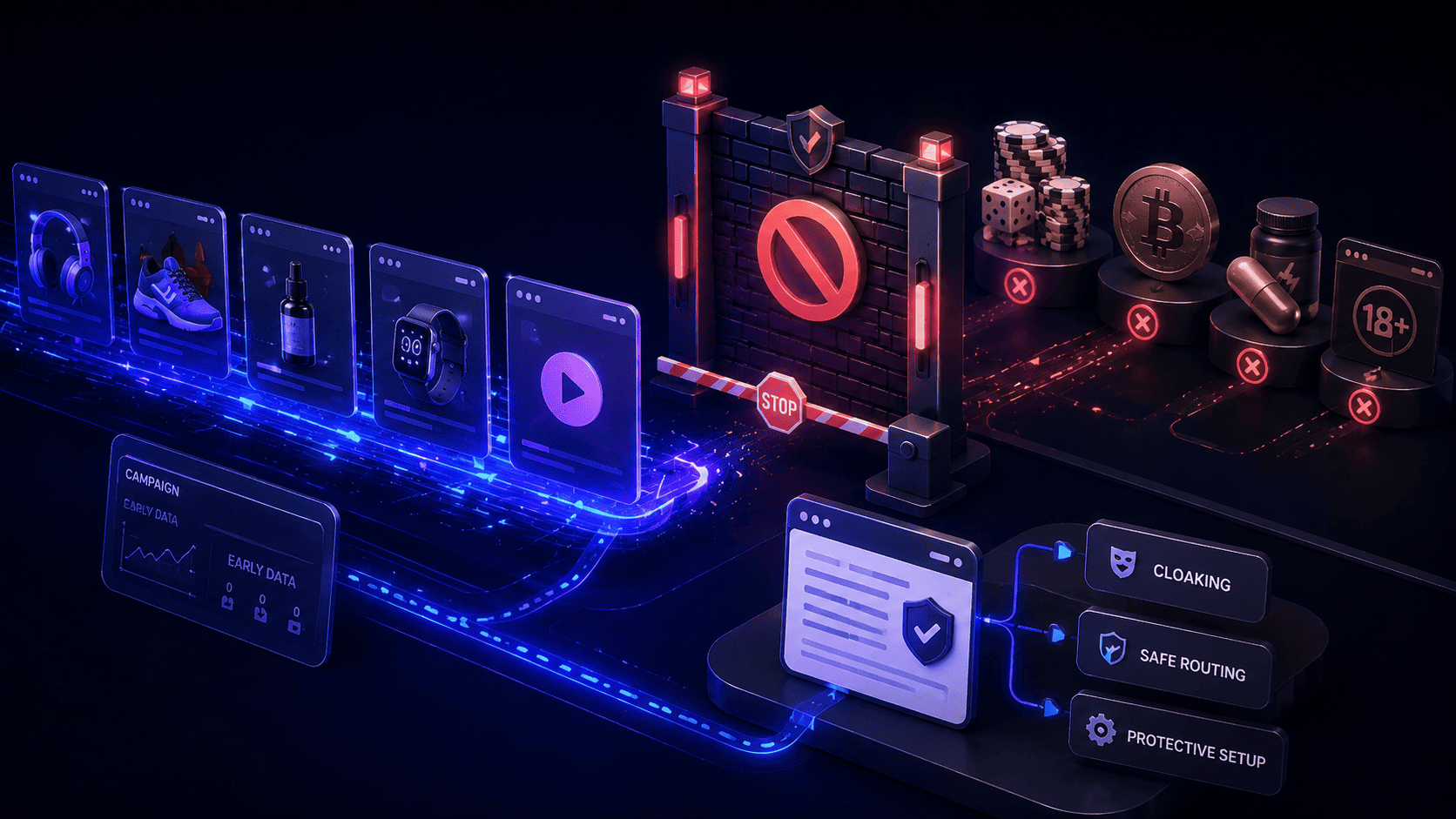 Gambling, betting, adult, some nutra, and crypto offers are directly banned on most mainstream platforms. Without cloaking, they do not survive there at all. If you launch such an offer without a protection infrastructure - moderation will kill the campaign before you collect any statistics at all.
The solution here is two-sided: either change the source (for example, move to native networks, which are more loyal to "gray" niches), or build the correct infrastructure with Cloaking.House, White Pages, and warmed-up accounts.
Sign 4: CPA is growing, but volume - is not
Imagine: the first 10 conversions came out at $8, the next 10 - already at $18, then at $30. The algorithm has exhausted the "cheap" audience segment and started climbing into where conversions are worse. This means that the intersection of the source's audience with the offer's target audience - is narrow. Scaling is unavailable.
Most often this happens when taking a very niche offer and trying to run it to a broad audience on Facebook or TikTok. Highly specialized products - medical services, professional tools, complex financial products - simply do not have a sufficient volume of target users in entertainment sources.
Sign 5: GEO does not match the audience level
The offer is designed for Tier-1 (USA, UK, Germany) - with a high average order value, certain payment habits, and a specific purchasing mentality. But the traffic is driven from Tier-3, because it is cheaper. As a result, the CPL is pennies, there are many leads, but the approval rate in the CPA network - is 5-10%, because the leads are non-targeted.
This works in the opposite direction too: offers designed for a low-income audience convert poorly in expensive Tier-1 traffic simply due to a mismatch in price perception.
Before launching, always look at what GEO the offer is tailored for - country, income level, payment system, language. Affiliate networks often provide this information in the offer card.
Sign 6: The vertical contradicts the source format
Each source has its "native" verticals. TikTok - is impulse purchases, dating, adult with the right infrastructure, nutra with viral creatives. Google Search - commercial queries, finance, loans, legal services. Facebook - broad reach, good for nutra, gambling, betting if cloaking is present. Native advertising - dating, nutra, news offers.
 If you launch a legal services offer on TikTok - it is a deliberately complicated story. Not because it is impossible, but because the user there is not in the right mood and not with the right intent. The conversion will cost several times more than in Search.
Sign 7: The gap between expected and real EPC
EPC (Earnings Per Click) - is one of the main guidelines when choosing an offer for a source. If the affiliate network claims an EPC of $1.2, and your real one comes out to $0.15 - it is not just bad targeting. Most often this is a traffic mismatch: a different GEO, a different type of device or a different audience "temperature".
Look at the EPC metrics in cross-section: what traffic source other affiliates used for this offer. Ask the affiliate manager directly - where the conversions are coming from. This will give a guideline faster than wasting the budget on testing yourself.
How to act if you found a mismatch
Step 1. Test the hypothesis with a minimal budget. Do not spend $500 to "see what happens". $50-100 on a narrow audience will already give a signal on CTR and initial CR.
Step 2. Check the source against the offer requirements. Affiliate networks usually indicate the allowed traffic sources. Violating these conditions - is not only a budget drain, but also a risk of leads not being approved.
Step 3. Evaluate the audience temperature. If the offer requires a "hot" intent - look for a source with commercial intent (Search, SEO). If the offer works on impulse - a broad reach source is needed (Facebook, TikTok, push notifications).
Step 4. Take into account the platform limitations. For "gray" niches - gambling, betting, nutra, adult - mainstream sources require cloaking and a properly built infrastructure: warmed-up accounts, quality proxies, a strong White Page. Without this, campaigns will not live to see the first data.
Step 5. Use spy tools. Look at how competitors are running similar offers: what creatives, what landing pages, in what source. This gives a quick answer - whether this combination works for anyone else at all.
Summary
The mismatch of the offer and the traffic source - is not a newbie mistake, it is a systemic problem faced at all levels. The main thing - is not to look for the reason only in the creatives or audience targeting, when the matter is in a basic mismatch of the purchasing logic.
A proper combination looks like this: the right user → in the right mood → meets the right offer. When at least one of the three does not match - the money goes nowhere. The sooner you notice this through metrics, the less you will lose.




Be the first to share your opinion!
We value your feedback — share your thoughts.