



In traffic arbitrage, almost everyone knows how to run tests. The real problems begin not at the start, but at the moment when the winning combination has already shown results and needs to be scaled. This is exactly where many teams lose money: they pour in more budget, expand the number of accounts, duplicate working creatives, enter new GEOs — and suddenly experience a drop in ROI, an increase in bans, payment chaos, and a complete loss of control over the combination.
Therefore, the main question is not: how to pour more money into advertising, but rather: how to properly scale a winning combination in traffic arbitrage without breaking what is already working. Scaling is not an "increase budget" button. It is a transition from manual mode to a system where the growth of traffic, expenses, and the number of entities does not destroy manageability.
Advertising platforms have an important feature: sudden changes in the budget and campaign structure can affect delivery, optimization, and result stability. Meta warns: if you drastically change the budget or other important settings, the ads may start changing their algorithms. Because of this, results often start to "float" and temporarily worsen. Google Ads specifically points out that frequent and sharp budget changes can affect the display and effectiveness of campaigns.
What scaling a winning combination actually means
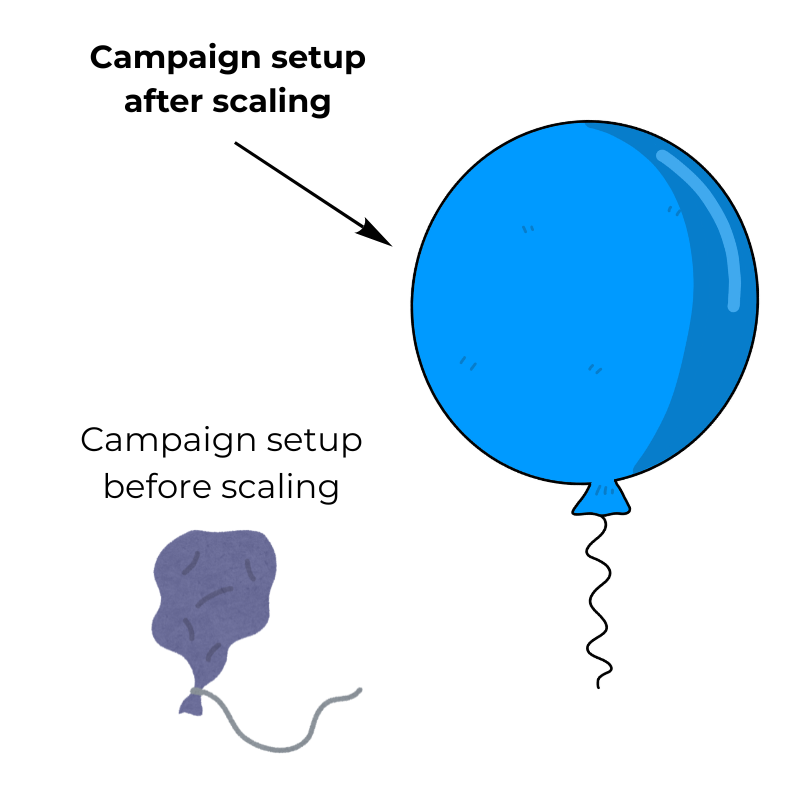
Scaling a combination is a situation where you can increase traffic volume, the number of accounts, the amount of tests, GEOs, or team processes without losing control over the result. In other words, a combination is considered scalable not when it is "run at large volumes," but when the growth does not turn into a mess.
In practice, scaling most often goes in several directions at once. First — scaling by budget: when you carefully increase expenses on a working campaign**. Second —** scaling by accounts: when one working mechanic is deployed across a larger number of accounts. Third — scaling by creatives and angles: when instead of one winning pitch, you build a whole assembly line of variations. Fourth — scaling by GEO: when a working model is transferred to new countries or regions. Fifth — scaling by team: when other media buyers, farmers, designers, and operations staff join the campaign management.
The mistake of many media buyers is that they try to scale only one layer — for example, the budget — and ignore everything else. As a result, the combination hits a ceiling not because of the offer, but because of the infrastructure.
Why even a good winning combination breaks during growth
While volumes are small, the system relies on manual control. One media buyer remembers which card paid for which account, where the limit was set, which creative was run on this account, which landing page was used, and where there were already moderation problems. But when you work in a team, memory and manual control come to an end.
Usually, five zones break down during scaling.
Analytics. If tracking is set up poorly, you stop understanding which source, account, creative, landing page, or traffic segment is actually bringing in money. With traffic growth, the correct data collection and reporting become key.
Creative part. When a combination grows, creative burnout accelerates. What yielded a profit at one volume can quickly get fatigued at another. If the team lacks a creative assembly line, scaling stops.
Launch infrastructure. This includes domains, cloaking, a high-quality white page, anti-detect browsers, proxies, warmed-up accounts, and everything that keeps the combination in working order. The higher the volume, the harder any weak link begins to hit the entire system.
Payment architecture. This is where chaos most often begins. Shared cards, mixed expenses, unclear limits, manual transfers between teams, linking multiple accounts to a single payment instrument — all this turns into a systemic problem during growth.
Operational work. Who is responsible for what, who tops up balances, who monitors limits, who tracks deviations, who turns off ineffective campaigns. Without this, scaling turns into an expensive show.
How to properly scale a winning combination: the basic principle
The main principle sounds simple: you must scale not the winner, but the system around the winner.

If a combination yields a profit, you shouldn't immediately pour three times more budget into it. First, you need to understand why it works: due to the creative, a specific GEO, a specific traffic segment, a successful offer, cheap CPM, account quality, a well-chosen funnel, or a combination of all factors. And only after that should you scale it, not blindly, but step by step.
Both Meta and Google recommend avoiding too frequent and sharp changes in running campaigns, because this can disrupt optimization algorithms. In arbitrage language, this means a simple thing: when a combination starts working, you shouldn't choke it with unnecessary edits every couple of hours.
Scaling by budget: why "pouring more in" is not a strategy
The most primitive mistake is to increase the budget sharply and expect the campaign to yield the same result at a larger volume. In reality, advertising systems do not always scale linearly. A combination that was profitable at one volume loses its effectiveness at another.
Therefore, budget scaling must be controlled. Not the logic of "yesterday it was plus 30%, today we pour in three times as much," but the logic of "we increase the load in steps, look at the cost per result, frequency, conversion quality, approval rate, and actual unit economics."
As for Google: the system explicitly states that budget changes affect how often ads are shown and how much the system can spend, while the average daily spend may fluctuate. This is another reason to look not only at the set budget but also at the actual unit economics by days and weeks.
Scaling by accounts: where serious affiliate work begins
As soon as a combination is confirmed, the next logical step is to spread it across accounts. This allows you not to keep the entire volume on one account and not to depend on a single point of failure. But a new problem arises here: accounts start multiplying faster than the team has time to maintain order.
This is exactly where the payment infrastructure becomes critically important. If several accounts are hanging on one card, you quickly lose transparency. It becomes unclear which account is actually spending how much, where a payment failure occurred, where there is overspending, where activity needs to be frozen, and where — conversely — accelerated.
That is why virtual cards in traffic arbitrage are not a "convenient minor detail," but a part of the growth architecture. They help not just to pay for ads, but to scale the winning combination without chaos.
Why virtual cards become mandatory during growth

While traffic is being driven by one person and at small volumes, an inconvenient scheme can be tolerated. But during scaling, the payment system becomes a separate circuit.
Firstly, virtual cards provide risk separation. There is no need to tie all accounts to a single payment instrument.
Secondly, they provide expense transparency. When a card is allocated for a specific task, you understand faster where money is actually working and where it is burning up.
Thirdly, they provide team manageability. You can logically distribute expenses by media buyers, directions, platforms, offers, and GEOs.
Fourthly, they allow you to separate all associated costs into a distinct layer: trackers, anti-detect browsers, proxies, AI services, infrastructure subscriptions, and other digital tools. Arbitrage has long consisted of more than just paying for traffic.
How flexcard helps here
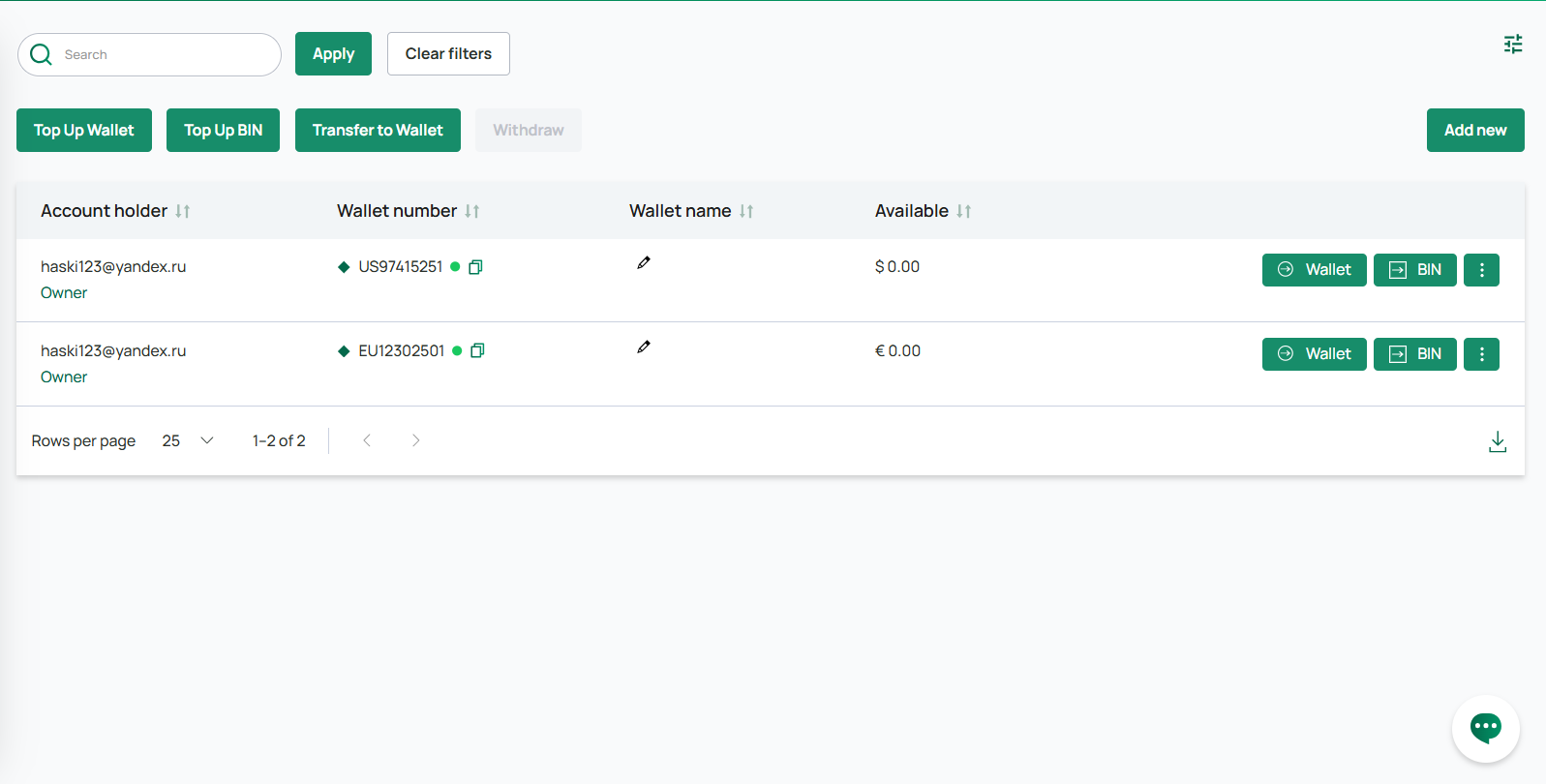
If you look at scaling as a system, flexcard solves a clear practical task: it helps distribute expenses across accounts, teams, GEOs, and tasks so that as volumes grow, control over payments is not lost. This is convenient when you need to issue virtual cards for different work scenarios, avoid mixing budgets, and manage the financial part of the combination faster. Additionally, the service provides a choice of BINs from different countries, multiple top-up methods, and flexibility in using cards not only for advertising accounts but also for other foreign services.
This is exactly the case when a payment service is useful not in and of itself, but as an infrastructure element. It does not "scale the combination" instead of the team, but it allows you to eliminate one of the most frequent stop-factors of growth — financial chaos.
Why one payment system is not enough
But payment architecture is only half the issue. The second half is the stability of the combination itself. You can perfectly distribute accounts across cards, but if moderation sees what it shouldn't see, if bots and unwanted traffic go to the wrong place, if the White Page is not of high quality, scaling will quickly hit a wall of bans and instability.
The flexcard + Cloaking House combination looks organic here: one service covers the financial side of scaling, the second — the technical stability of the launch. Infrastructure logic - means that volume growth requires not only working creatives and an offer, but also a clear payment system, expense distribution, traffic filtering, and protection of the combination from unnecessary risks.
What a proper campaign scaling scheme looks like
A normal scheme is usually built like this.
First, the team finds a winning combination that holds the result at a test volume.
Then it brings order to analytics: understands which segments bring in money.
After that, it carefully expands the selection of creatives, instead of squeezing one creative to death.
Next, it spreads the volume across advertising accounts, so as not to sit on a single point of failure.
In parallel, it builds the technical infrastructure: domains, cloaking, white pages, anti-detect browsers, proxies.
And on top of that, it overlays the financial structure: separate cards for accounts, media buyers, GEOs, stable combinations, and tests.
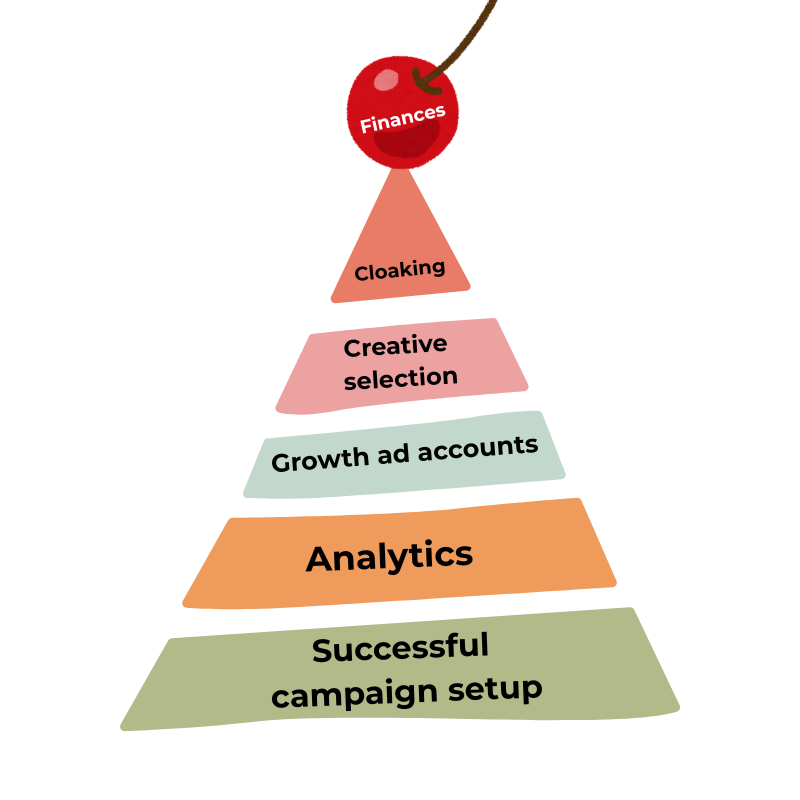
This is exactly the approach described in the attached material: not one card for the entire project, but for a specific task — for an account, a media buyer, a GEO, tests, stable combinations, ads separately, and services separately. This allows a growing team to avoid losing money out of nowhere.
Conclusion
If you answer the question of how to scale a setup properly, the answer is this: do not try to simply increase spend. You need to scale analytics, the creative funnel, ad accounts, traffic protection, payment structure, and team operations simultaneously.
A setup stops being a “successful launch” and becomes a system only when you can increase volume without panic, manual chaos, and blind decisions. This requires clear tracking, careful budget work, an understanding of ad algorithm limitations, stable technical infrastructure, and sound financial architecture.
That is why scaling in traffic arbitrage is always a matter of systems. And in this system, it makes sense when Cloaking House is responsible for traffic stability and filtering, while flexcard helps distribute and control financial load without chaos. This approach does not look like a random набор of tools, but like a strong infrastructure on which a setup can truly grow.






Be the first to share your opinion!
We value your feedback — share your thoughts.