



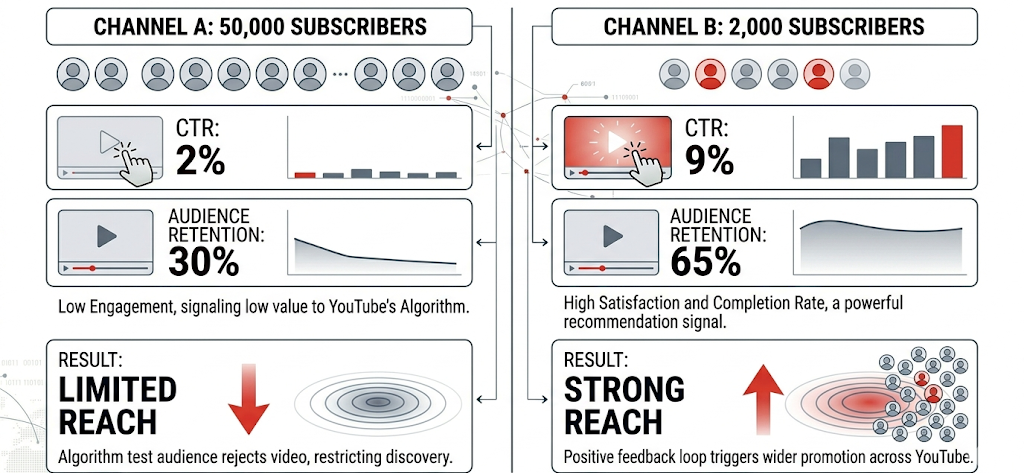
Most advice on growing a YouTube channel still portrays the number of subscribers as the main metric. On the platform itself, this is actually one of the least important signals. A channel with 50,000 subscribers and a 2% CTR (click-through rate) gets less reach than a channel with 2,000 subscribers whose videos viewers watch to the very end. Understanding why this happens, and which metrics actually influence recommendations, is the difference between blind guessing and real, calculated growth.
Below is a breakdown of which signals YouTube values most in 2026, how monetization thresholds actually work, and where creators most often unconsciously sabotage their own channel development.
Signals That Actually Drive Recommendations
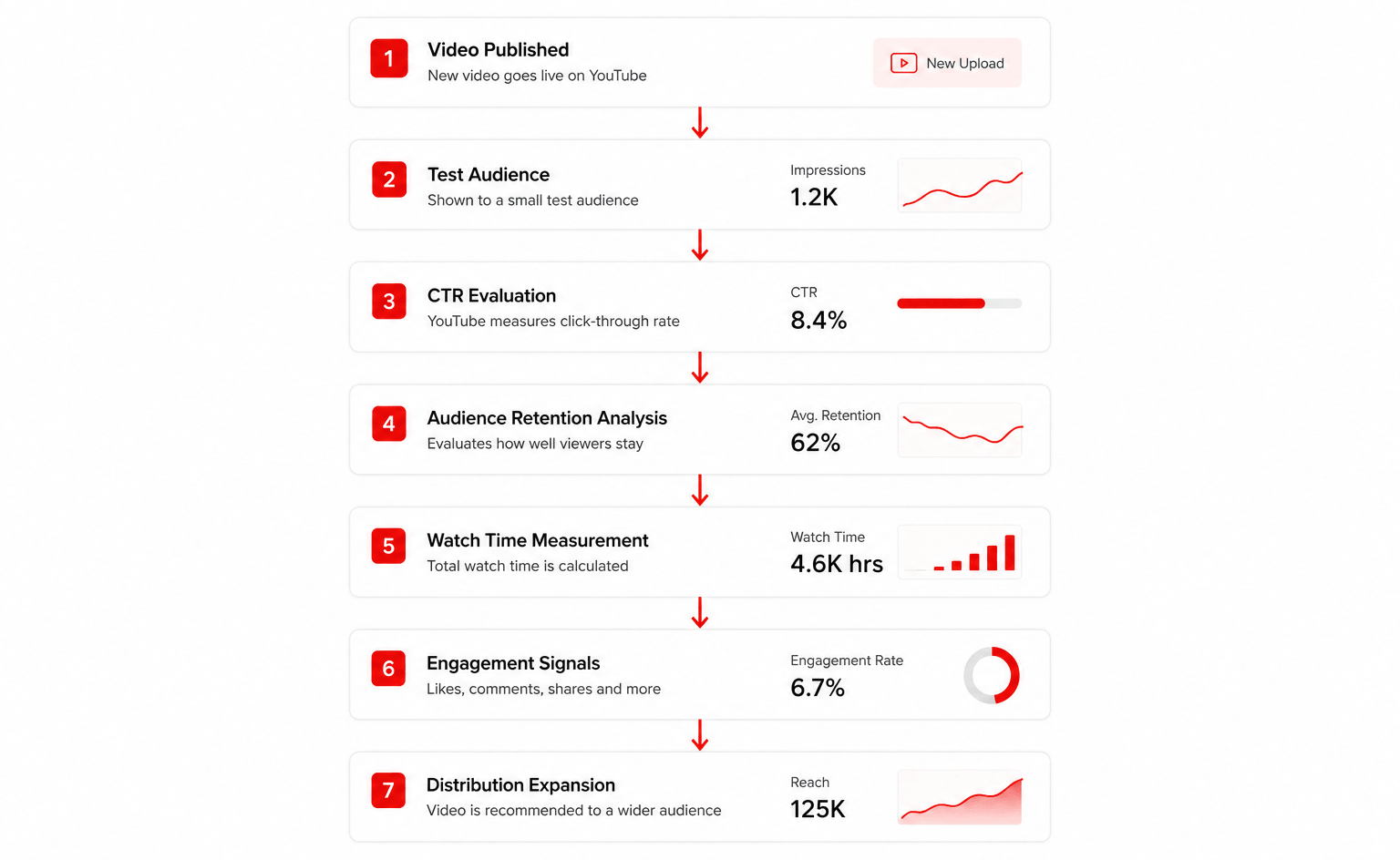
The YouTube recommendation system does not reward any single metric in isolation. It reads the relationship between them. The highest weight is given to four signals:
Average view duration and total watch time. This is the foundation of the entire system. YouTube's published guides have consistently stated for years that watch time and viewer satisfaction influence recommendations far more than any "vanity metrics." A video that holds attention tells the algorithm it is worth showing to more people.
Click-Through Rate (CTR). This is the metric creators underestimate most often. YouTube shows your thumbnail and title to a small test audience, measures what percentage of users click, and uses this data to decide on expanding distribution. A brilliant video with a weak thumbnail limits its own reach before anyone watches even a single second. Increasing CTR is often the most effective change a creator can make.
Engagement velocity in the first hours. How quickly a new video gains YouTube views, likes, and comments compared to your channel's norm signals early traction. This is why the first few hours after publication carry disproportionate importance for video promotion.
Subscriber-to-view ratio. YouTube monitors how many of your subscribers actually watch new videos. When this ratio drops, the platform views it as a sign that your content is not resonating and cuts impressions which is exactly why an inflated subscriber count can have the opposite effect on YouTube ranking.
Conclusion: These signals must align with one another. A video with 10,000 views, zero likes, and no watch time does not look successful to the algorithm. It looks like artificial manipulation, and the platform treats it accordingly.
The Cold Start Problem
Every new video starts from zero, and zero is both a psychological and an algorithmic barrier. Real viewers hesitate to click on videos with single-digit view counts, and the algorithm lacks early data to decide whether it's worth promoting. This is the cold start problem, and it is a major reason why creators experiment with giving new uploads an initial boost.
The principle behind any such boost is simple: overcome the cold start barrier without creating an imbalance among YouTube metrics. A small, proportional increase in early engagement can push a video into the algorithm's test pool, ensuring real viewers see an active video instead of an empty one. The mistake lies in being one-sided: a spike in a single metric without the support of the others is the most obvious red flag detection systems look for.
Monetization Math with Real Numbers
The main reason creators chase metrics is YouTube monetization, so it is worth defining the thresholds precisely rather than relying on outdated figures.
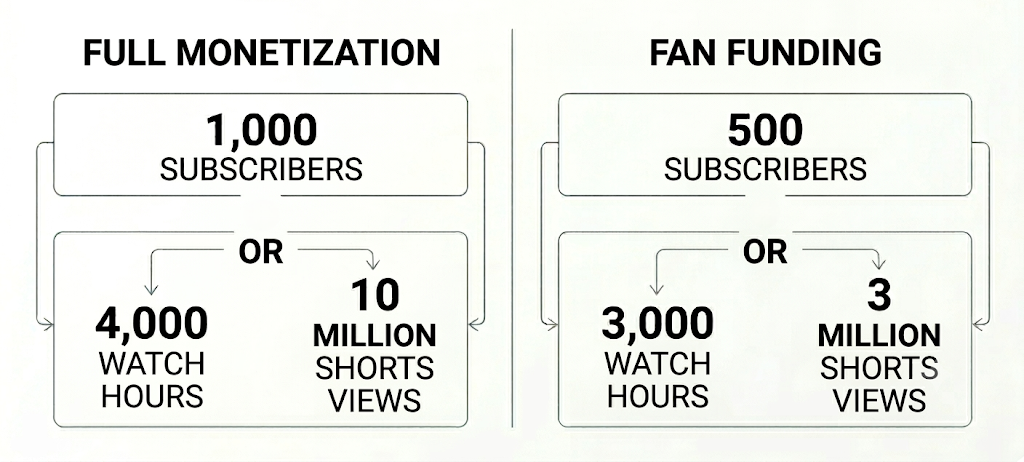
According to the published requirements of the YouTube Partner Program, the standard tier (full ad revenue, including pre-roll, mid-roll, and display ads) requires 1,000 subscribers and either 4,000 hours of valid public watch hours within the past 12 months, or 10 million valid public Shorts views within the past 90 days. You only need to meet one of these two conditions, not both.
There is also a lower tier for "Fan Funding" which unlocks access to Super Thanks, channel memberships, and Super Chats. This requires 500 subscribers and either 3,000 watch hours over 12 months, or 3 million Shorts views over 90 days, along with three public uploads within the last 90 days. Approval typically takes up to 30 days after meeting the requirements.
Two things creators regularly get wrong:
Shorts watch time does not count toward the 4,000-hour threshold for long-form videos. Shorts have a separate path of 10 million views. A channel that only publishes Shorts cannot use the watch hours path at all.
The 4,000 hours is a one-time qualification requirement, not a recurring one. Once approved, you do not need to maintain a specific amount of watch hours to stay monetized.
For most channels, the 4,000 watch time requirement is the harder barrier; subscribers usually come faster than steady watch time. Because of this, many creators turn to specialized sites to buy YouTube watch hours such as NLO SMM to fill this gap, though it is crucial to clearly understand what this can and cannot achieve, which brings us to the next point.
What Purchased Figures Can and Cannot Do
There is an honest version of this conversation that most sellers of "buy subscribers" services avoid. Purchased subscribers and views can help you cross the compliance line for example, the 1,000-subscriber barrier. What they cannot do is make the algorithm look favorably upon your content.
Subscribers who never watch your videos lower your subscriber-to-view ratio, and YouTube interprets a low ratio as proof that your content is uninteresting. Thus, a channel that artificially inflates its subscriber count without backing it up with real, engaging videos can end up with even worse distribution than one that grew slowly. Figures help overcome thresholds; audience retention on genuine content is what sustains the algorithm's interest. Anyone claiming otherwise is trying to sell you something, not give advice.
What YouTube Actually Detects
The platform's monitoring system is not looking for the abstract fact of inflated numbers; it targets specific patterns. Audits are consistently triggered by three signals:
A single IP address range. Views or subscribers coming from a tight IP range look coordinated.
Time-based spikes. Hundreds of accounts subscribing within the same short window is a sign of coordination.
Lack of engagement. Accounts that subscribe but generate zero views, likes, or comments anywhere else on the platform are gradually identified and removed during audit cycles.
This exact mechanism is behind the familiar complaint: "the numbers dropped after 24 hours"; low-quality manipulation via botnets is caught and reversed. The patterns that survive look like natural discovery: diverse IP sources, distributed timing, and accounts that maintain real activity beyond a single action.
Mistakes That Quietly Stifle Channel Development
Treating numbers as a substitute for content. This is the most expensive mistake. Inflated metrics on a channel with weak, inconsistent content make every ratio worse, not better.
Buying or creating a metric imbalance. A high view count with almost no likes or comments creates the exact imbalance that triggers a red flag in the detection system. Engagement must be proportional.
Ignoring CTR while obsessing over views. You can put massive effort into a video that the algorithm never tests on a wide audience because the thumbnail isn't getting clicks. Test your thumbnails just as you would test advertising creatives.
Inconsistency in uploads. No tactic, paid or organic, compensates for an irregular upload schedule. The algorithm rewards channels whose behavior it can predict.
Chasing the wrong threshold. A creator focused on Shorts who tries to cross the 4,000 watch hours threshold is chasing a figure their content is not designed to produce. Align your monetization path with the type of content you actually create.
One-Sentence Version
The YouTube algorithm ranks viewer satisfaction, not creator vanity. Watch time, CTR, and the consistency of your metrics determine your reach, and any growth tactic only works when it supports genuinely engaging content, rather than trying to replace it.






Be the first to share your opinion!
We value your feedback — share your thoughts.