



If you work with traffic at scale, you know: campaigns don’t stop because of weak creatives—they stop because of payment issues.
Payment declines, additional verifications, BIN blocks, “transaction declined” errors, delayed fund settlements, expense confusion, and uncontrolled team actions can wipe out profits in a single day.
This article explains how to build a resilient payment infrastructure for media buying and why Vmcard can be a practical solution when speed, structure, and transparency are required.
Why the Payment System Becomes a Vulnerable Link
Even with stable traffic, the payment layer often turns out to be the weakest part of the operational system.
1. Payment declines
Payment systems and merchants use automated risk assessment mechanisms.
They are sensitive to:
sudden spending spikes,
unusual charge patterns,
mismatched payer profiles,
country-specific rules or BIN ranges.
As a result, otherwise valid ad activity can be stopped due to technical limitations.
2. Balance management issues
Funds are topped up but not settled on time.
Multiple campaigns use the same card and unexpectedly drain the balance.
Subscriptions charge simultaneously, blocking critical services.
This is not a traffic error—it is weak financial architecture.
3. Lack of expense segmentation
When one card is used for:
ad accounts,
SaaS services,
cloud infrastructure,
automation tools,
it becomes impossible to quickly identify the source of a problem or correctly analyze expenses.
4. Insufficient team control
No role separation.
No standard card naming.
No regular transaction reconciliation.
No clear budget allocation workflow.
Result: hours spent investigating declines instead of managing scale.
What to Consider When Choosing a Virtual Card Provider
When selecting cards for media buying, focus not only on fees but primarily on manageability and stability.
Basic Requirements
| Criterion | Practical Value |
|---|---|
| Fast issuance of multiple cards | Ability to assign a separate card for each account or service |
| Transparent transaction history | Quickly identify problematic charges |
| Fast top-ups | Minimize downtime |
| Stable operation with popular merchants | Ad platforms, SaaS, cloud services |
| Team structure support | Controlled access and management |
Advanced Features for Scaling
| Feature | Why It Matters |
|---|---|
| Multiple BIN ranges | Increased stability with different platforms |
| Role-based access | Team action control |
| API integration | Financial process automation |
| Fast support | Reduce downtime in critical situations |
What Vmcard Is
Vmcard is a virtual card platform designed for cross-border spending: ad budgets, SaaS subscriptions, cloud services, and e-commerce tools.
The service is intended for spending only, not for receiving payments.
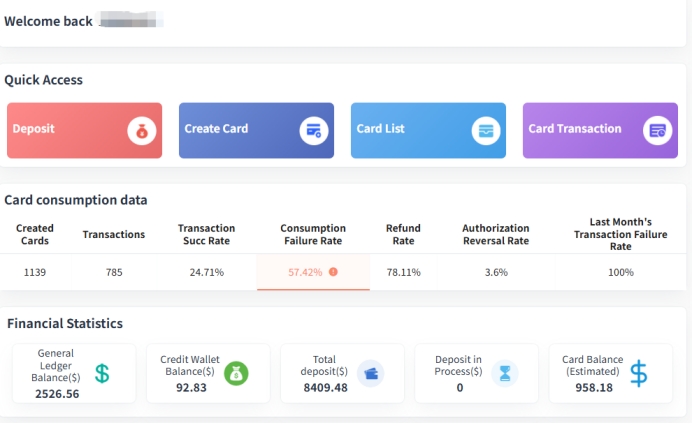
Teams use Vmcard to:
issue multiple cards for different purposes,
quickly top up balances (including via crypto methods such as USDT),
separate budgets by purpose,
maintain a clear view of all transactions.
Practical Vmcard Workflow
Step 1. Card Segmentation
Principle: one card = one spending unit.
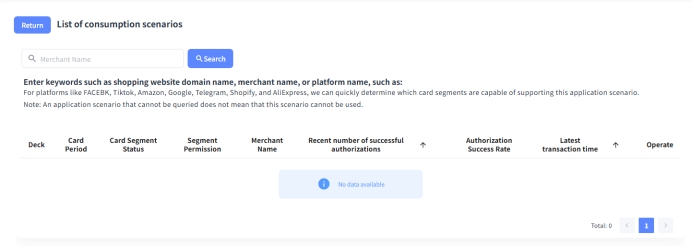
Examples:
separate card per ad account,
separate card per tool (tracker, proxy, anti-detect),
separate card per cloud provider,
separate card per client (agency model).
Step 2. Standardized Naming
Example structure:
GEO / Channel / Account ID / Owner / Month
US / TikTok / ACC3281 / Ivan / 02-2026
Additional tagging by:
channel,
geography,
business line,
risk level.
Step 3. Safety Buffer
Recommended:
keep a 3–7 day expense buffer on active cards,
maintain a centralized reserve,
top up cards before weekends and subscription billing dates.
Step 4. Weekly Transaction Reconciliation
Regular checks allow you to:
detect abnormal charges,
monitor unexpected recipients,
prevent repeated small unauthorized payments,
freeze cards immediately if risk is suspected.
Step 5. Role Separation
Minimum structure:
Responsible for card issuance,
Responsible for top-ups,
Operators with view-only access.
This reduces operational risk and simplifies audits.
Where Vmcard Is Most Effective
1. Ad Budget Stability
Separate cards for each ad account simplify diagnostics and reduce cross-account contamination.
2. Subscription Management
Isolating subscriptions prevents a failure in one service from affecting the entire stack.
3. Cloud Infrastructure
Dedicated cards for each cloud provider with a reserve prevent service interruptions.
4. Team Scaling
Centralized card management improves transparency and shortens response time to financial issues.
Conclusion
Media buying is not just about creatives and analytics. It also requires a resilient financial architecture.
If your payment system isn’t built for scale, it inevitably becomes a source of risk.
Vmcard provides a management-focused model: fast top-ups, multiple card issuance, and transaction transparency.
Properly built payment infrastructure is not an auxiliary tool—it’s a strategic advantage.






Be the first to share your opinion!
We value your feedback — share your thoughts.