


FB Storm is a state of unstable ad performance in Facebook and Meta, during which an affiliate marketer faces several problems at once: mass ad rejections, ad account restrictions, billing failures, spending drops, and sharp performance declines. In the affiliate marketing community, the term "Facebook storm" is used when the source starts operating unpredictably and usual actions stop producing the expected results.
Essentially, an FB storm is not a single error, but a combination of factors. The platform may increase automated moderation, change algorithm behavior, and revise its approach to evaluating creatives, landing pages, and account quality. For an affiliate marketer, it looks simple: ads were running yesterday, but today the same ads are getting rejected, spending poorly, or quickly hitting restrictions.
What an FB Storm Means for an Affiliate Marketer
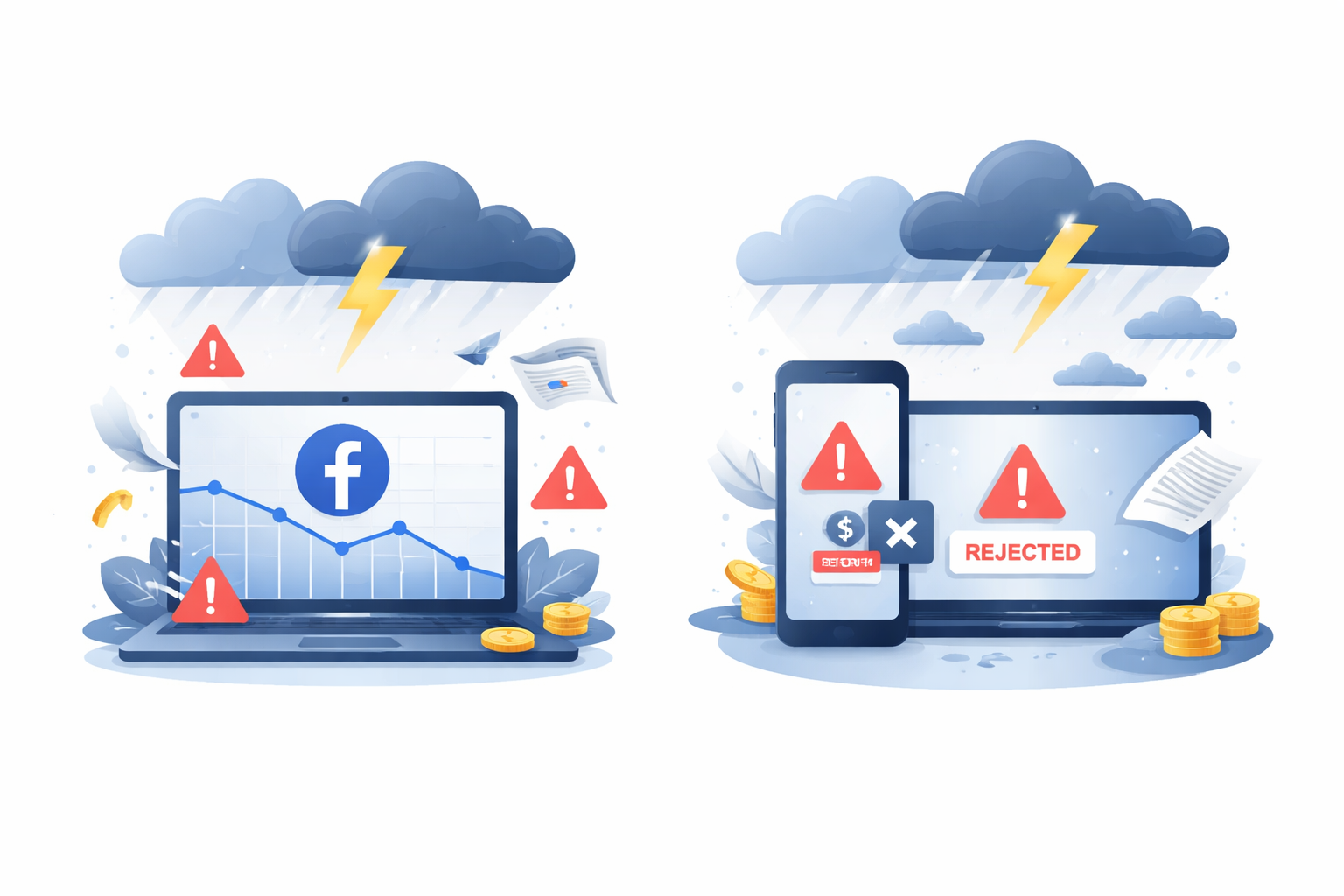 When a Facebook Ads storm begins, it affects not just the launch, but the team's entire operating system. Uncertainty grows sharply: it becomes harder to understand exactly where the problem lies — in the ad, the payment, the ad cabinet, the page, or in the launch logic itself. At this point, many start making the main mistake: chaotically relaunching campaigns, creating duplicates, sharply changing budgets, and jumping between accounts. This only increases instability and accelerates losses.
Therefore, the first principle is simple: you cannot act in a panic during an FB storm. You need to reduce the chaos and break the situation down into parts rather than increasing the number of movements.
Why a Facebook Storm Starts
The reasons for an FB storm usually lie in several dimensions at once. Firstly, there are changes within the platform itself: algorithm updates, increased moderation, and a revision of risk criteria. Secondly, there are problems on the advertiser's side: controversial creatives, aggressive copy, unstable payment history, and sharp actions within the account. Thirdly, there is a purely market factor: when many affiliate marketers start running similar approaches simultaneously, the platform tightens filters and sensitivity to suspicious behavior faster.
This is exactly why a Facebook storm for an affiliate marketer is a test not only of the "bundle" (funnel) but of the entire launch discipline.
Signs That an FB Storm Has Begun
Usually, a storm manifests through clear symptoms. Ads are rejected more often without visible logic. Campaigns may launch but fail to get normal spending. The number of restrictions on ad accounts and pages grows. Problems with payments and charges appear. Even working bundles start behaving weaker than usual.
If there are several such signals at once, it is no longer a single error, but a full-scale Facebook Ads storm.
What an Affiliate Marketer Should Do During an FB Storm
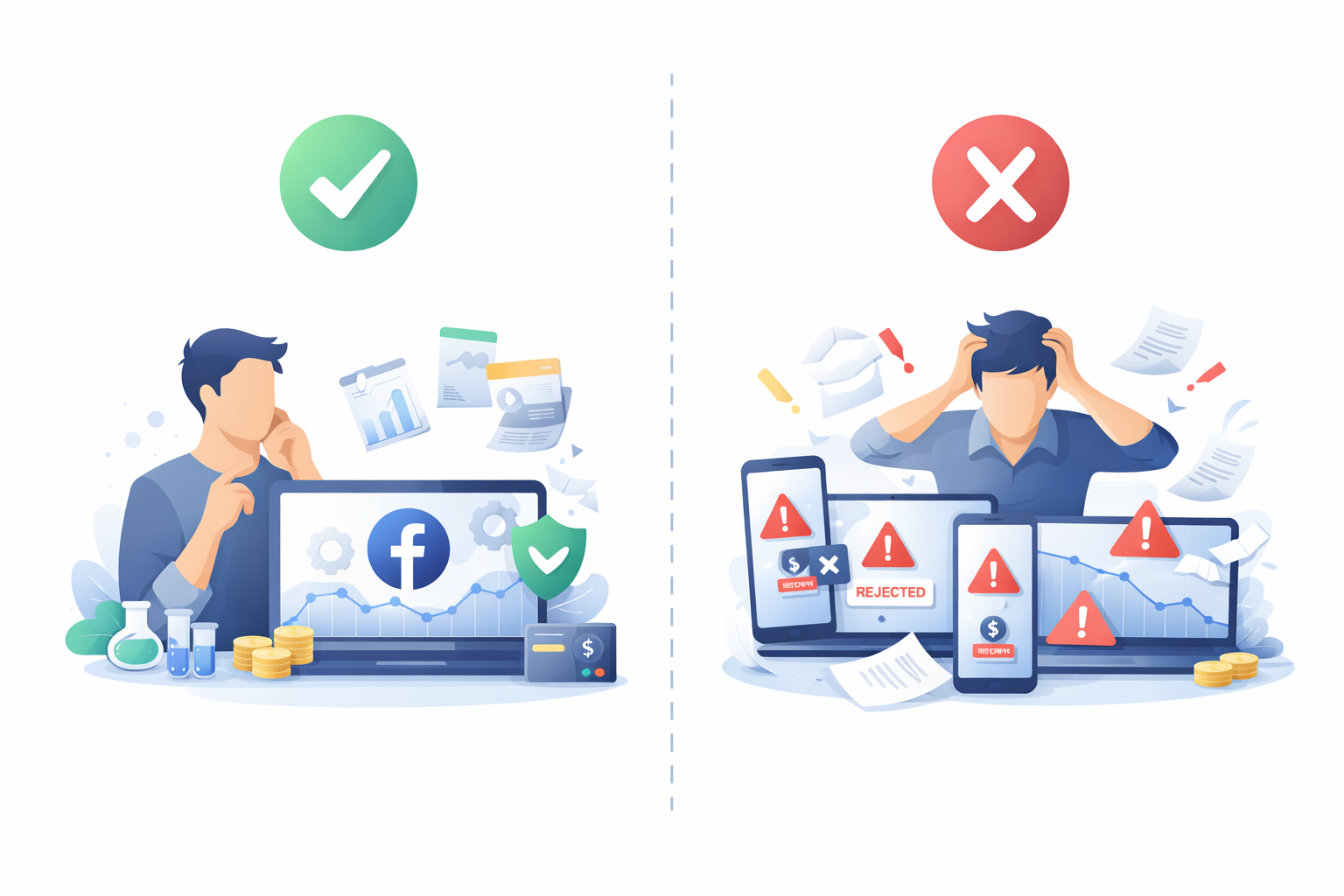 First — stop aggressive scaling. During a storm, you cannot try to push through volume by force. It is much more important to maintain control and understand exactly what broke.
Second — check the entire launch funnel step by step. You need to separate moderation problems from billing problems, and spending problems from account restrictions. Until this is broken down, any actions will be almost blind.
Third — simplify and clean up creatives. If an FB storm is underway, it is better to move away from controversial promises, sharp triggers, clickbait, and any wording that might increase the risk of rejection. The cleaner the approach, the higher the chance of passing through the period of turbulence with fewer losses.
Fourth — run small tests instead of aggressive launches. In a storm, the winner is not the one who does more launches, but the one who controls the signal better. Small, careful tests allow you to quickly understand where a working zone still exists.
Fifth — monitor infrastructure quality. Unstable payments, sharp changes, erratic behavior within accounts, and constant chaotic actions only increase the risk. Accuracy, consistency, and control are especially important during a storm.
What You Should Not Do During a Facebook Storm
The worst decision is to switch to "fuss mode." Do not endlessly duplicate campaigns, sharply jerk budgets, change all launch elements simultaneously, and try to solve a systemic problem with the quantity of actions. Such an approach does not cure the storm; it makes it more expensive.
Also, do not perceive the storm as a signal that you need to break the process for the sake of instant volume. On the contrary, an FB storm reveals weak points: messy operations, weak control over payments, poor launch structure, and sloppy work with advertising materials.
How to Survive an FB Storm with Minimal Losses
 The best approach is cold operational logic. Fix stable elements, remove unnecessary movements, and work from diagnostics rather than emotions. If there is a restriction, do not panic, but investigate the cause. If spending has dropped, do not jump between a dozen solutions, but test hypotheses sequentially. If rejections have increased, reassemble the approach and reduce risk.
The affiliate marketers who survive a Facebook storm are not the most aggressive, but the most composed. In such periods, it's not speed and boldness that matter, but precision, clean processes, and the ability not to break a working system with your own hands.
Conclusion
An FB storm is a period of instability in Facebook Ads when advertising, moderation, billing, and spending begin to work worse and more strictly. For an affiliate marketer, this is not a reason to increase chaos, but a signal to switch to a strict control mode. The main task is not to try to push the market by force, but to maintain manageability, reduce risk, and act step by step. It is this approach that allows one to pass through a Facebook storm without unnecessary budget drainage and without destroying the entire advertising infrastructure.






Be the first to share your opinion!
We value your feedback — share your thoughts.