


Facebook (Meta) remains the #1 traffic source for affiliate marketers, media buyers, and business owners. There is an audience for every vertical here: from e-commerce and nutra to gambling and crypto. But there is one problem — the auction is overheated, CPM (cost per 1000 impressions) is growing, and the cost per lead (CPL) sometimes breaks the profitability ceiling.
How do you plan your ad budget so you don't drain your deposit on the first day? Why does one affiliate get leads for $2 while another in the same niche pays $10?
In this article, we will break down the anatomy of Facebook pricing, show real numbers on screenshots from Ads Manager, and give working tips on how to lower traffic costs. Most importantly, we will figure out how account stability affects your final ROI.
How Ad Prices Are Formed: The Anatomy of the Facebook Auction
The foundation of FB Ads costs is the auction system. The mistake many beginners make lies in the thought: "Whoever pays more gets the impressions." It doesn't work that way on Facebook.
It is crucial for the social network's algorithms to keep users on the platform. If your ad annoys them — you will pay triple. If they like it — FB will give you a discount at the auction.
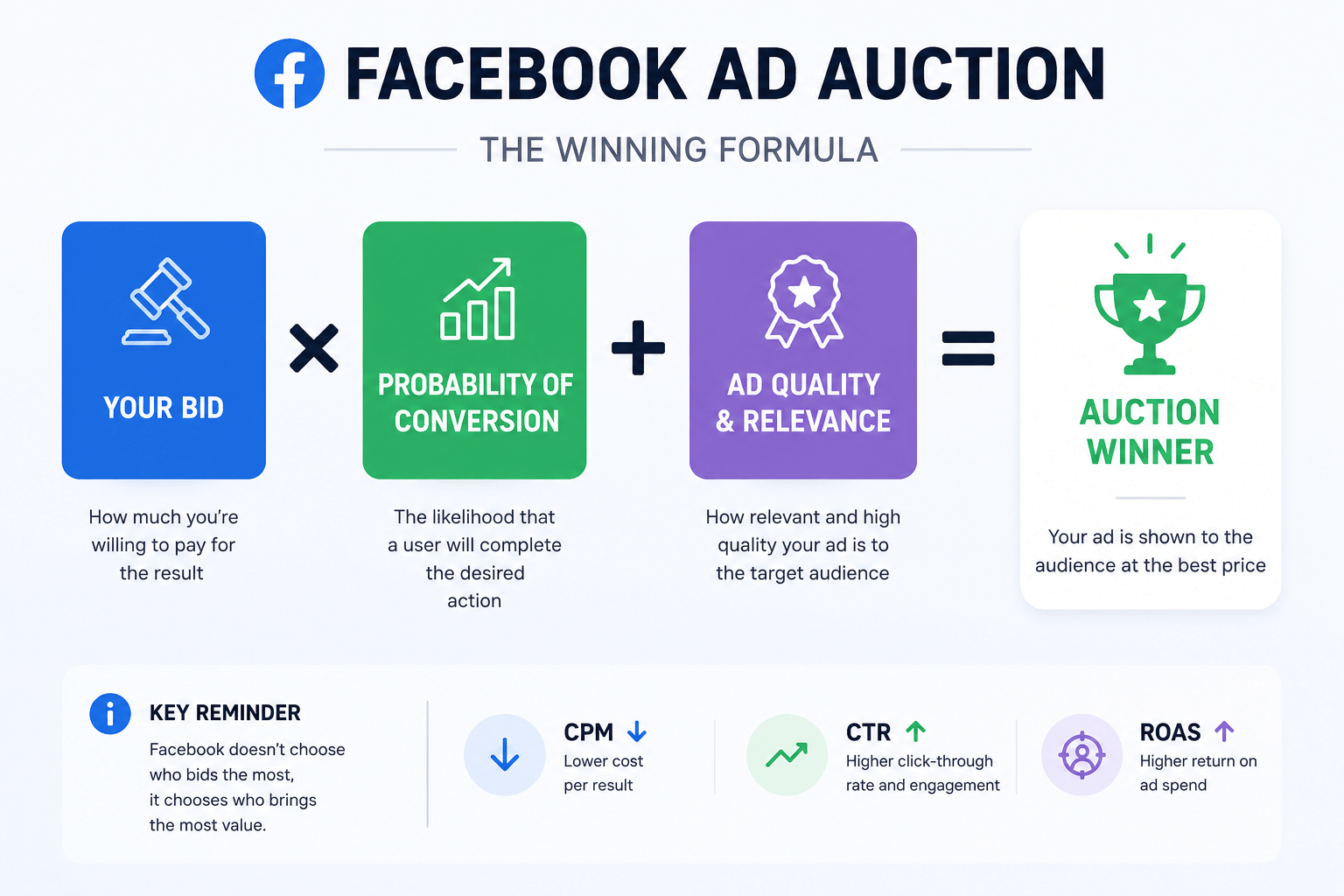
The formula for winning the Facebook auction looks like this:
Bid: The amount you are willing to pay for a targeted action (click, lead, purchase).
Estimated Action Rate: The algorithm's forecast of how likely a user is to click or convert after seeing your creative.
Ad Quality: If the creative gathers complaints, has a high bounce rate, or uses clickbait, its score drops, and your CPM skyrockets.
Conclusion: You can outbid a competitor with a budget 10 times larger than yours if your creative hits the exact pain point of the target audience.
Average Traffic Cost
Average market indicators are just an average value depending on the GEO. In Tier-1 countries (USA, Europe), CPM can easily be $15–$30, while in Tier-3 (Latin America, Asia), it stays around $1–$5.
Let's look at live statistics from our Ads Manager. The vertical is nutra (weight loss offer), GEO is Tier-2. The campaign ran for just a week, but the numbers speak for themselves.
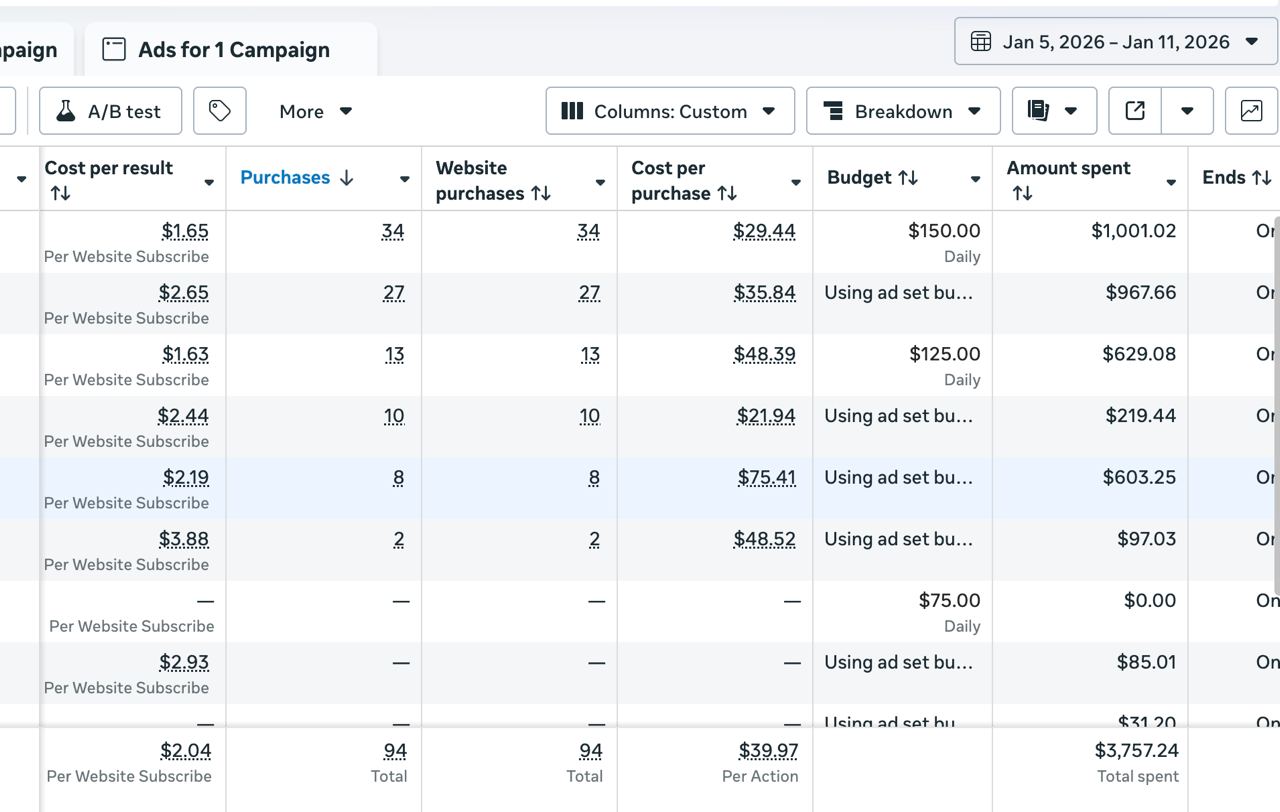
What we see on these screenshots:
Total Spent: $3,757.24 in a week.
Optimization Event: The campaign is set to collect leads/registrations (Website Subscribe). The average cost per subscription on the pre-lander turned out to be pennies — only $2.04.
Final Conversions (Purchases): 94 successfully completed purchases.
Cost per purchase: On average $39.97 (in the best ad sets, it even dropped to $21.94 - $29.44).
Calculating profit: In the global nutra market, under SS (Straight Sale) or Trial models, affiliate payouts easily range from $80–$120 for a confirmed order. With an average purchase cost of $40, we get a stable and very pleasant ROI.
Pay attention to the first line: the campaign stably spends $150 daily, bringing in 34 purchases at $29 each. This is an indicator that the Facebook pixel perfectly hooked the audience and passed the learning phase.
How to Lower Cost Per Lead (CPL) and Optimize Expenses
The cost per result is never set in stone. Even if a lead costs $15 today, you can knock it down to $7 by using the right levers.
1. Test Broad Audiences
Forget about detailed targeting with dozens of interests. In 2026, Meta's algorithms are so smart that the best targeting is its complete absence (selecting only GEO, gender, and age). Give the pixel freedom, and it will find buyers on its own. A broad audience always yields the lowest CPM.
2. Regularly Update Creatives
If you see the cost per purchase suddenly creeping up, and the Frequency has crossed 2-2.5 — your creative has burned out. The audience has stopped clicking on it, the CTR has dropped, and Facebook has automatically raised the cost of impressions.
3. Protect Your Funnel and Warm Up the Pixel
Many affiliates overlook this point, believing that traffic cost depends solely on settings inside the ad account. In reality, account stability is the main factor for cheap traffic.
How it works:
When you launch ads, the pixel spends its first 50 conversions on the "learning phase." During this period, leads are always the most expensive.
Once the pixel has learned, the price drops and stabilizes.
But if Facebook bots or competitors figure out your real landing page and the account gets banned (Policy) — everything burns to the ground. You will have to get a new account, a new pixel, and waste budget on expensive learning all over again.
This is exactly where Cloaking.House comes to the rescue. Traffic filtering blocks moderator bots, spy services, and VPN traffic. Your White Page is shown to moderators, while the target audience smoothly proceeds to the offer.
Scaling Your Funnel: How to Increase the Budget Without Breaking the Lead Cost
If you find a profitable funnel that yields purchases at $20-$30 with a $100 payout, a logical desire arises: pour as much money in as possible right now. But in Facebook Ads, greed is punished.
If you drastically change the daily budget from $50 to $500, the algorithm will panic. The campaign will drop out of optimization, the pixel will start looking for the audience from scratch, and your cost per result will skyrocket. In our screenshot, you saw daily budgets of $125 and $150 — you need to reach these numbers gradually.
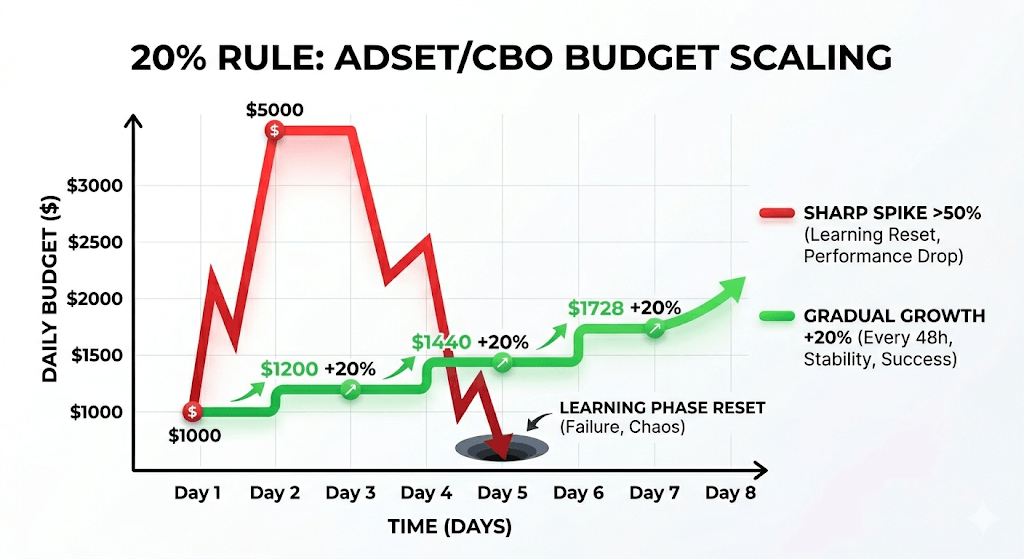
How to scale your budget safely:
The 20% Rule: Increase the daily budget of a working ad set or CBO campaign by no more than 15–20% once every 24-48 hours. This allows the algorithm to smoothly capture new layers of the audience without resetting the learning phase.
Scaling by Duplication: If you need to sharply increase traffic volume, do not touch the working campaign. Create a duplicate (or better, several) of the successful ad set or campaign and set a higher budget on the copies. Yes, they will compete with each other in the auction, but the original profitable campaign will remain untouched.
Expanding GEO and Audiences: If your offer allows, scale horizontally. Add new countries or launch new ad sets targeting a Broad audience to give the pixel more room to maneuver.
Conclusion
Budgeting and traffic costs in Facebook Ads is not a lottery, but a clear mathematical model. Your cost per lead depends not only on the auction but also on how competently you manage the campaign, how you test creatives, and, most importantly, how long your accounts live.
In aggressive verticals like nutra, where ROI can be 100% and higher, the main expense item is not the cost per click, but campaigns lost due to bans and budgets drained on endless pixel retraining. Successful affiliate marketing in 2026 is built on stability.
Ensure uninterrupted operation for your advertising campaigns. Hide your landing pages from bots, filter unwanted traffic, and let Facebook algorithms smoothly bring you cheap leads.






Be the first to share your opinion!
We value your feedback — share your thoughts.