


Cloaking remains an important part of the infrastructure for affiliates, media buyers, and teams working with paid traffic. Today, a cloaking service is no longer just a redirect between two pages. Modern platforms analyze visitor parameters, filter suspicious traffic, provide statistics, and allow managing advertising flows from a single interface.
There are several notable solutions on the market, among which Cloaking.House and Palladium Expert stand out. Both services are designed for traffic filtering and management, but they use a somewhat different approach.
Palladium places a strong emphasis on automated traffic analysis and its own system for detecting suspicious users. Cloaking.House combines automation with more detailed manual filter settings, analytics, ready-made cloaked links, API, and a built-in tool for creating White Pages.
Therefore, it makes sense to compare these platforms not by the principle of "who can cloak", but by more practical parameters: filtering, ease of setup, White Page, integration, analytics, scaling, and cost.
What a modern cloaking service should be able to do
The principle of cloaking is quite simple. After a user clicks on an ad, the system analyzes the request parameters and determines which scenario to use for them.
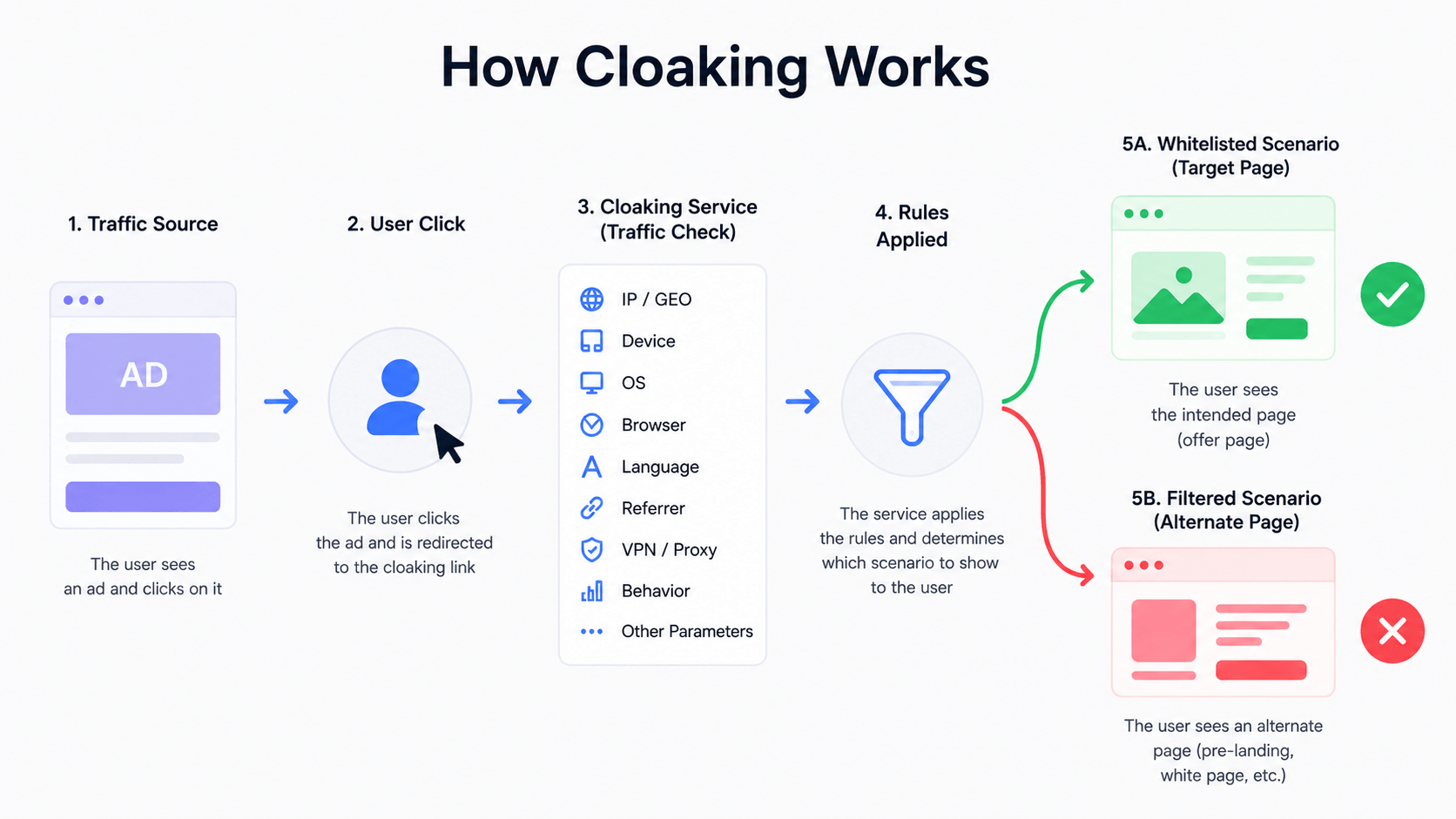
Depending on the settings, you can consider:
GEO;
IP address;
device;
operating system;
browser;
ISP;
VPN and Proxy;
IPv4/IPv6;
Referrer;
language;
number of clicks from one IP;
blacklists and whitelists.
After verification, the user is directed to the appropriate scenario.
For a media buyer, it is important not only to have these functions but also how quickly they can be configured and changed. If launching each new campaign requires a long time to figure out the technical part, it becomes a problem when scaling.
That is exactly why today a good cloaking service should be not just a filter, but a full-fledged working tool.
Cloaking.House vs Palladium Expert: main differences
At first glance, both services solve the same task. However, their philosophy differs.
Palladium focuses on automatic protection. The service uses its own traffic analysis algorithms, trust score, and IP database to automatically determine various categories of users and unwanted traffic. This is a convenient option, but it has a number of inconveniences due to the lack of necessary flexibility.
Cloaking.House takes a more flexible approach.
In addition to automatic filtering, the user gets the ability to independently manage traffic parameters and create their own logic for the flow. For an experienced affiliate, this is a major advantage: different advertising sources, GEOs, and verticals require different approaches, so a universal configuration is far from always suitable.
For an affiliate marketer, this is a fundamental advantage: instead of a universal system that defines the logic for the user, they get a tool that adapts to their tasks and allows them to more precisely control advertising traffic.
| Parameter | Cloaking.House | Palladium Expert |
| Traffic filtering | ✓ Flexible setup | ✓ Automatic |
| GEO filters | ✓ Detailed setup | ✓ |
| VPN / Proxy | ✓ | ✓ |
| Devices and OS | ✓ | ✓ |
| Browser / ISP / Referrer | ✓ | ✓ |
| GET parameters | ✓ | - |
| Language | ✓ | - |
| Time zone | ✓ | - |
| Connection type | ✓ | - |
| List filtering | ✓ | - |
| Blacklist / Whitelist | ✓ | - |
| Real-time analytics | ✓ | ✓ |
| AI White Page | ✓ Built-in generator | - |
| Ready Cloaked Link | ✓ | - |
| API | ✓ | - |
| PHP integration | ✓ | ✓ |
| Scaling | ✓ unlimited flows | ✓ up to 100 flows |
| Free trial | ✓ 7 days | - |
| Starting price | $49/mo. | $100/mo. |
| Annual discount | 50% | - |
Filtering is the main criterion when choosing any cloaking service.
Palladium offers a multi-level analysis system focused on the automatic detection of bots, moderators, VPN/Proxy, and other unwanted traffic. This approach is convenient when the user wants to minimize manual actions.
Cloaking.House gives more control over individual parameters.
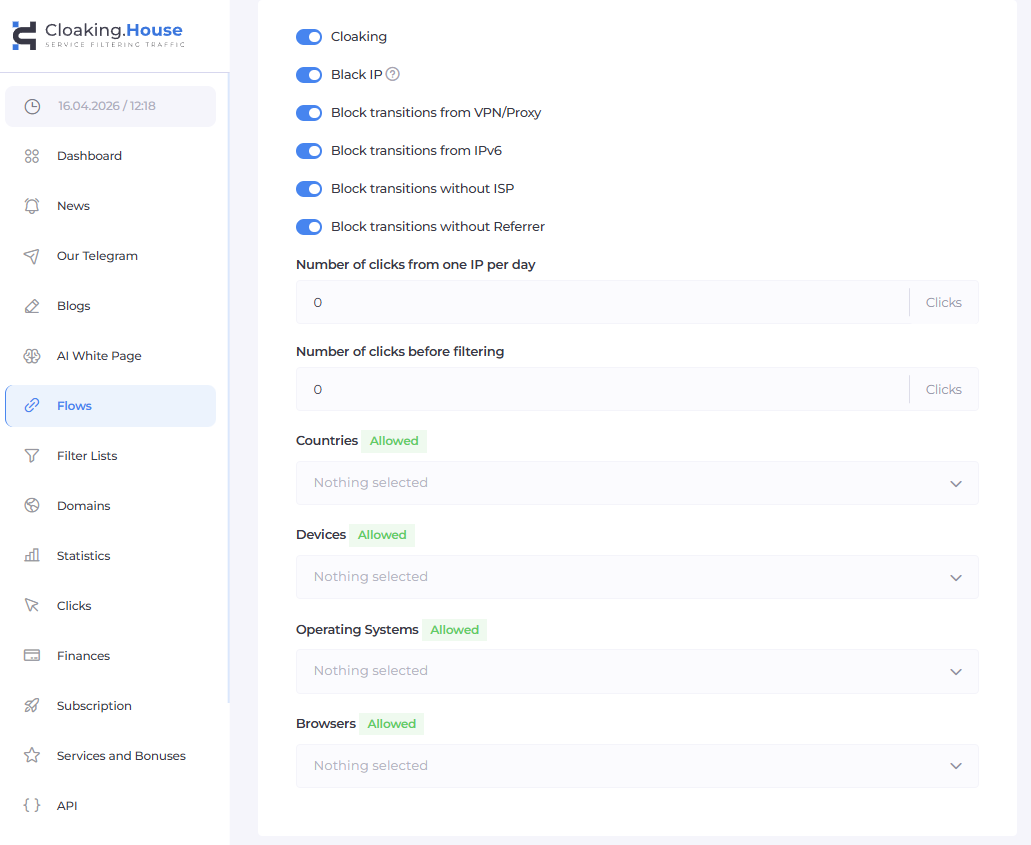
You can create rules taking into account GEO, device, OS, browser, ISP, Referrer, IP, VPN/Proxy, and other characteristics. Additionally, blacklists and whitelists, as well as filtering by GET parameters, are used. This is especially useful when working with a large number of advertising campaigns.
Imagine that one campaign setup is targeted at Android, another at iOS, and a third shows the best result only in a specific GEO. There is no need to use the same configuration for all campaigns. In Cloaking.House, each flow can be customized for a specific task.
Exactly flexibility is one of the main advantages of Cloaking.House over the more automated approach of Palladium.
GEO-filtering
For affiliate marketing, GEO is of huge importance. The same offer can show completely different results in the USA, Germany, France, or Tier-3 countries. Therefore, it is important for a media buyer to control not only the user's country but also additional parameters. Both services allow working with GEO; however, Cloaking.House allows combining GEO with other filters.
For example, you can build a flow considering:
country + device + OS + browser + language + time zone.
This level of detail allows you to create separate scenarios for specific advertising campaigns. For a small project, the difference may be insignificant. But with dozens of campaigns and several GEOs, flexibility begins to play a much larger role.
White Page: another important infrastructure element
Cloaking cannot be considered separately from the White Page. If the service is only responsible for filtering, the user still has to independently find or create pages for the appropriate scenario.
Cloaking.House went further and added its own AI tool for creating White Pages into the ecosystem. This allows you to quickly prepare a page for a new campaign without using separate third-party tools for each project. For a media buyer, this means a reduction in manual operations. Let's say a team launches a new setup. You need to prepare a flow, a domain, a page, and filters. When the White Page is created within the same ecosystem, the process becomes significantly simpler.
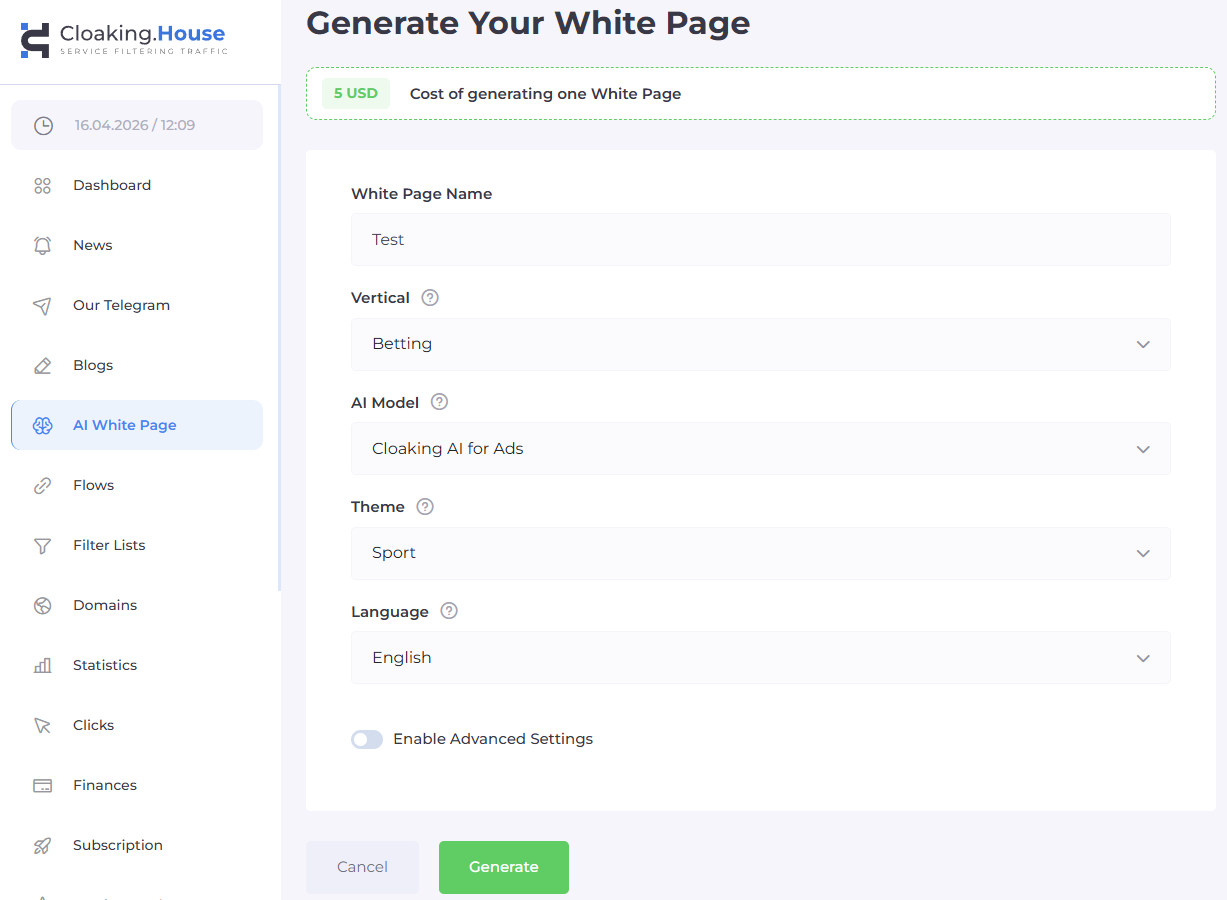
Palladium is primarily focused specifically on traffic filtering and protection, while Cloaking.House offers a more comprehensive set of tools. And this is one of the key differences between the platforms.
Integration and launch
Another important criterion is how quickly you can launch your first campaign. The traditional scheme of working with cloaking implies having a domain, hosting, uploading files, and setting up a script.
For a technically prepared user, this is not a problem. But for a media buyer, something else is often more important: how much time will pass from registration to the first test.
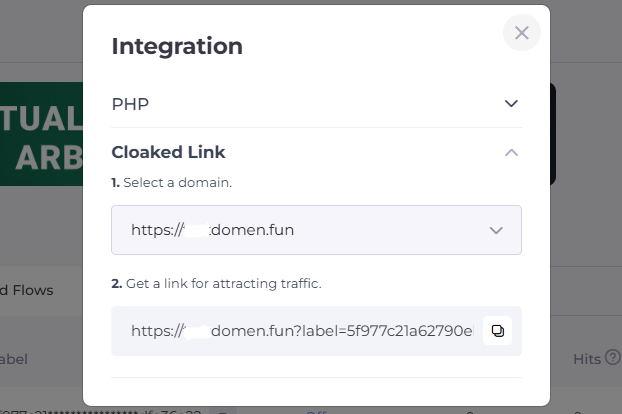
In Cloaking.House, you can use a ready-made cloaked link, which allows you to launch a flow without complex server configuration. If necessary, it remains possible to use your own domain and PHP integration. Thus, the user chooses the level of integration themselves. If you need to quickly test a setup, a ready-made option is used. If the project scales, your own infrastructure is connected. This approach is especially convenient for teams that constantly test new sources, offers, and GEOs.
Analytics and click control
Filtering without analytics quickly turns into working blind. It is important for a media buyer to understand what traffic comes to the page and why a specific user ended up in a certain scenario.
Palladium offers real-time analytics and traffic information, including data related to the detection of suspicious users.
In Cloaking.House, a Clicks section is also available, where you can track transitions and main user parameters.
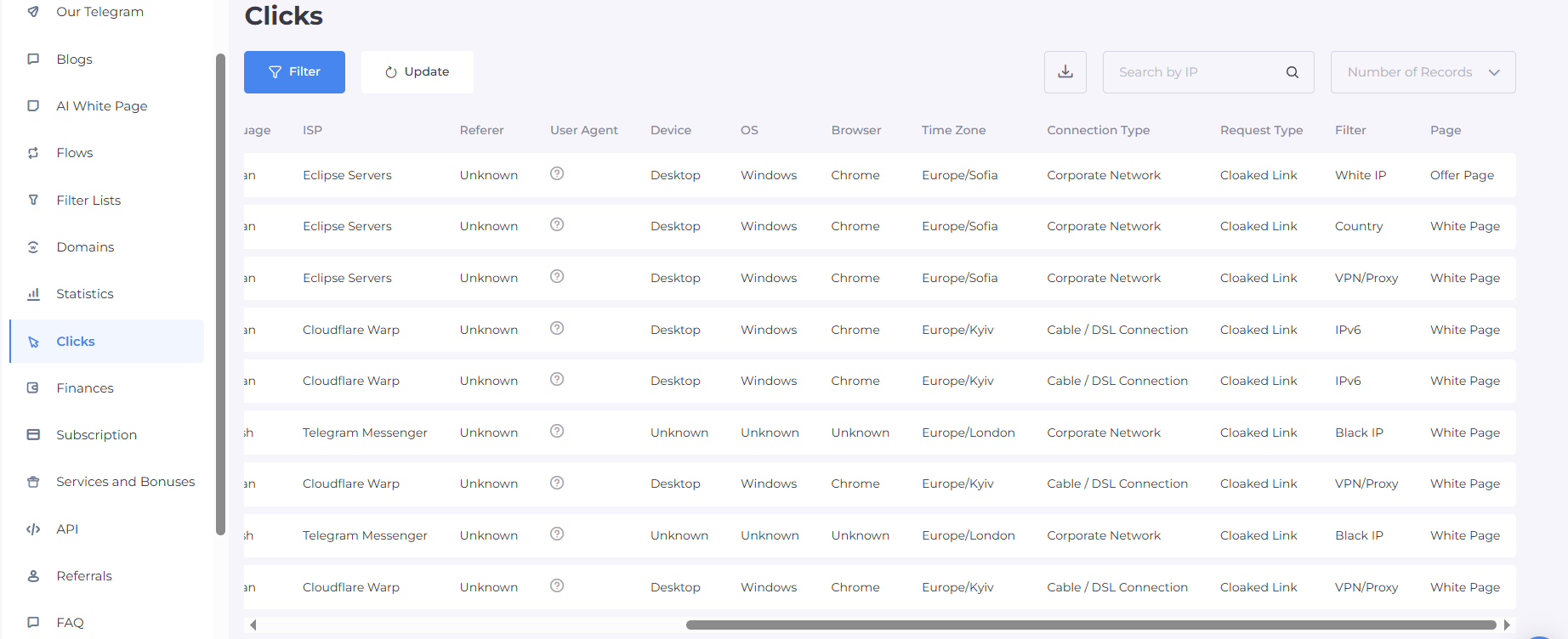
This allows you to analyze:
IP;
GEO;
device;
browser;
ISP;
Referrer;
triggered filter.
Such information is useful not only for monitoring the operation of cloaking but also for optimizing advertising campaigns. For example, if a certain segment is regularly filtered out, the media buyer can check its quality and change the flow settings if necessary.
The result is a closed loop:
traffic -> filtering -> statistics -> analysis -> changing settings -> new test.
The faster this cycle goes, the more convenient it is to scale advertising campaigns.
API and automation
For one or two flows, an API might not be needed at all. But when a team starts working with dozens or hundreds of advertising flows, manual management becomes inconvenient. Cloaking.House provides an API that allows you to integrate the platform into your own infrastructure. This is especially relevant for media buying teams, where some processes are already automated. For example, instead of constantly manually creating and modifying flows, certain operations can be performed through your own system.
Palladium focuses on automation directly within its platform.
Cloaking.House in this regard gives the user more freedom: you can use the service's automatic mechanisms, but if necessary, connect it to your own infrastructure. For small teams, this is just an additional feature. For large projects, it is a potentially important part of the workflow.
Plans and pricing
The price becomes especially important when the number of campaigns begins to grow.
Palladium uses a pricing model tied to the number of active campaigns. The minimum public plan starts from about $100 per month for a few campaigns.
Cloaking.House offers a wider range of plans starting from $49 per month.
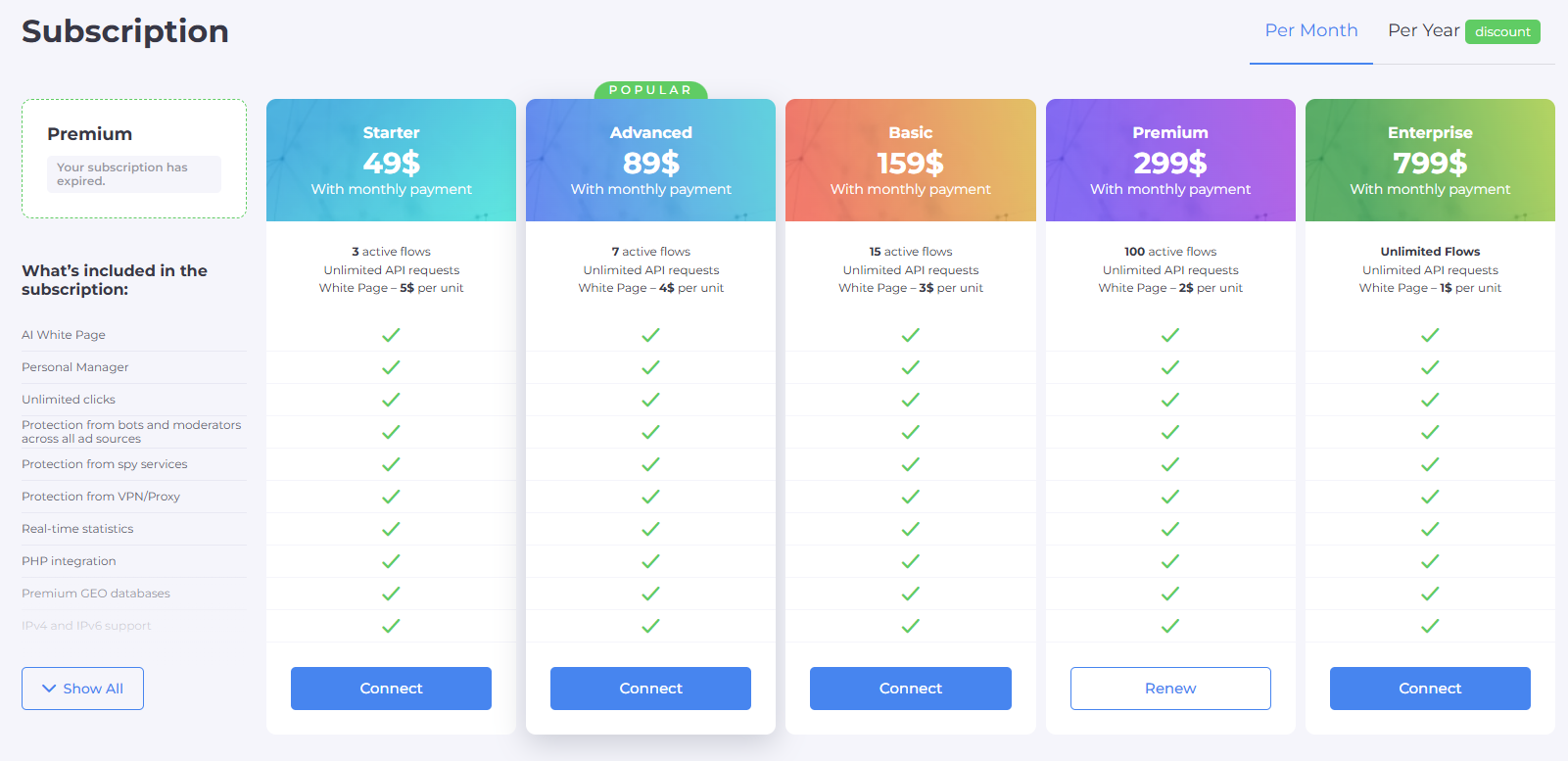
For a user who is just starting to work with cloaking, the difference is noticeable right at the entrance. Cloaking.House allows you to start from $49 per month without immediately switching to an expensive plan. At the same time, with an increase in the number of campaigns, it is not necessary to change the service - you can simply upgrade to a higher level. A separate plus is the ability to get a 50% discount when paying for an annual plan.
Thus, Cloaking.House is suitable for both small projects and teams with a large number of flows.
Cloaking.House or Palladium: what's the bottom line?
Palladium has its strengths. The service relies on automated traffic analysis and aims to simplify the user's work as much as possible. This is a good option for those who want to transfer most of the tasks to algorithms. But when comparing platforms, it is important to consider not only automation.
For a modern affiliate, flexibility, launch speed, cost, and scaling capabilities are no less important. And here Cloaking.House offers a wider range of features.
Main advantages of the platform:
Lower entry threshold. The starting plan starts from $49 per month.
Flexible filtering. The user can independently manage a large number of parameters.
White Page in one ecosystem. The AI White Page Generator allows you to quickly create necessary pages.
Multiple integration options. You can use a ready-made cloaked link or your own domain and PHP integration.
API. The service can be connected to your own infrastructure and automate workflows.
Scaling. Plans are available up to 100 active flows and Enterprise with unlimited flows.
Analytics. Information about clicks helps control the operation of filters and analyze traffic.
Final choice
If you need a more flexible tool that can be used for both the first tests and the large-scale work of a team, Cloaking.House looks like a more universal solution. Both solve this task. The difference is in the approach.
Palladium - automation and a minimal number of manual settings.
Cloaking.House - automation plus control, analytics, and additional tools in a single ecosystem. It is the second approach that becomes especially useful when the number of advertising campaigns is growing and simple filtering is no longer enough.
Cloaking.House provides everything necessary for this: flexible flows, filtering, analytics, White Page Generator, and several integration options.





Be the first to share your opinion!
We value your feedback — share your thoughts.