


Cheap traffic - is not a synonym for bad. In 2026, advertisers who know how to choose formats, payment models, and sources get conversions at prices unattainable in contextual advertising. The problem is not the cost per click, but the fact that most buyers stop at the first step - looking for "cheaper" - and miss the other four: source quality, GEO match, antifraud, and optimization for the goal.
In this article we will cover:
How cheap traffic differs from fraud traffic and why a low bid does not guarantee savings
Five criteria for choosing a source: format, payment model, GEO, antifraud, entry threshold
Overview of formats with prices and tasks
Practical playbook: testing, micro-bidding, blacklists, CPA goal, and working with creatives
What is cheap traffic and why price does not equal quality
What makes up the cost per click and impression
Traffic price is formed at an auction: advertisers compete for impressions or clicks in a specific GEO, on a specific device, and in a specific format. The fewer competitors in the segment - the lower the bid. Push traffic in Tier-3 GEOs costs times less than the same format in the US or Western Europe.
Three payment models set a different logic of "cheapness":
CPC - pay per click; the price depends on the creative's CTR and competition in the niche. The higher the CTR, the lower the effective cost per click at the auction.
CPM - pay per thousand impressions; profitable with a high landing page CTR, unprofitable with a low one - money goes to impressions without actions.
CPA goal - pay per click/impression, but the algorithm keeps the conversion cost within a specified range; technically more expensive per event, but eliminates non-targeted clicks and often yields a better final ROI.
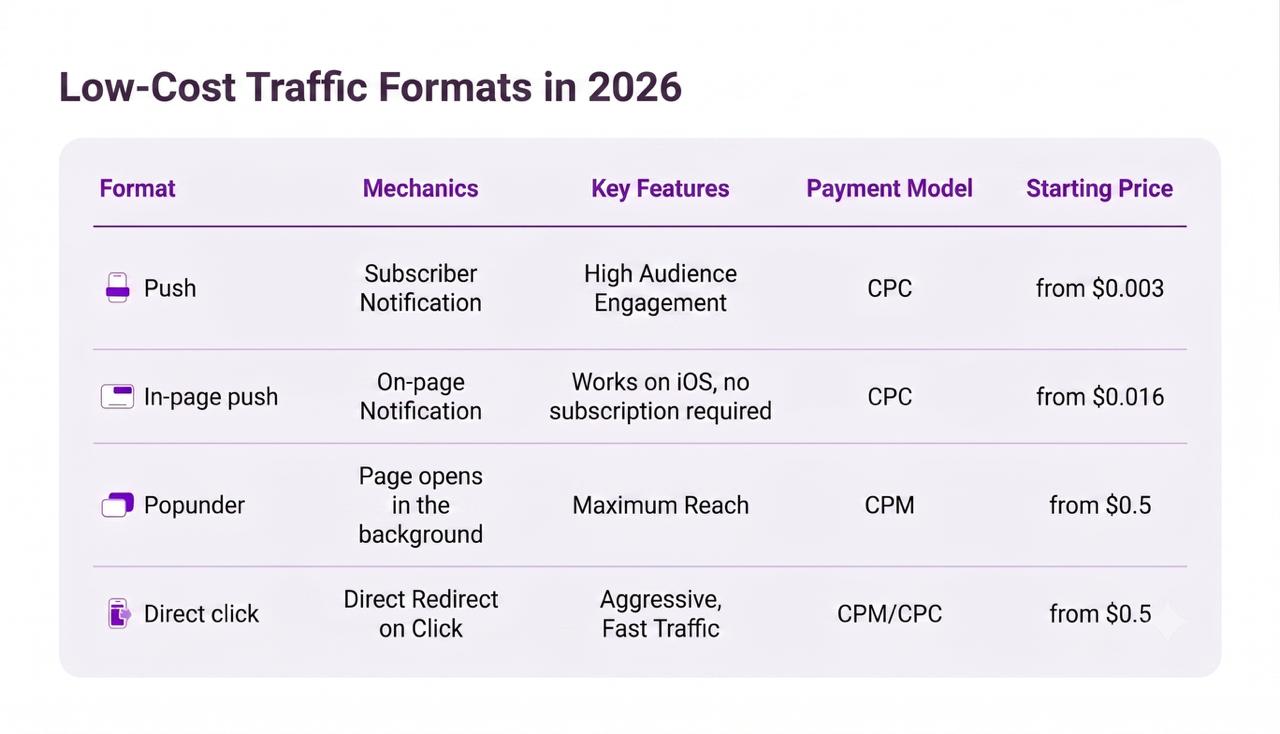
In ROIAds, push advertising starts from $0.003 CPC, and popunder - from $0.5 CPM. These are real entry points for testing Flows with a minimal budget.
When cheap traffic is profitable and when it drains the budget
Cheap traffic is profitable when:
the offer works for a broad audience (sweepstakes, nutra, gambling, VPN);
the campaign goal is data collection or testing multiple Flows in parallel;
the advertiser is ready to work with blacklists and optimize bids by zones.
Cheap traffic drains the budget when:
there is no antifraud filtration and bots are counted as real clicks;
the GEO does not match the language and logic of the offer;
the campaign is launched without an impression frequency cap - the audience burns out in 2-3 days;
the advertiser does not track micro-conversions (scroll, time on page, click on CTA) and does not see the real quality of the traffic.
The cost per click is just one of five factors. The other four are more important for the final ROI.
How to choose a source of cheap traffic in 2026
Formats: push, in-page push, popunder, direct click
Each format has its own economics and audience:
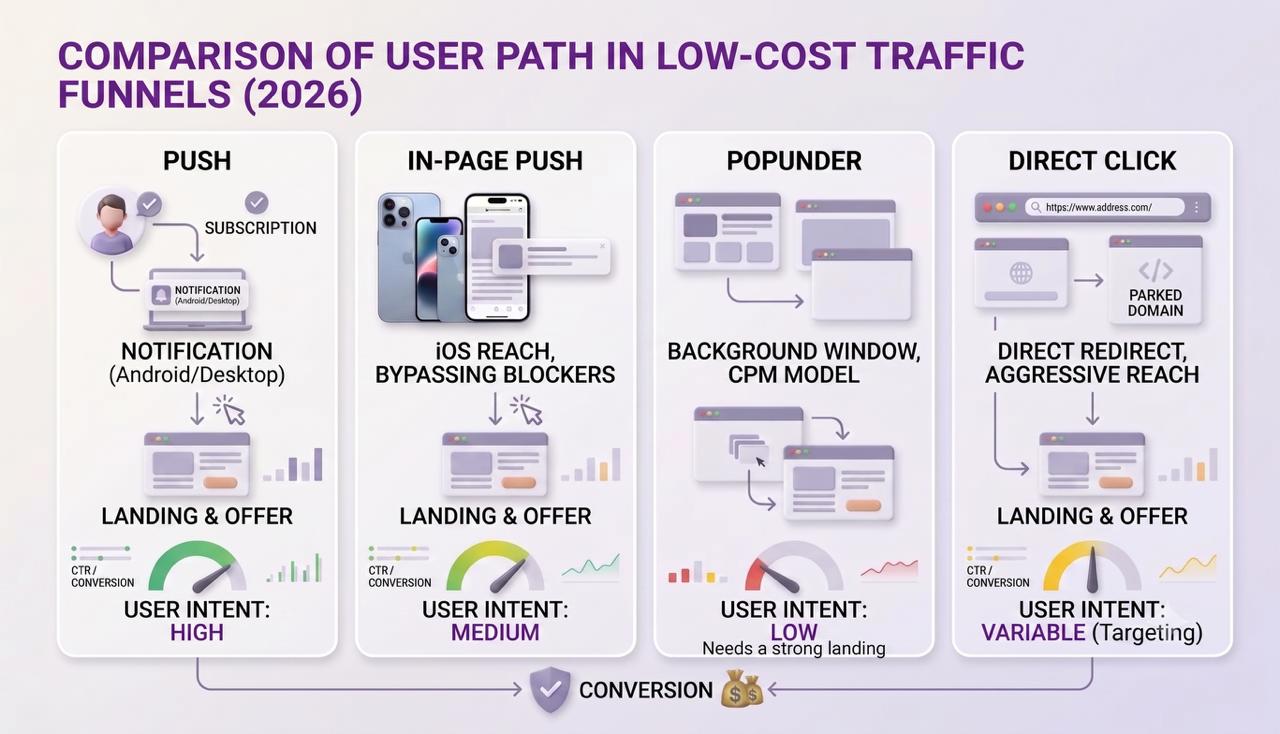
Push - notifications to subscribers; high intent, predictable CPC, works on Android and desktop.
In-page push - a notification-style banner inside the page; works on iOS without subscription and bypasses browser restrictions on push notifications.
Popunder - a page opens under the active window; maximum reach, payment by CPM, low initial user intent.
Direct click - redirect from parked domains; aggressive reach, minimum entry price, requires precise targeting.
Payment models: CPC, CPM, CPA goal
The choice of model depends on the type of offer. CPC is suitable for niche offers with a specific action - registration, installation, lead. CPM is effective with a high landing page CTR and a broad audience. CPA goal - a scaling tool: the algorithm itself optimizes bids for a given conversion cost. In ROIAds, CPA goal is available as a separate campaign optimization mode.
GEO and vertical: where cheap traffic actually converts
Tier-3 GEOs (Southeast Asia, Latin America, Africa) provide the lowest bids and the highest volume. Tier-2 (Eastern Europe, MENA, parts of LATAM) - a balance of price and quality. Tier-1 (US, UK, Germany) - expensive, but converts in premium verticals with a high average check.
Verticals with predictable economics on cheap traffic: gambling, betting, nutra, sweepstakes, finance, VPN and utilities, dating. All of them are included in the main list of ROIAds verticals.
Antifraud and source quality
Antifraud - a mandatory filter, not an option. A quality network checks sources for bot traffic, click farming, and impression manipulation. A practical sign of quality: CR for a micro-goal (scroll up to 50%, button click) should correlate with CR for the main goal. If there are micro-conversions but no main ones - the problem is in the landing page or offer, not in the traffic. If there are not even micro-conversions with sufficient volume - the source is under suspicion.
Minimum deposit and entry threshold
A low entry threshold allows testing multiple formats in parallel without the risk of freezing a large budget. ROIAds offers a low minimum deposit and a personal manager who helps plan the initial split test - this is especially important for new advertisers who do not yet know which format will work in their niche.
Best sources of cheap traffic in 2026: categories and formats
Push networks for cheap clicks
Push networks - a classic choice for budget campaigns with pay-per-click. Subscribers have given explicit consent to receive notifications, so the audience is warmer than in most other formats. Bids in Tier-3 GEOs are minimal, volume - high. The optimal strategy: launch several creatives simultaneously, quickly turn off inefficient ones, and scale Flows with a CR above average.
ROIAds specializes in push traffic and offers both classic push notifications and in-page push - this covers the audience on different devices and browsers within one account.
Popunder networks for cheap impressions
Popunder provides maximum reach at a minimum price per thousand impressions. The format is effective for offers with a simple action - registration, download, subscription - where the landing page itself "sells" without the additional context of a notification. Key risk: low user intent at the moment of impression, so the landing page must grab attention in the first 3 seconds.
In-page push for iOS and bypassing browser restrictions
In-page push solves the main problem of classic push - unavailability on iOS and in browsers with blocked notifications. The banner is displayed right on the page in a notification format, requiring no subscription. This expands reach and reduces acquisition cost in GEOs with a high share of iPhone users.
Direct click for aggressive verticals
Direct click (or domain redirect) - traffic from parked domains and typo URLs. The user gets to the landing page directly, without an intermediate banner. The format is aggressive in reach and cheap in CPM, but requires precise targeting by domain keywords, otherwise relevance drops. Works best in gambling, betting, and utilities.
Native and contextual networks as an alternative
Native advertising and contextual networks offer a "softer" interaction format, but are generally more expensive than push and popunder in the same GEOs. They are justified when the offer requires audience trust - financial products, insurance, education. For aggressive verticals with a short decision-making cycle, push and popunder are more profitable in terms of price-to-conversion ratio.
Comparison of cheap traffic formats
| Format | Payment model | Starting price (ROIAds) | Best for | Main risk |
| Push | CPC | from $0.003 per click | Gambling, nutra, sweepstakes, VPN | Audience burnout at high frequency |
| In-page push | CPC | on request | iOS audience, dating, finance | Lower CTR than classic push |
| Popunder | CPM | from $0.5 per 1,000 impressions | Sweepstakes, utilities, gambling | Low intent; a strong landing page is needed |
| Direct click | CPM / CPC | on request | Betting, gambling, antiviruses | Irrelevant traffic without precise targeting |
How to buy cheap traffic and not drain your budget
Initial test: budget, splits, and duration
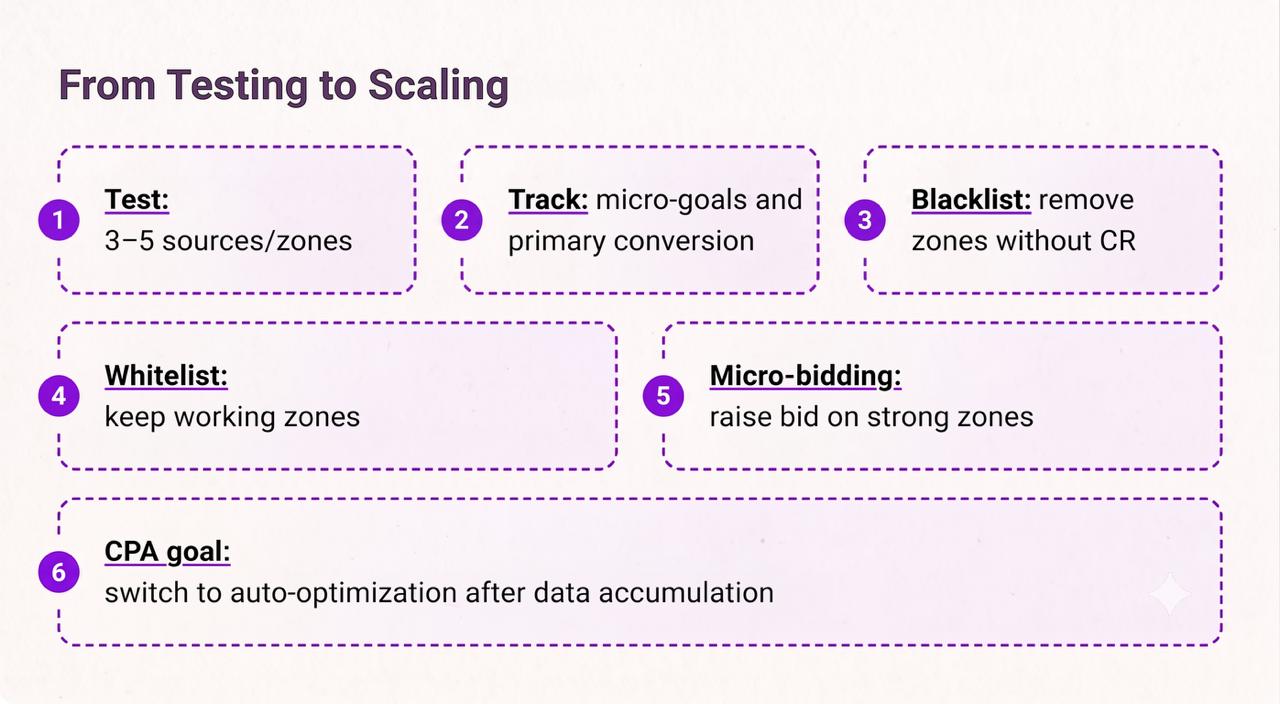
Testing rule: the starting budget should cover 200-500 clicks or impressions per Flow. Less - not enough data for a statistically significant conclusion. Launch 3-5 sources or zones simultaneously, record CR for a micro-goal (time on page, scroll, click on CTA) and the main goal. The duration of the initial test is 3-5 days, after which you disable the outsiders and scale the leaders.
A personal manager at ROIAds helps plan the test structure for a specific offer and GEO - this reduces the time to the first working result.
Micro-bidding and AI bid optimization
Micro-bidding allows setting different bids for individual zones (traffic sources) within one campaign. Zones with a high CR receive an increased bid and more volume; zones with a low CR - a reduced bid or are disabled. This is a key tool for working with cheap traffic: you pay less where there are no conversions, and more where they are.
AI bidding in ROIAds automates this process: the algorithm analyzes conversion history and adjusts bids by zones in real-time, without manual intervention.
Source blacklists and whitelists
After the initial test, you have data to form a blacklist (zones with zero CR and high spend) and a whitelist (zones with above-average CR). A whitelist campaign is the most predictable way to scale cheap traffic: you work only with proven sources and do not spend budget on exploration.
CPA goal and goal automation
CPA goal - a mode in which the network's algorithm manages bids itself to keep the conversion cost within a specified range. It is worth switching to CPA goal after gaining at least 20-30 conversions: the algorithm needs data to learn. Until then, work on CPC or CPM with manual micro-bidding.
Creatives and landing pages for cheap traffic
Cheap traffic - is a broad audience with low intent. A creative must solve one task: compel a click. A landing page - hold attention in the first 3 seconds and lead to the target action. Practical rules:
Test at least 3-5 variants of the headline and icon for push.
For popunder, use single-screen landing pages with one CTA.
Update creatives every 7-10 days to avoid burnout.
Adapt the landing page language to the GEO - a mismatch between the offer's language and the traffic kills CR.
Risks of cheap traffic and how to mitigate them
| Risk | Sign of a problem | Mitigation |
| Bots and fraud | Time on page over 2 sec, zero scroll, no clicks on CTA | Network antifraud + external tracker (Keitaro, Binom, Voluum), cut-off by behavioral metrics |
| Low-quality placements | Zones with high spend and zero CR | Blacklists and micro-bidding by zones in ROIAds |
| GEO and language mismatch | CR below average in specific GEOs with normal CTR | Separate campaign for each language; check landing page compliance with GEO |
| Creative burnout | CTR drop of more than 30% in 3 days | Creative rotation every 7-10 days, frequency cap at the campaign level |
| Seasonal audience | Sharp drops in CR without changes in the campaign | Check against holidays and seasonality in the GEO, bid adjustment |
Conclusion
Cheap traffic in 2026 - is a strategy, not a compromise. Push from $0.003 CPC and popunder from $0.5 CPM provide an opportunity to test offers in gambling, nutra, sweepstakes, and other verticals without the risk of losing a large budget at the start. The main thing - do not stop at the price: check source quality, set up antifraud, work with blacklists, and switch to CPA goal after gathering data.
If you are ready to launch your first campaign or scale an existing one on cheap traffic - register with ROIAds and get access to push, in-page push, popunder, and direct click with AI bidding, micro-bidding, and a personal manager.






Be the first to share your opinion!
We value your feedback — share your thoughts.