


Any large advertising platform - be it Facebook, Google, or TikTok - builds relationships with advertisers based on an internal trust rating. This rating is not explicitly shown, but it is exactly what determines how many ads can be launched on the first day, how closely creatives will be checked, and how quickly an account will get banned.
A newly registered account is at the very bottom of this hierarchy. It has minimal daily limits, every ad undergoes strict moderation review, and any rejection is perceived as a significant negative signal. As the account spends budget, receives no complaints, and passes verifications, its trust gradually grows. But this is a slow path that can take months.
The alternative to this is agency advertising accounts, which are at the highest level of trust from the very beginning.
What an Agency Account Really Is
An agency advertising account Lux Accs is an account registered and verified through an advertising platform's partner program or through a confirmed advertising agency. Unlike a personal ad account, an agency account undergoes a multi-stage verification process right at the creation stage: the company's legal data, payment details, and the history of relationships with the platform are confirmed.
The result of such verification is a fundamentally different level of treatment by the algorithms. The agency account is perceived by the platform as a more reliable counterparty, and this is expressed in specific things:
- Increased limits: Daily budget limits are significantly higher than those of fresh personal accounts, and are often completely absent.
- Fast moderation: Ad review is faster, and the AI control itself is less meticulous.
- Right to make a mistake: Upon the first creative rejection, the system usually does not send the account into an immediate ban, but gives an opportunity to fix the violations.
- Priority support: The support service responds many times faster, as agency accounts are served by a separate dedicated line.
All this does not mean that an agency account is completely invulnerable. But having this margin of safety in certain verticals becomes the difference between stable operation and constant blocks.
How Agency Accounts Differ from Farmed Accounts
It is important not to confuse agency accounts with so-called farmed accounts - accounts that are mass-created and warmed up manually or via scripts. A farmed account simulates the behavior of a real user to gain minimal trust, but its origin remains gray. At the slightest check by the platform, such an account can be blocked without the possibility of recovery.
An agency account is legitimate by its nature. It is registered to a real legal entity and has passed full verification. This is exactly what gives that high level of trust that cannot be simulated.
Another practically significant point is recovery. A banned farmed account is almost never subject to recovery. With an agency account, the situation is different: through the support service and the partner channel, the chances of restoring access are noticeably higher.
In Which Niches Agency Trust Matters
Formally, agency accounts are universal - you can run any advertising through them that is allowed by the platform's rules. But in practice, their value is especially high where moderation control is strict and the risks of losing an account are great.
Gambling and Betting
Platforms are extremely wary of gambling advertisements. Even if all the necessary licenses and certificates are present, creatives undergo a multi-stage review. An agency account in this niche is not a luxury, but a practical necessity for stable operation.
Nutra
Advertising for health and beauty products is traditionally under close scrutiny. Claims of a medical effect, "before and after" photos, unreliable promises - all this is a reason for instant rejection. An agency account gives room for maneuver, allowing you to quickly adapt creatives to changing moderation requirements.
Crypto and Financial Offers
In this vertical, the requirements for advertiser transparency are especially high. Without a confirmed legal entity and a verified history, it is practically impossible to launch a crypto product advertisement on major platforms. An agency account fills this need.
Product Offers
Even in e-commerce, where advertising policies are softer, agency trust is useful when scaling. When a campaign grows to thousands of dollars in daily budget, a regular account can hit limits, while an agency account continues to work smoothly.
Risk Structure: What Even an Agency Account Cannot Save You From
It would be a mistake to consider an agency account a magic shield. Platforms do not make exceptions to basic policies. We can list situations in which blocking occurs regardless of the level of trust:
- Direct deception of the user in creatives - for example, promising non-existent payouts.
- Use of prohibited content - pornography, violence, hate speech.
- Multiple rejections of ads without adjusting the approach.
- End-user complaints accumulated in large quantities.
In other words, agency accounts forgive more mistakes, but they do not forgive them indefinitely. It is a tool that requires discipline.
Extending Account Lifespan: Technical Methods
In addition to working carefully with creatives and budgets, there are technical ways to extend the lifecycle of an agency account. One of the most common is incoming traffic filtering, or cloaking.
The essence of the method is that traffic from an advertisement is directed not directly to the target page, but through an intermediate filter. This filter analyzes each incoming click and makes a decision: whether to show the visitor the real offer or a neutral page that is guaranteed not to violate the platform's rules.
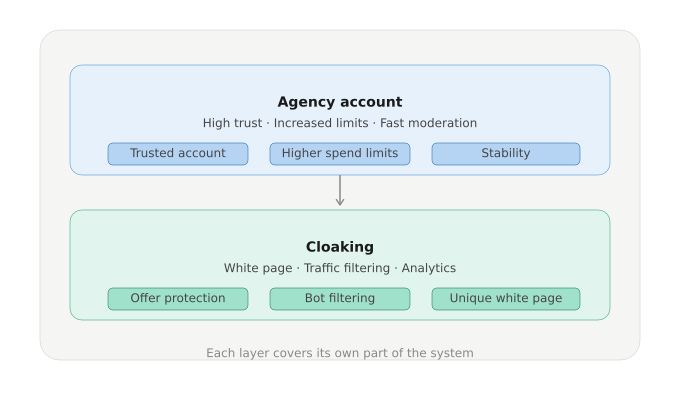
The difference from the regular scheme is fundamental. Without filtering, a moderator checking an ad clicks on the same link as the end user and sees the real content. If this content does not comply with the policies, the ad is rejected. With filtering, the moderator clicks the link, the system recognizes them by a set of technical parameters, and shows them a specially prepared safe page. Real users, meanwhile, see the offer.
Cloaking does not disrupt the platform's operation in the usual sense - it does not interfere with algorithms, modify the ad account code, or fake data. It is an external filtering layer located between the ad link and the destination server.
How Modern Traffic Filtering Works
Technically, the process looks as follows:
A special link is created - a cloaked URL. When someone clicks it, the request first hits the filtering server. There, within milliseconds, dozens of parameters are analyzed: IP address, its belonging to subnets of data centers or hosting providers, geolocation, internet service provider information, device type, operating system and browser version, presence of VPN or proxy connection signs, referrer, and much more.
Based on these data, the algorithm classifies the visitor. If the parameters match the patterns of a real user, the person is redirected to the offer. If the system recognizes a moderator, a bot, a spy service, or suspicious traffic, the visitor goes to a White Page, a neutral page that fully complies with the rules of the advertising platform.
The key indicator here is processing speed. If the filtering server significantly increases page load time, it affects the user experience and, as a result, conversion. Therefore, engineers in this niche are constantly working on reducing delays.
A Few Words About Choosing a Cloaking Service
There are many traffic filtering solutions available on the market - from simple custom scripts to large SaaS platforms. When choosing a service, it makes sense to pay attention to several parameters:
- Response speed - the lower it is, the fewer conversion losses due to the technical factor.
- Compatibility with required traffic sources - not all services work equally well with all platforms.
- Possibility of fine-tuning filters - in different verticals and geos, patterns of moderator traffic can vary greatly.
- Availability of automatic White Page generation - this saves time, especially when working with a large number of flows.
- API integration - if the team has already automated traffic acquisition processes.
One of the notable players here is Cloaking.House - a platform that received the AffBank Awards industry prize in 2025. According to public data, the service processes more than 35 million clicks per day with an average response time of about 120 milliseconds. This is not the only solution on the market, but its statistics allow us to appreciate the scale at which filtering technology operates today.
FAQ - Frequently Asked Questions
What is an agency advertising account?
An agency advertising account is an account created and verified through an advertising platform's partner program. Unlike a personal account, an agency account is linked to a confirmed legal entity, has a transparent payment history, and initially receives a higher level of trust from moderation algorithms.
Why is an agency account better than a regular one?
The main differences are: higher daily budget limits, accelerated ad moderation, a more lenient attitude during the first creative rejections, and a priority support line. All this gives more room for maneuver when launching campaigns.
In which verticals are agency accounts most useful?
First of all, in niches with strict moderation control: gambling, betting, nutra, crypto, and financial offers. Agency accounts are also in demand in product verticals with large budgets, where regular accounts hit limits.
Can an agency account be blocked?
Yes, agency accounts do not have immunity to blocks. A platform can restrict or ban an account for gross violations of policies, a large number of complaints from users, or suspicious payment activity. However, the chances of recovering an agency account through a partner support channel are significantly higher than for a regular one.
What is cloaking?
Cloaking is a traffic filtering technology in which different content is shown to different categories of visitors to the same link. The target user sees the real page (offer), while moderators, bots, and unwanted traffic see a neutral safe page (White Page).
Why is traffic filtering needed for an agency account?
Even the most trusted account is not immune to moderation checks of target pages. Cloaking adds an additional technical layer: a moderator following a link from an ad sees a safe page and records no violations. This reduces the number of rejections and helps keep the account in a working state longer.
Is it mandatory to use cloaking with an agency account?
No, it is not a mandatory condition. An agency account in itself already gives an advantage over regular accounts. Cloaking is an additional option for those who work in high-risk verticals and want to minimize the number of contacts between moderators and the real offer.
Can the traffic filtering process be automated?
Yes, modern cloaking platforms provide an API interface for managing flows, domains, and filtering settings. This allows you to integrate cloaking into automated traffic acquisition and distribution chains without manual intervention at each stage.






Be the first to share your opinion!
We value your feedback — share your thoughts.