


Many beginners, when they learn about the existence of cloaking, happily buy dozens of accounts and promote prohibited offers from them. Then these accounts get banned, but the issue here isn't bad cloaking, it's that the accounts were raw and not warmed up.
Why accounts need to be warmed up before launching cloaking and how to do it — we explain in this article.
About Cloaking
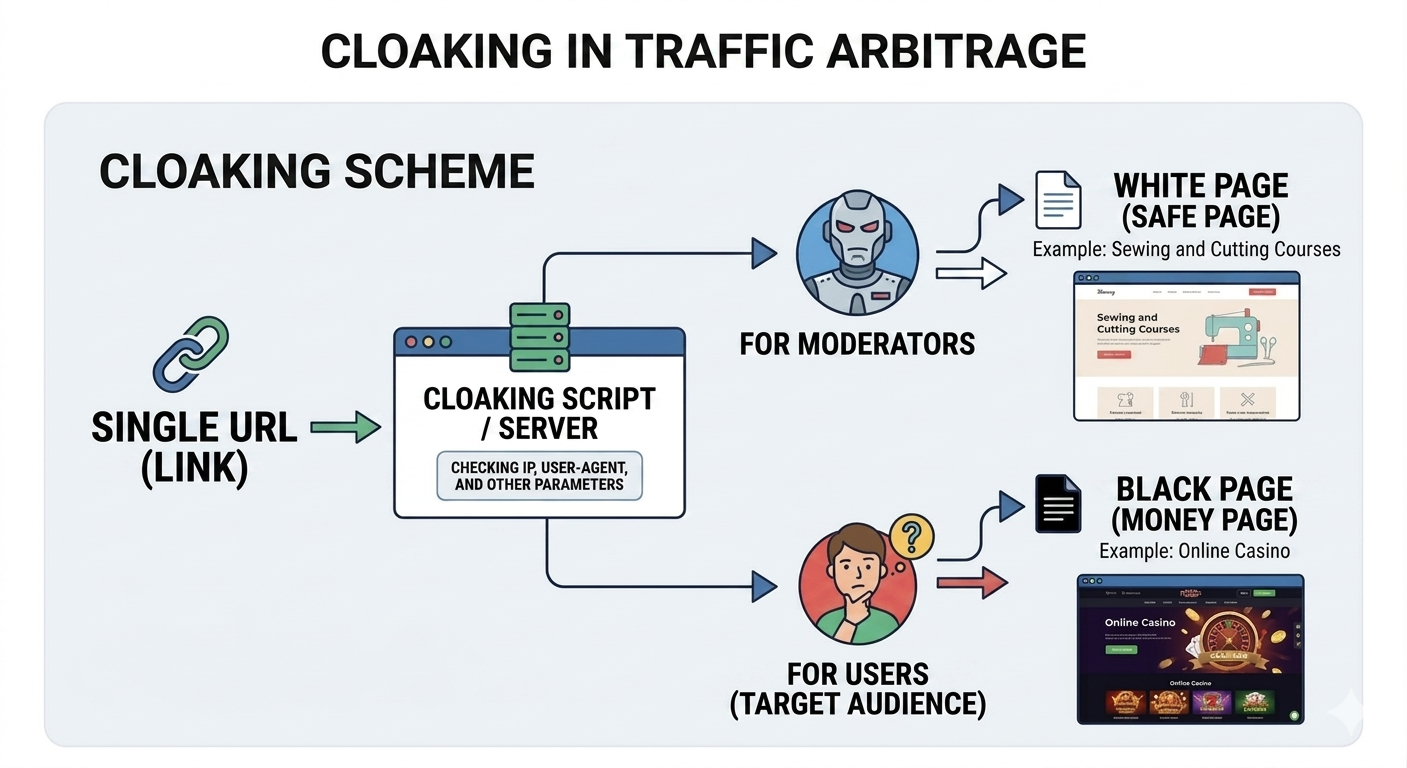
Cloaking is a technology that shows different categories of visitors different content, even though everyone follows the same URL. Roughly speaking, a substitution occurs. In affiliate marketing, cloaking is used to deceive the moderators of advertising platforms and promote gray and black offers that are prohibited on the platform.
For example, an affiliate marketer tries to promote an online casino offer on a platform where it is forbidden. They set up cloaking, and now moderators, clicking the link, will see a so-called White Page — a clean page, for instance, about sewing classes. Meanwhile, regular users, the target audience, will see the Black Page, which is the actual offer — the online casino.
This is how prohibited ads bypass moderators, conversions happen, and the affiliate marketer earns money despite the rules of the advertising platform.
What Advertising Platforms Think About Cloaking
Be warned: nothing good. All popular advertising platforms invest maximum effort into fighting cloaking — you could say they hate it. After all, it is essentially a tool for deceiving users, which kills the platform's reputation. Google alone banned over 39 million advertising accounts in 2024. Other giant advertising platforms are not far behind, sending approximately the same number of accounts and ads to the ban list.
Punishment for cloaking is severe and comes without warning — don't expect mercy, because there won't be any. However, despite the strict attitude toward cloaking, it is still possible to hide from anti-fraud systems: many affiliates successfully promote prohibited offers and earn money.
For successful cloaking without catching a ban, several factors must align: a reliable cloaking service, a properly designed White Page, and a warmed-up account.
Warming up is the simulation of a real user's behavior to increase the level of trust the advertising platform has in the profile.
Why a Warmed-Up Account is Important for Cloaking
Anti-fraud systems of advertising platforms detect cloaking by anomalies, not just by individual forbidden words like "online casino" or "betting." Anomalies are suspicious behaviors not typical of an average user. One such anomaly is frantic activity from a freshly created account without a profile picture, friends, or browsing history. By frantic activity, we mean excessively high advertising spend immediately after registration, mass launching of campaigns, and pouring in gray offers. At this point, it doesn't matter if you've connected cloaking or not; you'll be banned for suspicious activity anyway.
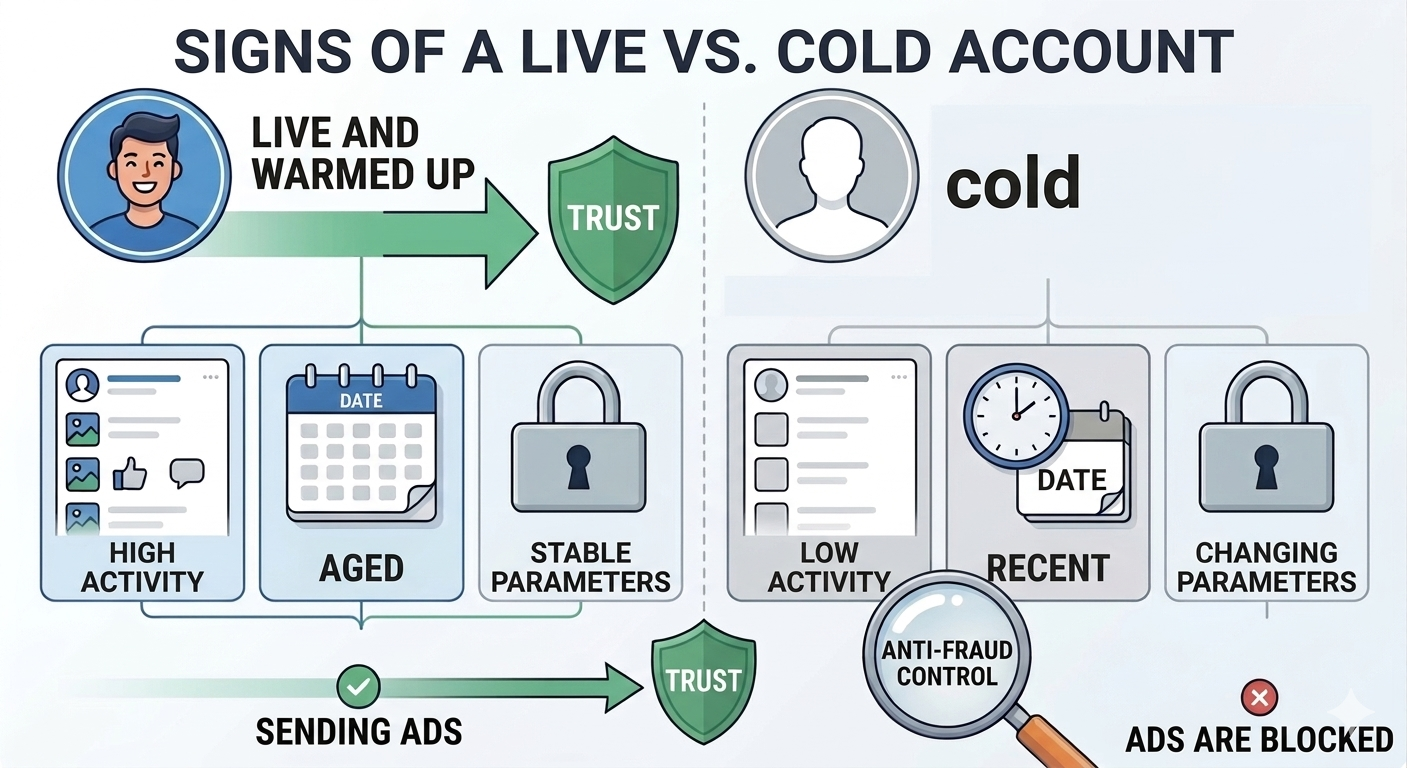
It's a completely different story if you launch cloaking from a live account that doesn't stand out among other regular users. Here are the signs that show an account is live or warmed up:
It has posts, likes, and comments;
It wasn't created yesterday: it's several months or years old;
Network parameters are stable and don't change: IP, cookies, digital fingerprint.
The better an account is warmed up, the higher its trust — the level of confidence advertising platforms have in the profile. Anti-fraud systems trust a live account, so they won't scrutinize every redirect and script, which cannot be said for a cold account — where every step will be examined under a microscope.
What Happens if You Launch Cloaking from a Cold Account
Suppose you ignored our recommendations and didn't warm up the account. Here are the consequences awaiting you:
Ad account ban. This is the most likely outcome. Moreover, the ban can happen 15 minutes after launching an ad campaign with cloaking, or after 4 days. If the campaign survived for a few days, it's too early to celebrate, because eventually, the account will still be banned.
Ad manager ban. This is even more unpleasant than an individual account ban because, in this case, all linked accounts are banned.
Payment method ban upon withdrawal. The campaign might live for a while and even bring conversions, but when you try to withdraw money, the system won't let you due to a ban on the card or payment method. Most frustratingly, you lose not just the profile but also the payment card — it gets blacklisted and you won't be able to use it on the advertising platform again.
How to Warm Up Ad Platform Accounts
Different advertising platforms have their own recommended warming periods: for Google, for example, accounts should be warmed for at least 10 days, while for TikTok, 7 days is enough. We won't break down every platform but will provide a generalized instruction for all. However, it's better to aim for a minimum warming period of 7 days; anything less is very risky.
Here are the stages of warming up:
Day One – Account Creation. Create an account on the platform and fill it out: add an avatar, photos, and contact details. It's best to create the profile manually via a real device. But the main problem isn't the creation itself, but where you "appear" from to the system. If you log in from your home IP, the platform will remember it — and if you try to start a second account, the system will link them and ban you for multi-accounting. To avoid a ban, use an anti-detect browser to spoof the digital fingerprint and a proxy to spoof the IP address. This way, you can create even 100 accounts with different IPs; the main thing is to use a separate proxy server for each profile.
Days 2–3 – Mimicking Regular User Behavior. After filling out the profile, start following various pages, adding friends, liking, and leaving comments. Essentially, act like an active user.
Days 4–5 – Launching First Ad Campaigns. But make sure they are "white," with permitted offers: clothing, cosmetics, online courses. This is like a warm-up before the main launch. Choose neutral, non-aggressive ad creatives so they definitely pass moderation.
Days 6–7 – Gradual Budget Increase. Spend the bare minimum in the first days, then increase the budget by 20%. Under no circumstances should you spend a lot at once — anti-fraud systems won't like it, and they will put you "under the radar."
The key is to do everything smoothly, without sudden movements. If you launch ad campaigns, do 1–2 per day. If you add friends, don't send 100 requests per hour.
Which Proxies to Choose for Warming Up?
We mentioned that each account needs a separate proxy, but we didn't specify which proxies are actually suitable for advertising platforms. Not all are suitable because advertising platforms have powerful anti-fraud systems, and to deceive them, you need an equally powerful tool.
Warning: free or cheap data center proxies will lead to a ban with a 90% probability. Their IP addresses have already been flagged in blacklists, so they get banned instantly. You need anonymous and secure proxies — you can rent them from specialized services. Mobile or residential proxies are best: they look as much like regular users as possible and are almost never banned.
There are several proven services on the market, for example, Proxys.io. The service provides private mobile and residential proxies with an increased level of anonymity and security.
Why Proxys.io is good:
Over 200 countries available;
All types of proxies;
Prices starting from $0.13 per month of proxy rental;
After payment, proxies automatically appear in your personal account;
Speeds from 7 Mbps — enough for everything;
Tech support that helps you choose proxies and navigate the service.
Common Mistakes When Warming Up Accounts
Even knowing the theory, many step on the same rakes. Here are the top 5 mistakes:
Using one proxy server for 3–5 accounts. Ad platform anti-fraud systems see that multiple profiles share an IP, and a ban won't be far off because multi-accounting is prohibited. Follow the golden rule: one account = one proxy;
Drastically increasing the budget. For example, in the morning you set $5, in the evening $50, and the next day $150. Any sudden movements raise suspicion in the system, and the risk of a ban increases;
Doing nothing in the account except advertising. If you don't like, don't comment, and don't watch anything, the account once again falls into the suspicious category. This means the system will start monitoring you more closely, and you can forget about cloaking.
Launching cloaking on day 3–4. Cloaking should be the very last step, at the point when the system already trusts the account, and 3–4 days is too little for that.
Summary: 5 Rules for Warming Up
Let's repeat the main points so you can save this as a checklist before launching an ad campaign with cloaking:
Warm up the account for at least 7–14 days. Do not try to launch cloaking on an account that is 2–3 days old, or you won't avoid a ban. It's better to be safe and extend the warming period slightly than to work with a semi-cold account.
First, launch white ad campaigns with permitted offers and neutral creatives. Only after this should you connect cloaking.
Don't skimp on an anti-detect browser and proxies. Cheap tools will end up costing you more: in the best case, you'll be detected and banned, and in the worst case, they'll infect your device with viruses and steal personal data.
Manage the account like a real person. Don't just run ads; scroll through the feed, subscribe to pages, leave likes, and comments.
One account = one proxy. It's better to get mobile or residential proxies from Proxys.io — they guaranteed to spoof the IP and provide anonymity and security on the Web.
And remember: cloaking is a tool, not a magic wand, and for it to yield results, it must be used correctly. Without a warmed-up account, cloaking is useless and even harmful. Warm up your accounts thoroughly, don't skip any stages, and then your ad campaigns will bring in lots of money, and a ban will only be seen in your nightmares.




Be the first to share your opinion!
We value your feedback — share your thoughts.